Sunframe-Logo

Facade Selection Guide: A Step-by-Step System Selection Process

Introduction

Facade selection is a progressive decision process that turns building conditions into a final system choice.

The process moves from understanding project behavior, to identifying controlling factors, then to narrowing system options, and finally to confirming a stable facade solution.

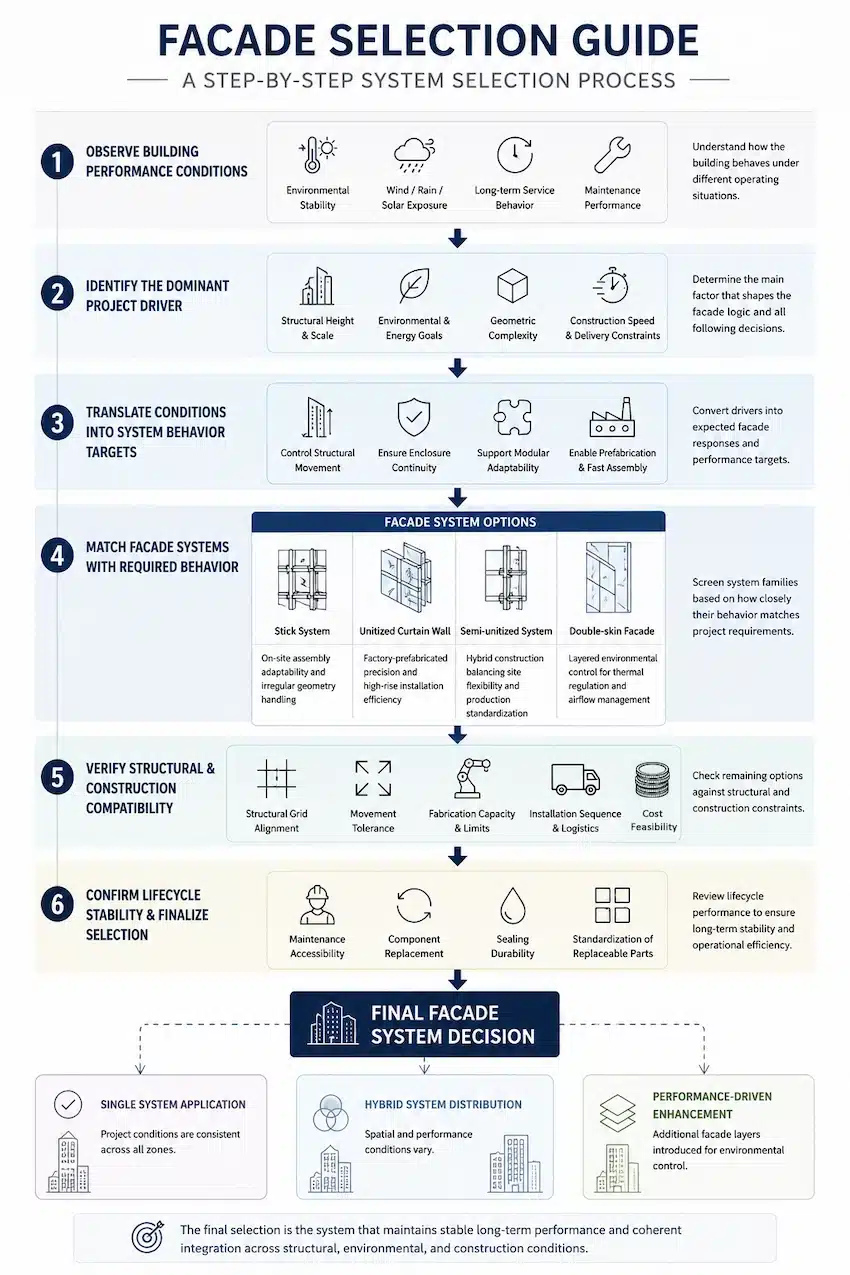
Facade Selection Guide

Step 1: Observe building performance conditions

Start by observing how the building behaves under different operating situations.

Key conditions include:

  • daily environmental stability inside the building
  • exposure periods involving wind, rain, or solar load
  • long-term service behavior including aging and maintenance performance

At this stage, the goal is to map performance behavior rather than move into system classification.

Step 2: Identify the dominant project driver

Every project is driven by one main condition that shapes facade logic.

Common drivers include:

  • structural height and building scale
  • environmental and energy expectations
  • geometric complexity of the facade form
  • construction speed and delivery constraints

Once identified, this dominant factor becomes the reference point for all following decisions.

Step 3: Translate project conditions into system behavior targets

Convert project drivers into expected facade responses.

For example:

  • tall buildings demand controlled response to structural movement
  • energy-focused projects rely on enclosure continuity performance
  • complex geometry is supported by modular panel adaptability
  • fast-track delivery is achieved through predictable prefabrication and assembly flow

This step shifts thinking from project description into system behavior expectations.

Facade design decision framework - Identify the dominant project driver

Step 4: Match facade systems with required behavior

Each facade system responds differently to performance demands.

Typical matching patterns:

  • stick system→ on-site assembly adaptability and irregular geometry handling
  • unitized curtain wall system→ factory-prefabricated precision and high-rise installation efficiency
  • semi-unitized system→ hybrid construction logic balancing site flexibility and production standardization
  • double-skin facade system→ layered environmental control for thermal regulation and airflow management

At this stage, system families are screened based on how closely their behavior matches project requirements.

System behavior is extended into spatial deployment based on project context.

✔ System selection by project scenario

Facade system choice is determined by building context, performance priorities, and construction logic.

♦ High-rise commercial towers

Typically require a continuous external envelope with strong performance under wind load and structural movement.

Curtain wall systems are the primary solution, often forming the main facade layer across the tower.

In podium or lower levels of the same project, window wall or cladding systems may be introduced to respond to slab-based geometry or architectural variation.

♦ Residential and mid-rise developments

Facade systems are often coordinated around construction efficiency and repetitive floor logic.

Window wall systems are commonly applied due to slab-integrated installation and simplified sequencing.

In areas requiring stronger architectural expression or material variation, cladding systems may be introduced as secondary layers.

♦ Complex architectural or mixed-program buildings

Projects with irregular geometry or multiple functional zones often require a combination of systems.

Stick systems or cladding systems are typically used in geometrically complex or highly customized areas, while curtain wall or window wall systems are applied in repetitive structural zones.

♦ High-performance or climate-responsive buildings

Projects driven by energy performance, solar control, or environmental regulation may introduce double-skin facade systems in specific zones.

These systems are often combined with curtain wall or cladding systems depending on exposure intensity and energy strategy.

★ Selection logic

Facade selection is not a one-to-one mapping between system and building type, but a zoning-based decision process where multiple systems may coexist within a single project.

How to select facade systems

Step 5: Verify structural, construction and cost compatibility

Remaining options are checked against structural and spatial constraints.

Key checks include:

  • alignment with structural grid and slab edges
  • movement tolerance between structure and facade
  • fabrication capacity and production limits
  • installation sequence and logistics feasibility
  • cost feasibility across system options

Only systems that can integrate with both structural and construction conditions remain under consideration.

Step 6: Confirm lifecycle stability and finalize selection

Final systems are reviewed through lifecycle performance conditions.

Key aspects include:

  • maintenance accessibility
  • component replacement logic
  • sealing durability
  • standardization of replaceable parts

Final selection is confirmed when structural, construction, and lifecycle conditions operate in alignment within a single facade strategy.

Facade outcomes generally fall into three categories:

  • Single system application where project conditions are consistent across all zones
  • Hybrid system distribution where spatial and performance conditions vary
  • Performance-driven enhancement where additional facade layers are introduced for environmental control

The final selection is the system that maintains stable long-term performance and coherent integration across project conditions.

Conclusion

Facade selection operates as a structured decision process that progressively reduces uncertainty through behavior analysis, system matching, and spatial coordination.

What defines a successful outcome is not system complexity, but the coherence between structural behavior, environmental performance, and construction feasibility.

Related Facade Topics

Foundational Understanding

What Is a Facade System?

System Comparison

Curtain Wall vs Facade System
Facade System Types Comparison

Technical Breakdown

Facade System Components Explained

Work With SunFrame on Your Next Facade Project

If you are planning a residential, commercial, or infrastructure facade project and require curtain wall engineering, system development, or installation support, SunFrame can assist from early design coordination to project execution — helping ensure reliable, well-engineered facade performance throughout the building lifecycle.

Leave a Reply

Your email address will not be published. Required fields are marked *

This site uses Akismet to reduce spam. Learn how your comment data is processed.

Other Posts

Contact Us