When Should You Contact a Facade Supplier?
When Should You Contact a Facade Supplier? A façade supplier is often contacted when a project is ready to request quotations. However, meaningful discussions often
When discussing façade systems, customization is often viewed as a sign of flexibility and design freedom.
This perception has led many people to associate standardized systems with fixed solutions or limited possibilities.
However, the role of standardization in façade engineering is more complex. Behind many successful façade projects are carefully developed systems, refined processes, and engineering decisions that balance consistency with project requirements.
Looking beyond the idea of customization alone reveals a different perspective on how standardized façade systems contribute to modern building solutions.
One common perception is that standardized façade systems restrict architectural creativity.
In reality, standardization provides a structured foundation that allows façade solutions to be adapted efficiently for different building requirements.
A standardized system is built around established design principles, tested connection details, and optimized components. These elements help improve technical reliability while still allowing adjustments based on:
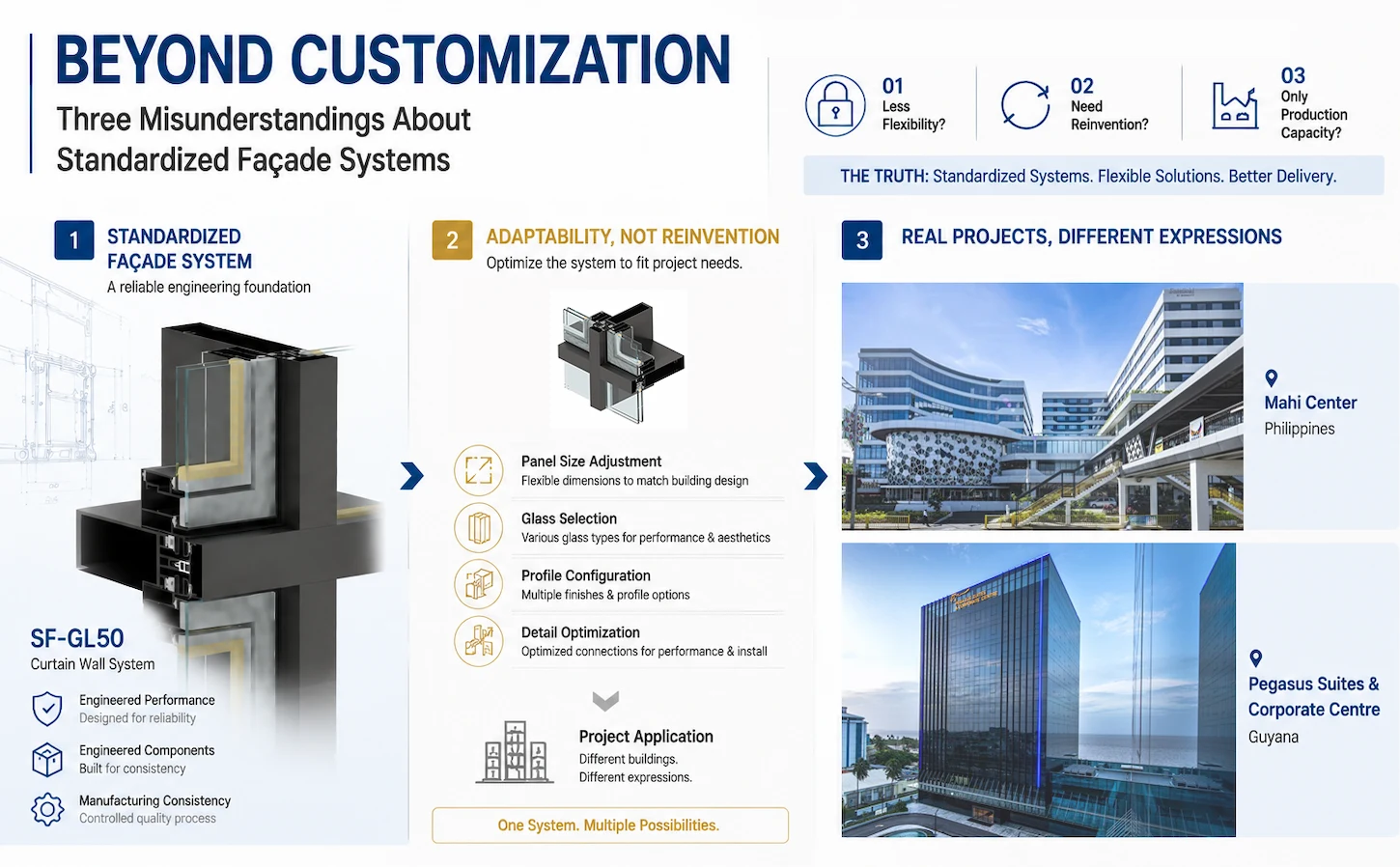
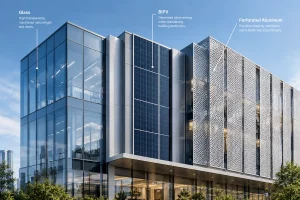
For example, SunFrame’s SF-UN150 Unitized Curtain Wall System and SF-GL50 Curtain Wall System represent two standardized façade solutions serving different façade applications.
SF-UN150 applies a modular unitized approach with configurable unit dimensions, frame options, and façade accessory integration, making it suitable for high-rise and fast-track projects. SF-GL50 features a slim 50mm profile that enables refined architectural expressions through flexible glazing arrangements and façade compositions while maintaining reliable performance.
The value of standardization lies in creating a reliable engineering foundation through which design concepts can be realized with greater consistency and efficiency.
Every building project has unique requirements. However, uniqueness does not always mean creating a completely new façade system from the beginning.
Experienced façade engineering often focuses on optimizing proven solutions according to specific project conditions.
This approach helps project teams balance:
A successful façade solution often comes from adapting reliable systems to new challenges rather than developing an entirely new approach for every project.
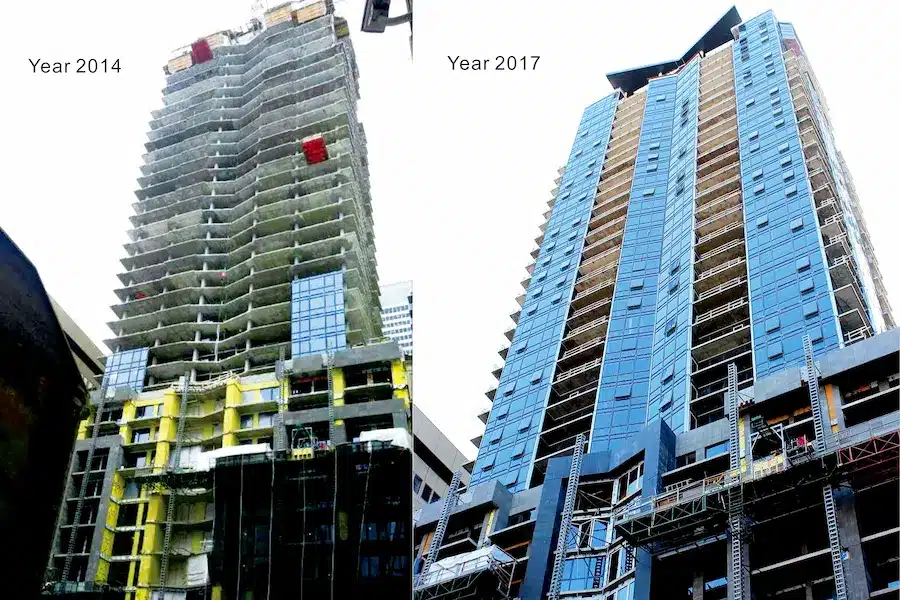
For example, SF-UN150 Unitized Curtain Wall System has been successfully applied in projects with different requirements. In TOM Condos, Canada, the system was adapted for a high-rise residential development with considerations for façade performance and the project’s design intent.
SF-GL50 Curtain Wall System further demonstrates this flexibility through projects such as the Mahi Curtain Wall Project in the Philippines and Pegasus Hotel in Guyana, where variations in glazing, framing, and detailing contributed to distinct façade appearances.
This process transforms standardized systems into adaptable solutions that respond to the practical demands of different projects.
When evaluating a façade manufacturer, production capacity is only one part of the overall capability.
For complex façade systems, manufacturing capability also involves process control, fabrication accuracy, quality consistency, and delivery reliability.
A well-established manufacturing process ensures that every component meets the required specifications before reaching the construction site.
Key factors include:
Manufacturing capability is therefore not only about how much can be produced, but also how consistently and accurately façade systems can be delivered.
Standardized façade systems provide more than repeatable solutions. They create a foundation for reliable engineering, efficient manufacturing, and project-specific optimization.
The most effective façade solutions combine proven systems with thoughtful adaptation to each project’s requirements.
By integrating standardized systems with project-specific requirements, façade teams can achieve better coordination, consistent quality, and long-term building performance.
If you are planning a residential, commercial, or infrastructure facade project and require curtain wall engineering, system development, or installation support, SunFrame can assist from early design coordination to project execution — helping ensure reliable, well-engineered facade performance throughout the building lifecycle.

When Should You Contact a Facade Supplier? A façade supplier is often contacted when a project is ready to request quotations. However, meaningful discussions often

Hotel Façade Design: Why Different Hotel Types Require Different Façade Strategies Introduction Looking across SunFrame’s Hotel & Hospitality Facades Projects, one interesting observation stands out. Although

Coastal Façades Across Five Regions Eight projects. Diverse marine environments. One continuously evolving engineering experience. Coastal developments are found across a wide range of climates,

Façade System Evaluation: How Architects, Contractors, and Façade Suppliers Evaluate Solutions Differently Introduction A façade system involves multiple decisions throughout the development of a building