Curtain Wall Project Delivery: Why Site Issues Occur Even When the Design Is Correct
Curtain Wall Project Delivery: Why Site Issues Occur Even When the Design Is Correct Introduction Successful curtain wall project delivery is often judged by what
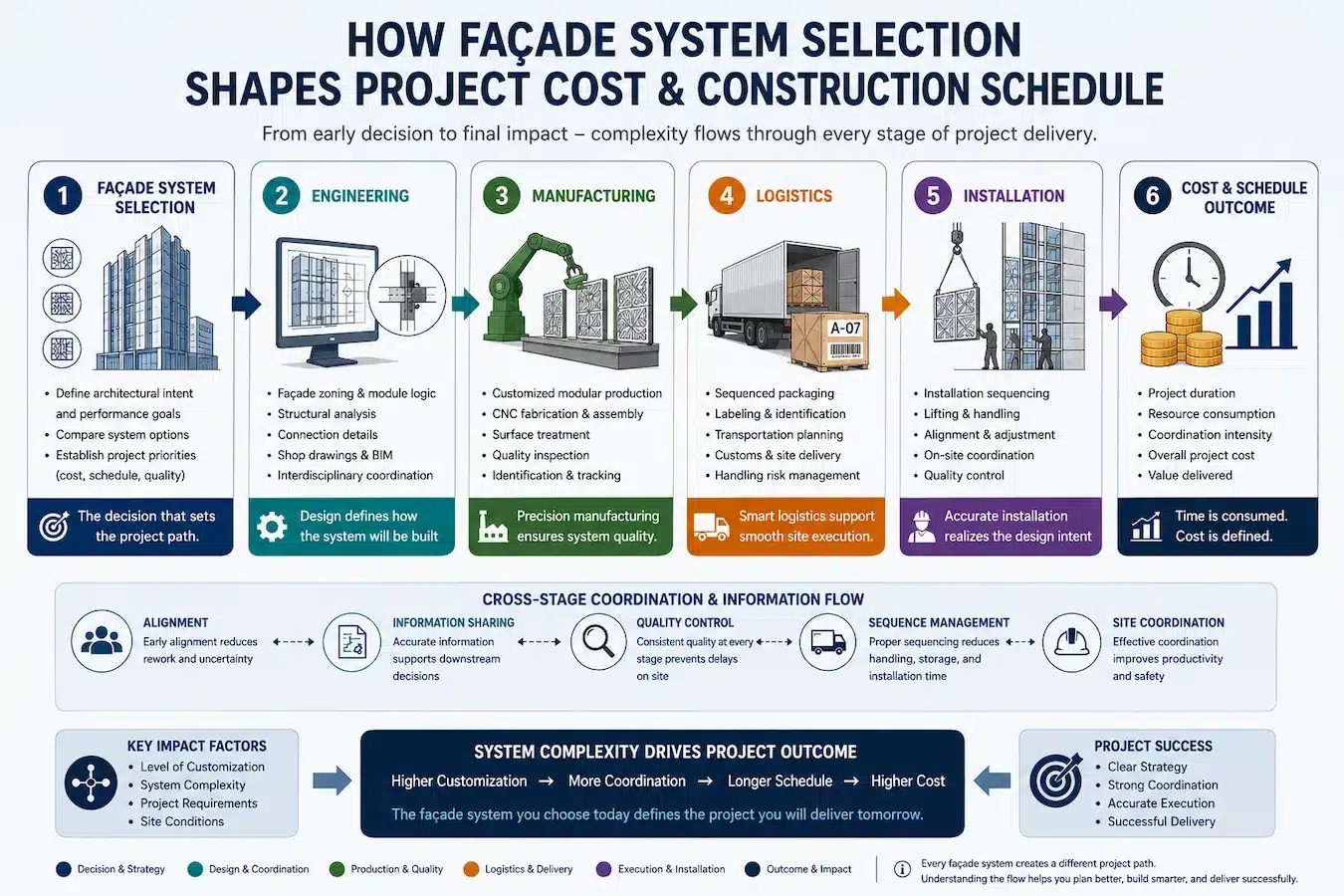
Selecting a façade system is one of the earliest decisions in a building project, and it has a significant impact on both project cost and construction schedule. Different façade systems require different approaches to engineering, fabrication, logistics, and installation, making system selection an important factor throughout project delivery.
Every façade system introduces a different level of project complexity.
In this article, we examine how façade system choices influence project costs and construction timelines. We also look at the Burj Al Mana Tower project to illustrate how a custom façade solution can affect planning, manufacturing, and on-site execution.
Façade systems are often compared by appearance, thermal performance, or structural capability. From a project delivery perspective, however, they differ in another important aspect: the way work is organized.
Once a façade system has been selected, many downstream activities begin to take shape. Engineering teams develop connection details around that system. Manufacturers prepare dedicated tooling and production plans. Logistics teams determine transportation methods based on panel dimensions and packaging requirements. Installation teams establish sequencing according to component size, lifting strategy, and site conditions.
These activities are interconnected. A decision made during system selection gradually influences every subsequent stage of the project.
Different façade systems therefore create different project characteristics.
Façade System | Typical Project Influence |
Stick-built Curtain Wall | Greater on-site assembly and labour coordination |
Increased factory production and logistics planning | |
Higher structural coordination and installation accuracy | |
Expanded panel identification and installation management | |
Extensive engineering development and customized fabrication | |
Additional multidisciplinary coordination and electrical integration | |
Integrated lighting coordination, wiring, and maintenance planning |
Understanding these differences helps project teams select the most appropriate façade system for their project priorities, including budget and schedule.
The Burj Al Mana Tower project shows how façade system selection becomes a source of project-wide complexity.
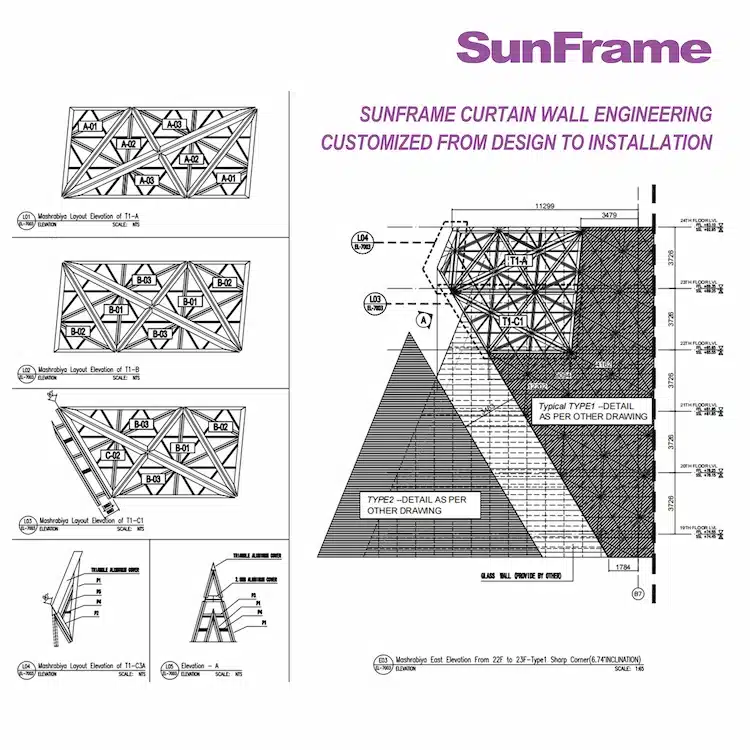
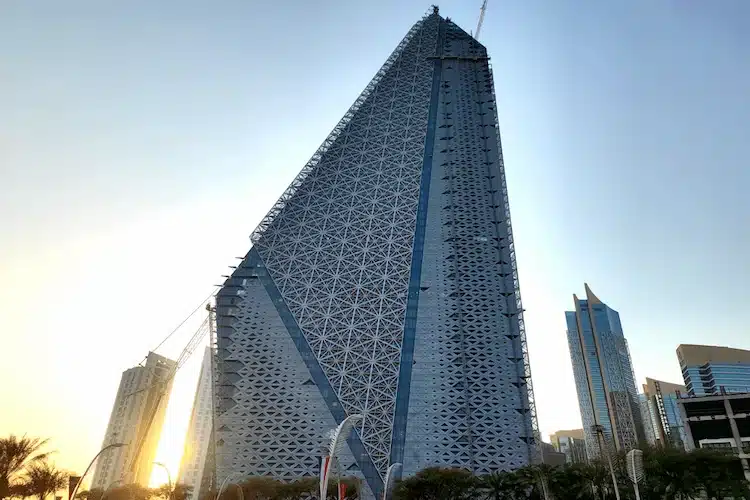
The project adopted a Custom Aluminum Panel & Mashrabiya Shading System, combining decorative aluminum panels with a highly customized shading façade inspired by traditional Mashrabiya patterns. Architecturally, the system created a distinctive identity for the tower while improving solar shading and adding visual depth. From a project delivery perspective, however, it introduced a level of coordination that extended across the entire construction process.
This modular system was first defined at the engineering stage. Teams developed and refined façade zoning, module configuration rules, shop drawings, connection details, and dimensional coordination to ensure the system could be accurately realized in fabrication and installation.
As façade zones became more complex, drawing reviews and interdisciplinary coordination also became increasingly detailed.
Unlike conventional aluminum panel systems, where many panels share identical dimensions and repetitive manufacturing processes, the Mashrabiya façade was developed using a set of customized modular components. Different pattern zones required specific combinations of these modules, enabling efficient batch production while still achieving a highly customized architectural expression.
While the system allowed for efficient batch fabrication, the primary focus of this stage remained on manufacturing precision and consistency across all modules.
Modules were produced in batches with strict dimensional control, surface quality checks, and identification management to ensure reliable assembly during later stages.
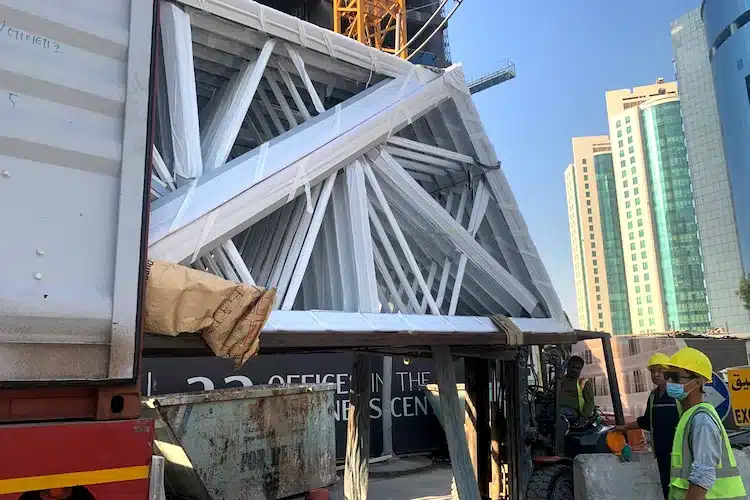
Packaging became part of the delivery strategy, reflecting the need to manage increasing coordination complexity at the logistics stage. Components were labeled, organized, and packed according to installation sequence to support efficient site coordination and reduce handling errors during construction.
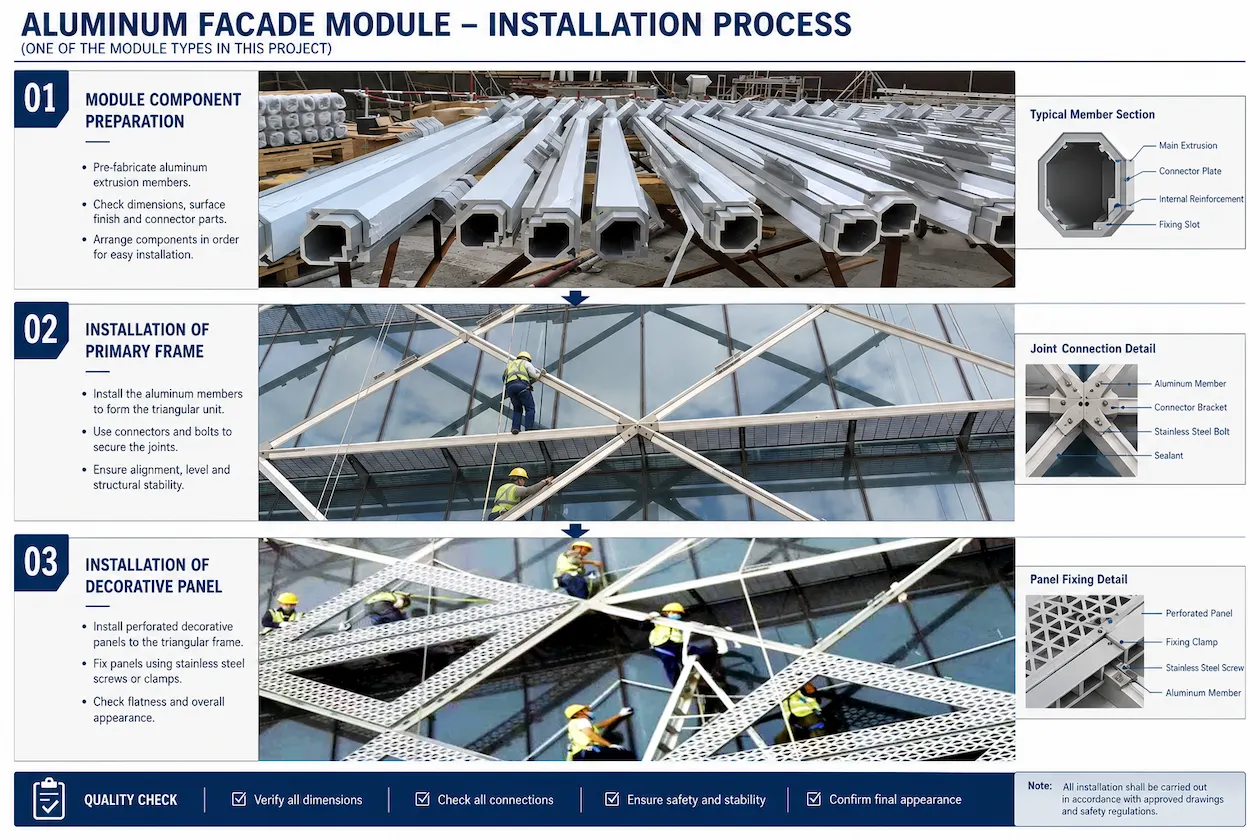
Installation required close coordination between crews and technical supervisors. Each module had to be installed in the correct position and orientation to maintain continuity of the overall Mashrabiya pattern across the façade. Progress depended not only on installation speed, but also on the accuracy of preceding engineering, fabrication, and logistics stages.
The project was delivered between 2019 and 2023. The duration reflects the high level of cross-stage coordination required for a highly customized façade system.
The project confirms that complexity extends throughout all project phases, from initial architectural concept through engineering, manufacturing, logistics, installation, and quality control. Understanding this flow helps project teams better anticipate project delivery requirements from the earliest design stage.
The influence of façade system selection eventually becomes visible in the project’s time structure. What begins as a technical decision in design gradually turns into a scheduling condition that affects how resources are allocated across the entire delivery process.
As complexity increases, more coordination is required between engineering, fabrication, logistics, and installation. These activities no longer operate in a linear sequence. Instead, they overlap and continuously adjust to each other. Engineering may still be refining details while manufacturing has already started, and installation planning often depends on information that is still being finalized.
This type of workflow introduces a different form of cost. It is not measured only in materials or fabrication effort, but in the duration and intensity of coordination required to keep the project moving forward.
When interdependence between stages increases, coordination shifts from a supporting activity to a continuous requirement across the entire delivery process. Engineering adjustments influence fabrication outputs, fabrication constraints affect logistics planning, and installation sequencing depends on upstream accuracy.
At this point, maintaining alignment between stages becomes as critical as the execution of each individual task.
When a façade system requires higher levels of customization, project timelines extend due to increased coordination demands across all stages.
Time therefore becomes part of project cost, as extended coordination periods require continuous engagement of management, equipment, supervision, and site operations.
The schedule effectively represents the consumption of project resources rather than a fixed duration.
In this context, the selected façade system does not only define how the building is constructed. It defines how time is structured, coordinated, and consumed throughout construction.
Façade system selection establishes the structure of project delivery long before construction begins. It determines how engineering is developed, how fabrication is organized, how logistics are coordinated, and how installation is sequenced.
As system complexity increases, its influence extends across all project stages, increasing coordination requirements and reshaping construction timelines.
In façade engineering, the most important decisions are often made at the very beginning. Once a system is selected, the trajectory of cost and time is already set in motion.
Not sure whether operable or fixed windows are appropriate for your project?
The answer often depends on facade performance targets, ventilation strategy, building height, and operational requirements.
SunFrame works with architects, consultants, contractors, and developers to evaluate curtain wall configurations based on project-specific conditions and performance goals.
Contact our team to discuss your facade system requirements.

Curtain Wall Project Delivery: Why Site Issues Occur Even When the Design Is Correct Introduction Successful curtain wall project delivery is often judged by what

Villa Façade Systems: Key Lessons in Multi-System Project Delivery Luxury villas may appear straightforward from an architectural perspective. Yet behind many successful villa developments lies

Operable vs Fixed Windows in Curtain Wall Systems: A Performance-Based Comparison Introduction Curtain wall systems are often expected to satisfy two competing objectives. Buildings require

Cost vs Performance in Façade Systems: What Really Drives Project Value Introduction In façade projects, cost is rarely a simple reflection of material prices or