
Coastal Façades Across Five Regions
Coastal Façades Across Five Regions Eight projects. Diverse marine environments. One continuously evolving engineering experience. Coastal developments are found across a wide range of climates,
Curtain wall systems are often expected to satisfy two competing objectives. Buildings require access to fresh air and occupant comfort, while the facade is expected to function as a stable barrier against wind, water, heat, and noise.
The choice between operable and fixed windows sits at the center of this balance.
Introducing operable units creates opportunities for natural ventilation. Fixed glazing maintains a more continuous facade assembly.
Understanding how these two approaches influence curtain wall behavior is essential for making informed facade design decisions. This article examines how operable and fixed windows influence curtain wall performance and where each approach is most appropriate.
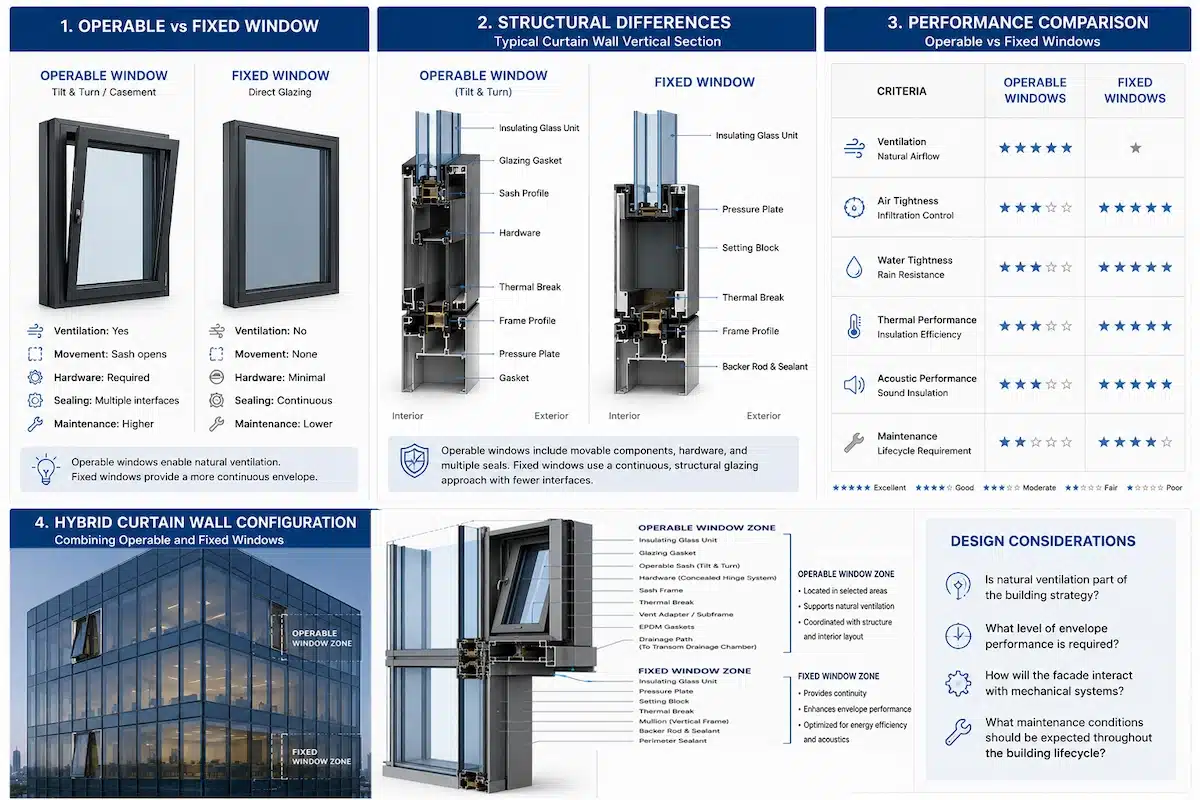
Operable windows incorporate a movable sash that can open and close within the curtain wall frame. To accommodate movement, the system includes hardware components such as hinges, friction stays, locking mechanisms, and compression seals. These elements create additional interfaces between the sash and the surrounding frame.
Fixed windows use a stationary glazing assembly secured directly within the frame. Since no opening function is required, the configuration contains fewer components and fewer interface conditions. This allows the facade to maintain a more continuous frame-to-glass assembly.
The fundamental difference is the presence of movement within the system. Operable windows rely on hardware, seals, and movable components to function, while fixed windows remain permanently sealed within the facade. This distinction influences many of the performance characteristics discussed in the following sections.
Operable windows create a direct path for air exchange between indoor and outdoor environments. This can support occupant comfort and reduce reliance on mechanical ventilation in certain conditions.
Fixed windows do not provide direct airflow through the facade. Air exchange, when required, is handled by other building systems.
Air tightness depends on how continuous the air barrier is across the facade.
Fixed windows maintain a more continuous sealing line, which supports stable airtight performance.
Operable windows introduce additional interfaces at frame joints and hardware locations. These areas require careful detailing to maintain performance under pressure changes.
Water resistance in curtain walls is controlled through sealing design and drainage strategy.
Fixed windows rely on continuous seals and internal drainage paths within the facade system.
Operable windows include moving joints that require additional attention to gasket compression and water management at interface zones.
Thermal behavior is affected by frame continuity and interface detailing.
Fixed windows maintain more uniform thermal conditions across the facade surface.
Operable windows introduce additional frame elements and hardware zones. These areas need specific attention to reduce localized thermal bridging.
Sound insulation is closely linked to the quality of sealing.
Fixed windows provide consistent acoustic performance due to continuous sealing conditions.
Operable windows rely on compression seals and hardware engagement, which makes installation quality and long-term condition more critical.
Fixed windows require limited maintenance related to glazing and seal inspection.
Operable windows include hardware systems such as hinges, locking devices, and opening mechanisms. These components require periodic inspection during the building lifecycle.
Movement introduces additional performance responsibilities within the facade.
Operable units rely on seals, hardware assemblies, and interface details that must continue to function throughout the life of the building. Fixed glazing maintains a more continuous assembly with fewer interface conditions to manage.
As a result, operable windows can support natural ventilation, while fixed windows often provide greater consistency in envelope performance. The appropriate choice depends on the priorities established for the project.
Operable windows are typically used in buildings where direct interaction with the external environment is part of the design intent.
This includes residential buildings, hotels, and mixed-use developments.
In these cases, natural ventilation is often part of the indoor environmental strategy.
As building height increases, environmental exposure becomes more demanding.
Wind pressure, air pressure variation, and facade loading conditions all become more significant.
Under these conditions, curtain wall systems often move toward more controlled envelope behavior. Fixed glazing supports this by reducing system interfaces and maintaining consistent performance across large facade areas.
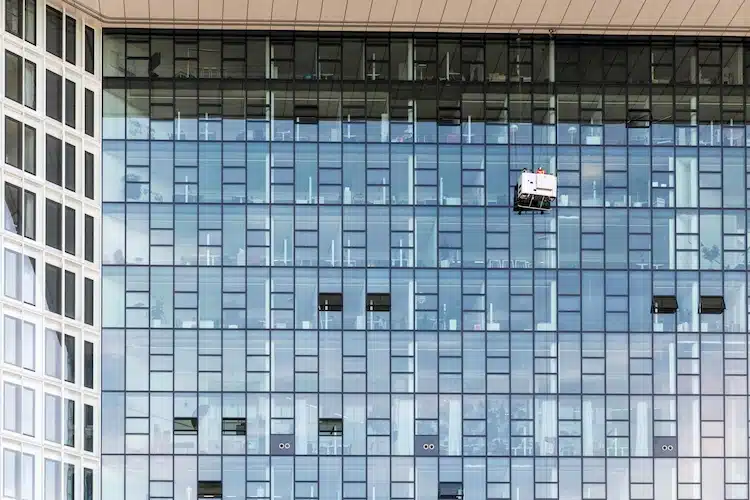
Many curtain wall systems use a hybrid configuration.
Fixed glazing forms the main facade surface, while operable units are placed in selected zones where ventilation is required.
These operable zones are usually coordinated with structural grids and interior planning requirements. Mechanical systems are also considered to ensure overall environmental balance.
Before selecting operable or fixed windows, several questions are typically evaluated:
☛ Is natural ventilation part of the building strategy?
☛ What level of envelope performance is required?
☛ How will the facade interact with mechanical systems?
☛ What maintenance conditions should be expected throughout the building lifecycle?
Operable and fixed windows serve different roles within curtain wall systems.
Rather than asking which option is better, the more useful question is which configuration best supports the performance objectives of the building.
Understanding the relationship between ventilation, envelope performance, and long-term operation helps guide more effective facade design decisions.
Not sure whether operable or fixed windows are appropriate for your project?
The answer often depends on facade performance targets, ventilation strategy, building height, and operational requirements.
SunFrame works with architects, consultants, contractors, and developers to evaluate curtain wall configurations based on project-specific conditions and performance goals.
Contact our team to discuss your facade system requirements.

Coastal Façades Across Five Regions Eight projects. Diverse marine environments. One continuously evolving engineering experience. Coastal developments are found across a wide range of climates,

Façade System Evaluation: How Architects, Contractors, and Façade Suppliers Evaluate Solutions Differently Introduction A façade system involves multiple decisions throughout the development of a building

What Can a General Contractor Really Control in Curtain Wall Decisions? Introduction A curtain wall system is the result of many interconnected decisions made throughout

Curtain Wall Air Tightness: Why Testing, Fabrication, and Installation Matter Introduction Air tightness is a key performance requirement of curtain wall systems. Standardized testing helps