Sunframe-Logo

Cost vs Performance in Façade Systems: What Really Drives Project Value

Introduction

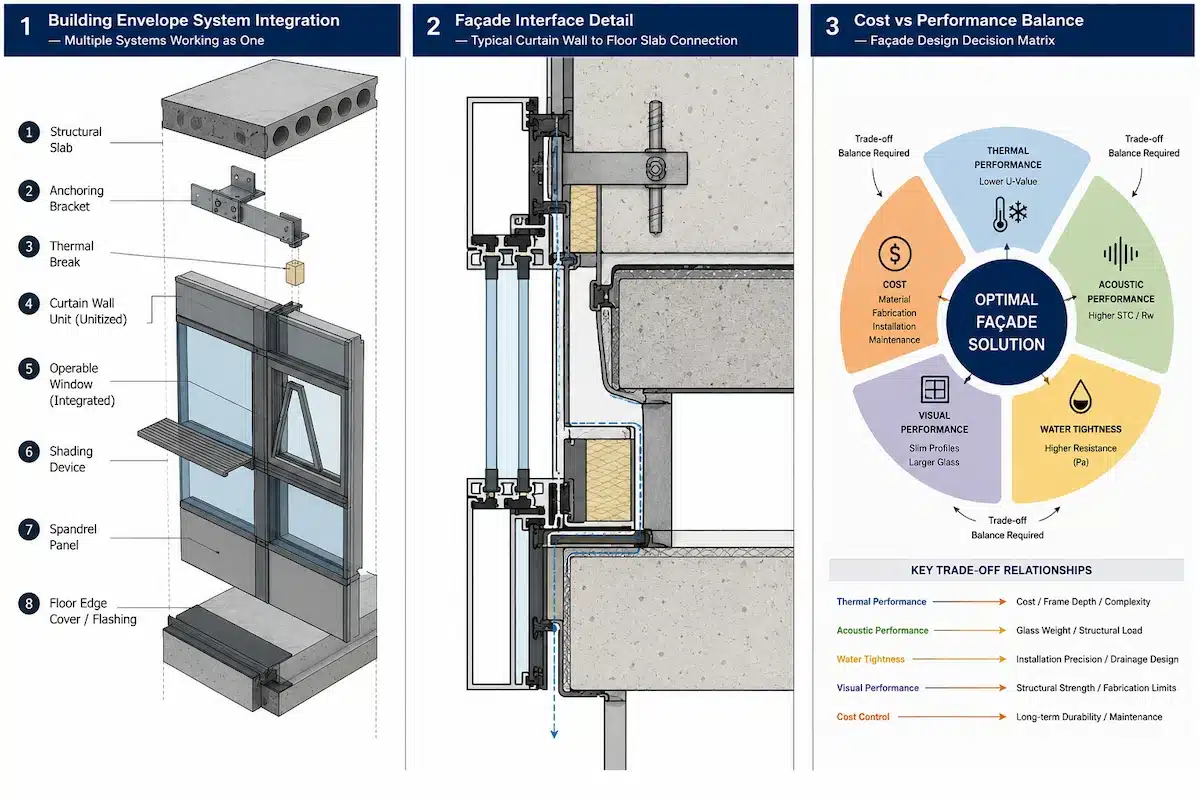
In façade projects, cost is rarely a simple reflection of material prices or system ratings. Most buildings combine curtain walls, windows, doors, shading devices, canopies, and structural interfaces. Once these elements come together, the real cost starts to come from how they interact, not how they are specified individually.

A façade system behaves as one assembly. When one part changes, it usually affects several others—installation, waterproofing, structure, or finishing details. This is where cost actually builds up.

Cost vs Performance in Façade Systems

1. A façade is built from interactions, not isolated products

A window, a curtain wall, or a shading system may look simple when viewed separately. In real projects, none of them work alone.

  • A window opening can trigger structural reinforcement.
  • A shading system can affect waterproofing routes.
  • A canopy can change drainage logic.
  • A curtain wall can influence interior finishing tolerances.

These interactions often create more work than the products themselves. What looks like a small design change can multiply into extra detailing, coordination, and site adjustment.

2. Performance is always a balance of conflicting requirements

On paper, performance categories look independent. In practice, they constantly affect each other.

  • Improving thermal insulation usually means deeper profiles or more complex assemblies.
  • Enhancing acoustic performance increases glass weight and affects structural design.
  • Tighter water resistance often requires more precise installation and drainage control.
  • Reducing visual frame size challenges both fabrication and installation.

Each decision pulls on the others. Every improvement in one area creates pressure somewhere else in the system.

3. Cost increases with complexity, not just material value

Material price is only one layer of cost. In most façade projects, it is not the dominant one.

Cost grows as the system becomes harder to coordinate:

  • additional interfaces between systems
  • customized geometries
  • tighter installation sequences
  • higher on-site adjustment requirements
  • dependencies between structure and façade

These factors increase fabrication precision, demand more careful installation, and raise coordination effort. The result is higher cost and longer execution time.

Lifecycle Cost in Façade Design

4. The real cost pressure comes from uncertainty

Uncertainty can emerge at every stage of a façade project:

  • alignment issues during installation
  • material behavior under heat, wind, and movement
  • mismatches between different suppliers
  • variation between production batches
  • difficulty in long-term maintenance or replacement

When uncertainty is high, teams compensate with additional time, labor, stricter tolerances, and more conservative installation methods. These measures help manage risk, but they also become part of the project’s cost structure.

5. Lifecycle behavior matters more than initial pricing

Once installation is complete, the façade continues to respond to its environment every day.

Over time, performance is shaped by factors such as:

  • seal durability
  • maintenance accessibility
  • thermal cycling
  • weather exposure
  • repair and replacement requirements

These conditions influence how much attention the façade demands throughout its service life.

Systems that are easier to maintain and more stable in behavior reduce long-term operational burden. Over time, this often has a larger financial impact than initial procurement differences.

Façade Cost Drivers

6. Predictability is what actually controls project value

Across projects, the systems that perform best are usually the ones that behave consistently.

Key aspects include:

  • stable dimensions during fabrication
  • installation following the planned sequence
  • consistent performance across production batches
  • durable interfaces between systems
  • minimal on-site adjustments

When a façade behaves predictably, coordination becomes simpler. Site risks decrease. Schedules become more stable. Rework is reduced.

This predictability is what ultimately defines value in real projects.

Conclusion

Façade system cost is shaped by how the system behaves, not only by what it is made of.

When multiple systems work together in a façade, complexity, interaction, and uncertainty become the main cost drivers.

Performance is not a checklist of isolated targets, but a set of linked decisions that affect fabrication, installation, and long-term behavior.

The most effective façade systems are the ones that maintain stable performance, require minimal on-site corrections, and deliver reliable results over time.

This level of reliability defines real project value.

This becomes even clearer when we examine how pricing is structured at the product level. For a detailed look, see Every Detail Counts – Understanding SunFrame’s Product Pricing.

Work With SunFrame on Your Next Facade Project

If you are planning a residential, commercial, or infrastructure facade project and require curtain wall engineering, system development, or installation support, SunFrame can assist from early design coordination to project execution — helping ensure reliable, well-engineered facade performance throughout the building lifecycle.

Leave a Reply

Your email address will not be published. Required fields are marked *

This site uses Akismet to reduce spam. Learn how your comment data is processed.

Other Posts

Contact Us