Sunframe-Logo

Villa Façade Systems: Key Lessons in Multi-System Project Delivery

Luxury villas may appear straightforward from an architectural perspective. Yet behind many successful villa developments lies a far more complex challenge: coordinating multiple façade-related systems into a unified building envelope.

Unlike standalone product installations, villa projects often combine curtain walls, windows, doors, shading structures, canopies, gates, fences, and landscape elements within a single architectural environment. Each system performs a different function, but all must work together to achieve consistent aesthetics, reliable performance, and efficient project delivery.

Across SunFrame’s villa projects, one principle has remained constant:
Successful façade delivery depends on coordination.

Villa Façade Systems

Multiple Systems, One Façade Strategy

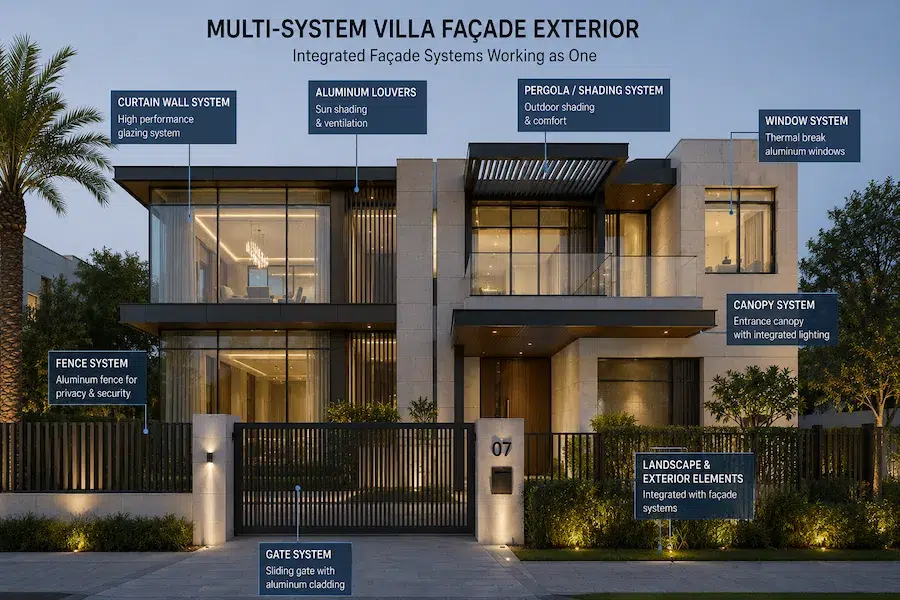
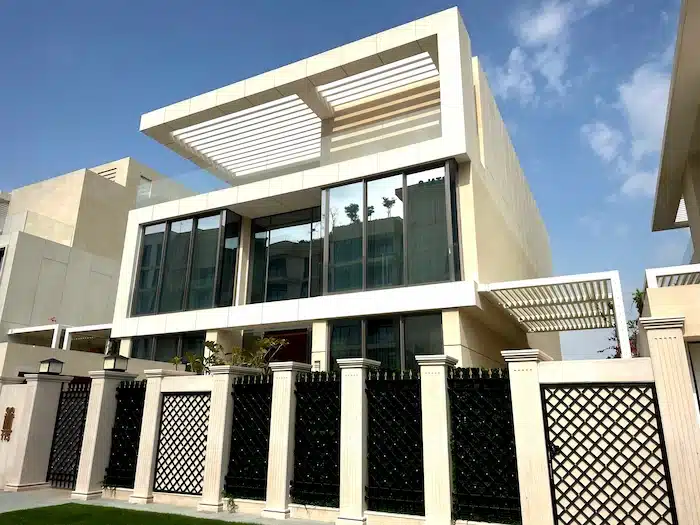
In our villa projects, multiple façade systems come together to form a cohesive architectural envelope.

These typically include curtain walls, aluminum doors and windows, louvers, shading structures such as pergolas, aluminum and steel canopies, gates and fences, as well as interior decorative metal elements.

Rather than functioning in isolation, these systems operate as a single integrated façade.

This pattern is evident across several projects:

CMT Villa

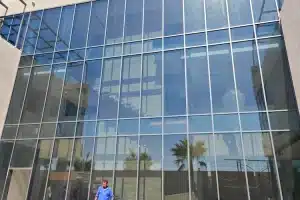
A fully integrated façade package where curtain walls, windows, louvers, and access systems were delivered as a single coordinated scope with aligned design and execution logic.

Giardino 49 Villas

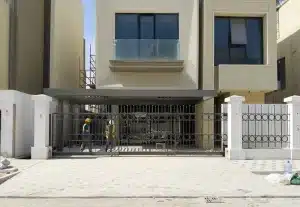
Aluminum canopies, steel fences, and gate systems were implemented across 49 villas, requiring consistent interfaces and repeatable installation coordination.

Corinthia Gewan Villas

Pergolas, shading structures, fencing, and landscape elements were developed as interconnected systems across 18 villas, unified through standardized coordination principles.

Across these projects, the combinations may differ, but the underlying principle remains consistent:

Façade performance depends on how effectively multiple systems interact across design development, fabrication, and installation.

Repetition Does Not Eliminate Complexity

Large villa compounds introduce a unique challenge:

Repeated layouts combined with varying site conditions.

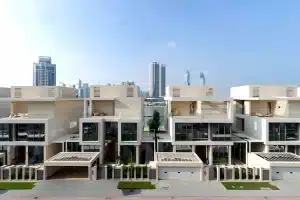
Projects such as Giardino 49 Villas and Corinthia Gewan Villas required system consistency across dozens of individual villas while accommodating differences in positioning, interfaces, and installation sequences.

Key coordination considerations included:

  • Establishing repeatable module logic
  • Maintaining dimensional consistency across multiple units
  • Managing production tolerances
  • Coordinating installation sequencing
  • Preserving architectural alignment throughout the development

The objective is controlled repetition with predictable outcomes, ensuring fabrication efficiency and consistency across the entire villa community.

Coordinating Interfaces Between Different Systems

Façade challenges are most prominent at system interfaces, where alignment and connection precision are essential.

Villa projects involve key junctions such as:

  • Curtain walls and window systems
  • Pergolas and supporting structures
  • Canopies and adjacent façade elements
  • Gates and boundary walls
  • Fencing systems and landscape features

Each connection introduces potential risks related to alignment, tolerances, waterproofing, structural attachment, and installation sequencing.

Successful coordination requires these relationships to be resolved during engineering development rather than during site installation.

By addressing interfaces early, on-site adjustments can be minimized and overall construction efficiency can be improved.

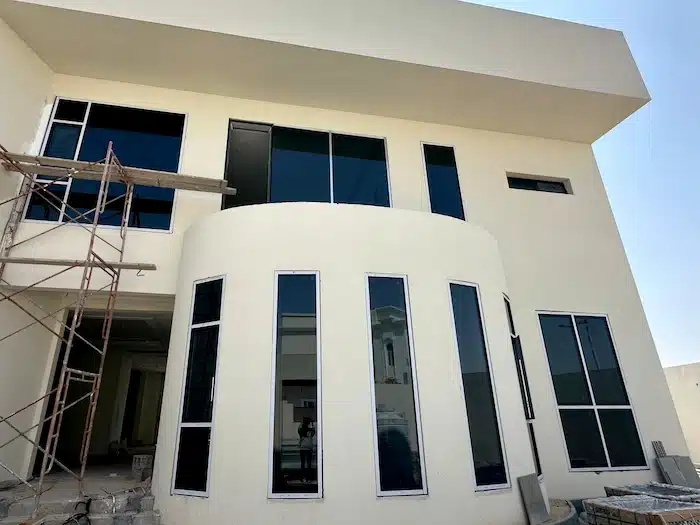
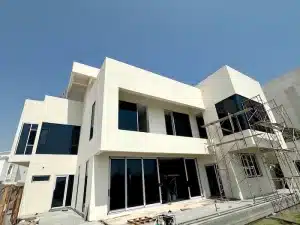
Villa Façade System Coordination and Installation

Climate as a Key Driver of System Behavior

Environmental conditions play a defining role in shaping façade system requirements and performance expectations.

Extreme Solar and Coastal Environment

Villa projects in Qatar face:

  • Intense solar radiation
  • High temperatures
  • Dust and sand exposure
  • Coastal corrosion risks

These conditions drive façade systems toward enhanced thermal control and long-term durability, including:

  • Low-E glazing for solar control
  • Thermal break aluminum doors and windows
  • Durable powder-coated aluminum and steel finishes
  • Corrosion-resistant detailing for exterior applications

Humid and High-Exposure Climate

In Mauritius, façade systems respond to high humidity, frequent rainfall, and strong UV exposure.

System requirements prioritize moisture resistance, ventilation, and long-term material stability:

Environmental Performance as a System Requirement

Across both regions, façade systems are defined by environmental performance requirements that shape material selection, detailing, and system configuration.

Multi-System Façade Projects

Coordination Continues During Project Execution

Façade coordination continues throughout the project beyond drawing approval.

Project execution frequently requires adjustments based on site conditions, mock-up evaluations, and client feedback.

One example can be seen in the Giardino 49 Villas project, where the original ground-floor aluminum canopy design was reassessed after mock-up review. Following evaluation, the canopy layout was redesigned to improve visual proportion and architectural balance before production proceeded.

This type of refinement demonstrates an important aspect of façade delivery:

Engineering flexibility must be supported by effective coordination between design teams, fabrication facilities, and site installation crews.

The ability to adjust efficiently to evolving project requirements is often as important as the original design itself.

Conclusion

Villa façade delivery is ultimately a matter of system relationships.

Each project brings together multiple façade elements that must operate within a shared architectural and environmental framework. The outcome depends less on individual components, and more on how system interfaces are resolved across the full project lifecycle.

This is where façade capability is truly expressed.

Work With SunFrame on Your Next Facade Project

If you are planning a residential, commercial, or infrastructure facade project and require curtain wall engineering, system development, or installation support, SunFrame can assist from early design coordination to project execution — helping ensure reliable, well-engineered facade performance throughout the building lifecycle.

Leave a Reply

Your email address will not be published. Required fields are marked *

This site uses Akismet to reduce spam. Learn how your comment data is processed.

Other Posts

Contact Us