

Curtain Wall vs Facade System: What’s the Difference?
Curtain Wall vs Facade System: What’s the Difference? Introduction In construction and architectural practice, the terms “curtain wall” and “facade system” are often used interchangeably.
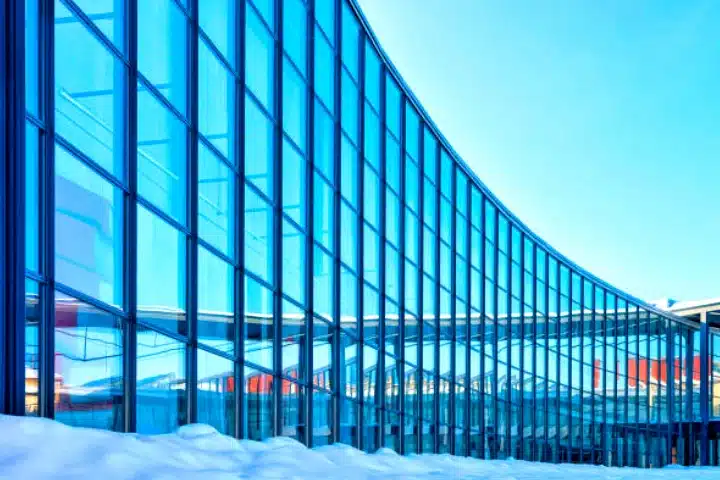
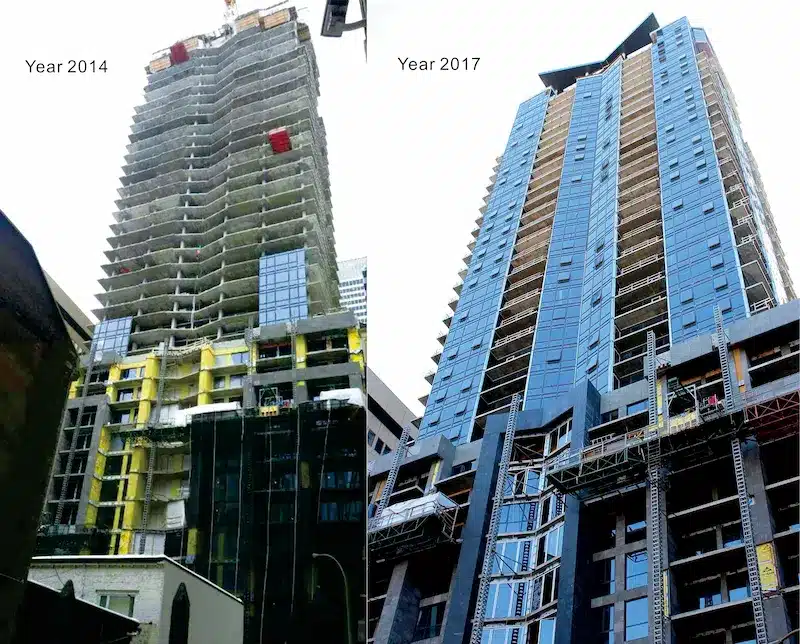
The coming of Canada’s Thanksgiving Day also signals the approach of the country’s harsh winter. Montreal’s winters are severe, with temperatures often dropping below -20°C and relentless freeze-thaw cycles. Therefore, the construction season there feels far too short. However, against this backdrop, TOM CONDOS still stayed on schedule. More than that, it also showcased a unitized curtain wall system – a reference for cold-climate building envelopes for now. Let’s move on to the following parts to take a closer look at the strategies and technologies that made it possible.
It’s fair to say that the key to TOM CONDOS’ success was moving risk off-site. By shifting most of the curtain wall assembly to the factory, the team sidestepped the typical winter challenges.
Each curtain wall unit arrived pre-assembled with frames, dual sealing (butyl tape + structural silicone), and glazing already in place. This approach ensured that critical waterproofing and airtightness were completed under ideal conditions. And it was to avoid the risk of low-temperature curing failures or installation errors.
There were only lifting, positioning, and securing left for on-site work. By coordinating installation with interior trades, the project maintained protection for ongoing work while keeping the schedule tight.
Even the small amount of sealing done on-site used low-temperature curing silicone. Besides, the work was carried out only when both the surface and ambient temperatures met the product’s minimum limits. This allows the sealant to bond properly even in extreme cold.
The curtain wall system was not only an off-the-shelf product. Rather, it was a carefully engineered envelope designed to resist heat loss and water intrusion. Next, let’s talk about how to optimize the thermal performance first.
Multi-chamber aluminum frames with calculated insulation widths blocked linear thermal bridges.
Triple-glass, double Low-E, argon-filled units balanced winter heat gain with extremely low U-values, while “warm-edge” spacers minimized edge condensation.
Apart from the thermal optimization, another key factor must be the airtightness and water management.
Each panel included equal-pressure chambers and drainage paths to evacuate any infiltrated water.
Operable units were all AAMA-certified, with independent testing guaranteeing long-term performance under extreme wind and rain.
To keep these systems working as designed, a set of pre-winter checks and protective actions is needed.
For facilities managers, a proactive inspection before the cold sets in is crucial:
–Seals: For the seals, all silicone joints must be checked for cracks or detachment. Special attention must be paid to the panel intersections and roof/floor transitions.
–Drainage: As to the drainage, they should clear open and hidden channels. Then, simulate rainfall to confirm proper flow.
–Glazing and Panels: Inspect for internal condensation, mold, or coating degradation.
–Hardware: When it comes to the hardware, they should operate all movable units, check the locks and hinges carefully, and make sure that the multipoint locking systems close tightly and function as intended.
TOM CONDOS has told us that in extreme-cold climates, a successful building envelope is the result of thoughtful integration including the following four elements:
① prefabrication, ② thermal engineering, ③ airtightness, ④ proactive maintenance
Hence, we can learn from that its achievement lies not in a single innovation but in the systematic coordination of multiple disciplines. Without doubt, it also offers a blueprint for projects facing similar environmental challenges.

Curtain Wall vs Facade System: What’s the Difference? Introduction In construction and architectural practice, the terms “curtain wall” and “facade system” are often used interchangeably.

What Is a Facade System in Building Construction? Introduction In modern architecture, facade systems are essential to building design, influencing energy efficiency, environmental control, and

Cultural Architectural Systems in the GCC: Glass and Aluminum Material Logic 1. Cultural architecture in the GCC operates through layered material logic In the GCC

Smart Façade Systems and Urban Skin Design Introduction: Façade as an Adaptive Interface Revolution Day in Argentina is often associated with systemic transition and structural