Sunframe-Logo

Movement Compatibility as a Foundation of Curtain Wall Safety

In facade engineering, structural calculations typically begin with load.

  • Wind load.
  • Seismic load.
  • Dead load.

Before resistance is verified, another question deserves attention:

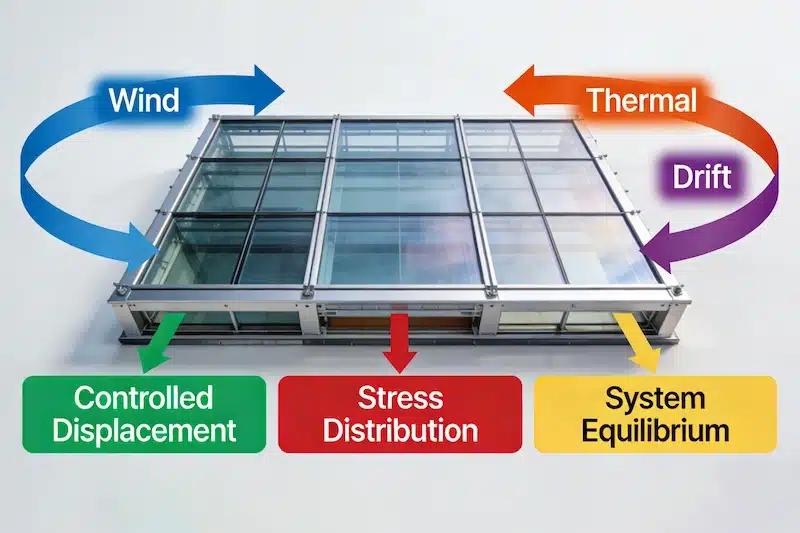
How will the system move?

  • Buildings expand and contract.
  • Structures drift.
  • Materials respond differently to temperature and stress.

Movement is part of a building’s normal condition. It accompanies the facade throughout its service life.

Curtain Wall Movement Compatibility

Rethinking Rigidity

Stiffness is often associated with safety. Larger sections, tighter tolerances, and reduced joint gaps can create an impression of robustness.

However, when a system becomes overly rigid, deformation does not disappear. It is redirected.

If movement cannot be accommodated within the framing and connections, stress concentrates at interfaces:

  • Glass edges
  • Anchoring points
  • Sealant joints

Many facade issues are linked less to insufficient strength and more to incompatibility between components.

Differential Behavior

Glass, aluminum, steel, and sealants possess distinct thermal expansion coefficients and elastic characteristics.

Under temperature fluctuation or wind-induced deflection, their responses are not identical. Even small differences accumulate over repeated cycles.

Allowing controlled displacement within the system helps maintain predictable stress distribution. Without such provision, internal forces may shift toward more brittle elements.

Compatibility requires deliberate coordination between materials, geometry, and detailing.

Detailing and Force Path

Movement compatibility is resolved primarily through detailing.

Sliding connections, setting blocks, gasket compression ranges, and joint tolerances influence how forces travel through the facade assembly.

A well-considered detail channels deformation in a controlled manner. Instead of restraining every displacement, it defines where and how movement can occur.

This controlled flexibility supports equilibrium across the system.

Curtain Wall Differential Movement

Consequences of Constraint

When visual minimalism or extreme slenderness reduces movement allowance, performance often becomes sensitive to minor deviations:

  • Edge cracking
  • Sealant fatigue
  • Anchor distress
  • Progressive glass breakage under moderate conditions

Such issues rarely appear immediately. They develop through repeated thermal cycles and service-level deflection over time.

Movement-related distress is frequently cumulative.

Designing with Real Conditions in Mind

Movement compatibility depends on acknowledging practical realities:

  • Materials behave differently
  • Buildings deform continuously
  • Installation precision has limits

Design decisions that incorporate these conditions tend to produce facades with more stable long-term behavior.

Systems that provide measured freedom at critical interfaces are better equipped to absorb variation without concentrating stress.

Position

In curtain wall engineering, managing movement shapes overall system performance.

Strength verification remains essential, yet accommodation of deformation defines how a facade behaves in daily service.

Movement compatibility therefore stands at the foundation of facade reliability.

Work With SunFrame on Your Next Facade Project

If you are planning a residential, commercial, or infrastructure facade project and require curtain wall engineering, system development, or installation support, SunFrame can assist from early design coordination to project execution — helping ensure reliable, well-engineered facade performance throughout the building lifecycle.

Leave a Reply

Your email address will not be published. Required fields are marked *

This site uses Akismet to reduce spam. Learn how your comment data is processed.

Other Posts

Contact Us