Sunframe-Logo

Curtain Wall Maintenance and Performance Degradation Management

Curtain wall systems continue to evolve after completion.

Once a building enters operation, environmental exposure and material aging begin to influence performance in subtle but continuous ways.

Maintenance is the mechanism that keeps these changes within acceptable limits throughout the service life of the facade system, forming the basis of curtain wall maintenance strategy.

Unlike design, which defines how a system should behave, maintenance deals with how that behavior shifts in real conditions over time.

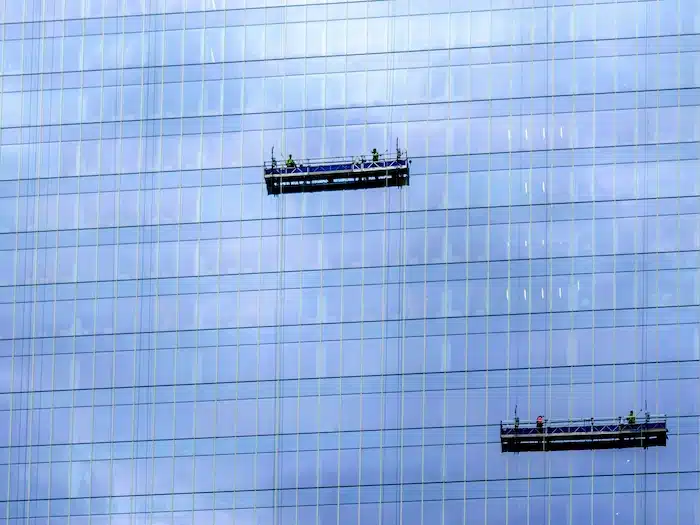
Curtain wall maintenance

01 Why Maintenance Becomes Critical Over Time

A curtain wall is exposed to constant environmental variation throughout its lifecycle.

Temperature changes, humidity, UV radiation, wind action, and pollution all interact with materials and connections in different ways.

None of these effects typically cause immediate damage. Their impact appears through slow accumulation.

Small changes in seal behavior, surface condition, and connection stability progressively alter system performance.

Maintenance exists to manage this accumulation before it affects overall facade reliability.

02 Curtain Wall Inspection Cycles and Condition Monitoring Strategy

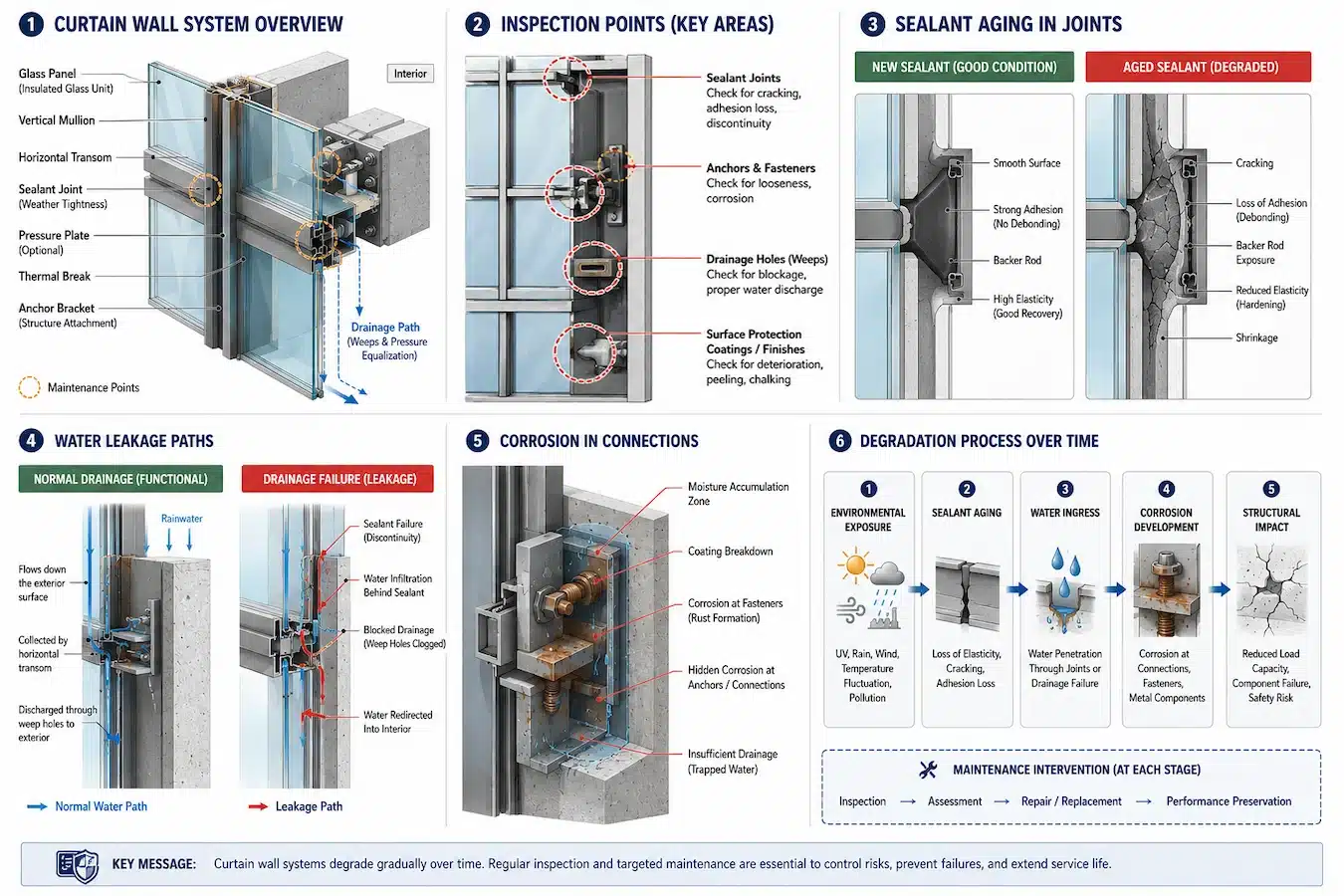
Curtain wall inspection is less about checking for visible damage and more about understanding how the system is changing.

Key attention is usually given to:

  • Sealant joints and surface continuity
  • Anchoring and connection points
  • Drainage paths and water movement behavior
  • Surface protection layers

Different buildings require different inspection rhythms.

Exposure conditions, height, and environmental intensity have a stronger influence than fixed time intervals.

The purpose of inspection is to capture early deviation in performance, more than confirming failure after it occurs, especially when many of these deviations originate from installation and anchoring conditions.

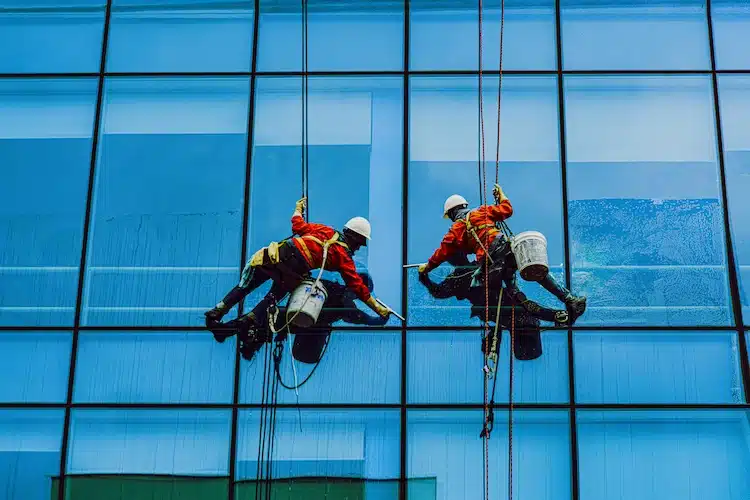
curtain wall inspection

03 Sealant Aging and Joint Behavior

Sealants gradually change under long-term exposure to heat, moisture, and movement.

The most common changes appear as reduced elasticity, slower recovery after deformation, and gradual loss of adhesion at interfaces.

These changes directly affect how joints respond to daily thermal cycles.

Once joint flexibility decreases, both air and water tightness begin to weaken under repeated movement.

Understanding this behavior allows maintenance planning to shift from reaction-based repair to condition-based replacement.

04 Waterproofing Performance Over Service Life

Waterproofing in curtain wall systems is closely linked to joint behavior and drainage continuity.

Performance degradation usually develops step by step.

Small disruptions in seal continuity or drainage flow can slowly redirect water paths within the system, making curtain wall leakage prevention a key aspect of system maintenance.

Over time, these changes increase the likelihood of moisture reaching unintended areas.

Maintenance attention is typically focused on:

  • Keeping drainage routes open and functional
  • Preserving continuity of sealing lines
  • Identifying localized water ingress patterns early

Water leakage is often the final visible stage of a long internal process.

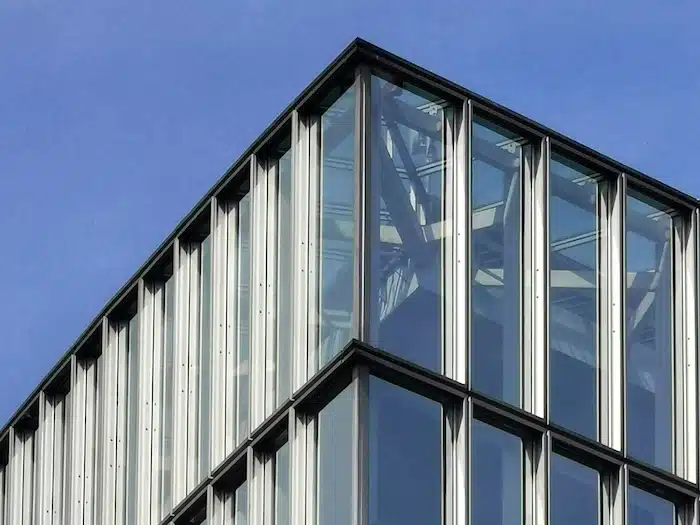
façade maintenance strategy

05 Corrosion Progression and Material Exposure

Metal components remain in a continuously exposed environment throughout their service life.

Moisture, pollutants, and temperature cycles affect both surface protection and hidden connection zones over sustained exposure.

Corrosion rarely starts where it becomes visible.

It often begins at interfaces, fasteners, or areas with limited drainage.

Maintenance focuses on slowing this progression through:

  • Condition assessment of protective coatings
  • Monitoring of moisture accumulation zones
  • Local repair of early-stage corrosion areas

The objective is not elimination of exposure, but control of its impact over time.

06 Glass and Component Replacement Planning

A long-life curtain wall system inevitably requires partial replacement during its lifecycle.

Different components age at different speeds, even under identical conditions.

A maintainable system allows targeted replacement without disturbing the overall facade structure.

Typical interventions include:

  • Glass unit replacement
  • Seal and gasket renewal
  • Hardware and localized connection replacement

This approach avoids full-system intervention and extends usable service life through staged maintenance.

building envelope maintenance

07 Typical Facade Degradation Patterns

Most curtain wall failures do not appear suddenly.

They develop gradually through interacting conditions that reinforce each other.

Common patterns include:

  • Progressive sealant hardening leading to joint opening
  • Localized corrosion at concealed connections
  • Reduced drainage efficiency increasing moisture retention
  • Repeated thermal cycling contributing to joint fatigue

These processes often overlap, making early detection essential for long-term stability.

08 Conclusion

Curtain wall maintenance is a continuous management process.

Its role is to track, control, and respond to gradual changes that occur during service life.

While design establishes the initial behavior of the system, maintenance determines how long that behavior remains stable under real environmental conditions.

A well-managed curtain wall maintenance strategy helps ensure that curtain walls maintain performance consistency throughout their intended lifecycle.

Related reading

Understanding curtain wall performance requires a lifecycle perspective, from design decisions to construction execution.

 How curtain wall service life is defined during design

 How installation and anchoring affect long-term performance

Work With SunFrame on Your Next Facade Project

If you are planning a residential, commercial, or infrastructure facade project and require curtain wall engineering, system development, or installation support, SunFrame can assist from early design coordination to project execution — helping ensure reliable, well-engineered facade performance throughout the building lifecycle.

Leave a Reply

Your email address will not be published. Required fields are marked *

This site uses Akismet to reduce spam. Learn how your comment data is processed.

Other Posts

Contact Us