Sunframe-Logo

Curtain Wall Construction Guide: Installation Safety and Anchoring System

Curtain Wall Construction Safety and Anchoring Guide

Curtain Wall Installation Guidelines

01 Introduction: Safety and Installation Practices

Achieving a 50-year service life for a curtain wall system depends not only on design, but equally on construction quality and installation control.

Even a well-engineered façade can experience premature failure if anchoring, assembly accuracy, and on-site safety are not properly managed.

This guide outlines the key construction principles, installation methods, and safety practices required to ensure long-term durability.

02 Construction Impact on Curtain Wall Lifespan

Construction is where design intent is translated into a physical system. Any deviation at this stage may introduce hidden risks that shorten service life.

Common construction-related impacts include:

  • Installation tolerances that lead to stress concentration or deformation
  • Improper handling causing damage to coatings, edges, or sealants
  • Inadequate joint treatment resulting in water ingress and corrosion
  • Misalignment affecting load transfer and overall system behavior

In many cases, these issues do not cause immediate failure, but gradually reduce the long-term performance and safety margin of the curtain wall.

03 Installation Load Transfer Control

♦ Load Transfer Principle

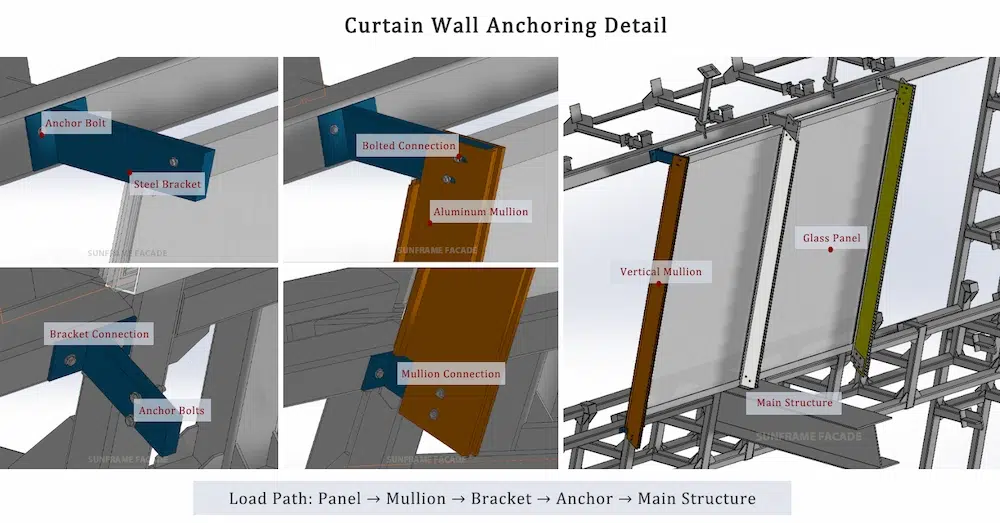
A curtain wall system is designed to transfer loads through a defined path:

Panel → Supporting frame → Connector → Anchor → Main structure

Installation should be carried out in a manner that is consistent with the designed load transfer path, so that no unintended forces or constraints are imposed on the system.

♦ Installation Stage Control

During installation, particular attention should be given to:

  • Avoiding forced alignment of components
  • Ensuring temporary supports do not create excessive deformation
  • Maintaining consistency with the structural calculation assumptions

Temporary supports and installation equipment should be properly arranged and adjusted to limit unintended loads, especially for large panels or unitized systems.

If the load transfer path is disrupted during installation, it may give rise to residual stress, loosening of connections, or gradual fatigue effects over time.

Curtain Wall Anchoring System Detail

04 Curtain Wall Anchoring System Installation

The curtain wall anchoring system forms the critical interface between the façade and the main structure, and must be installed with strict control.

♢ Anchor Design Requirements

The design bearing capacity of the anchorage system should not be less than that of the connected components, based on structural calculation.

Anchors should be:

  • Verified through structural analysis and, where necessary, testing
  • Compatible with the type, stiffness, and deformation characteristics of the main structure

For typical applications:

  • Embedded parts are commonly used in concrete structures
  • Pre-installed adapters or welded connections are typically adopted in steel structures

Alternative anchoring methods (such as post-installed anchors) may be used, provided that:

  • Their performance is properly verified
  • They comply with relevant design standards and project requirements

♢ On-Site Installation Control

Key control measures during installation include:

  • Accurate positioning and alignment of anchors
  • Verification of embedment depth and fixing conditions
  • Control of tightening force and connection reliability
  • Avoidance of unverified on-site modifications

On-site drilling or adjustment should only proceed when supported by structural verification and formal approval.

 Proper anchoring installation is a fundamental requirement for façade safety and long-term stability.

05 Mullion and Transom Assembly Accuracy

The installation accuracy of mullions and transoms directly affects both structural performance and façade quality.

★ Structural Requirements

Profile dimensions and section properties should be consistent with design calculations 

Connections should be capable of accommodating:

  • Horizontal loads (e.g., wind)
  • Vertical loads (e.g., self-weight)
  • Torsional effects caused by structural movement

Mullions are typically designed as top-suspended members to better accommodate interstory drift; alternative configurations may be adopted when justified by design.

★ Installation Control

During assembly, the following should be controlled:

  • Verticality and alignment of mullions
  • Level and spacing of transoms
  • Installation tolerances within specified limits

Allowance should also be made for:

  • Interstory deformation
  • Thermal expansion and contraction

Accurate assembly promotes uniform load distribution and reduces the risk of local overstress or seal failure.

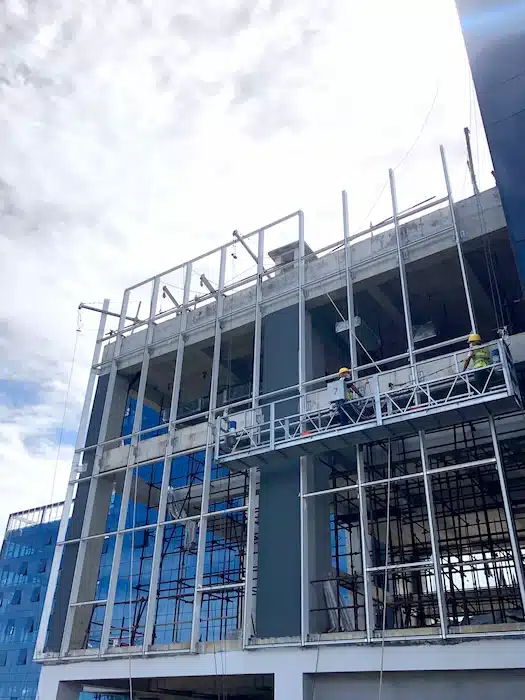
Facade Construction System

06 On-Site Construction Safety Measures

Construction safety is essential for both personnel protection and system performance.

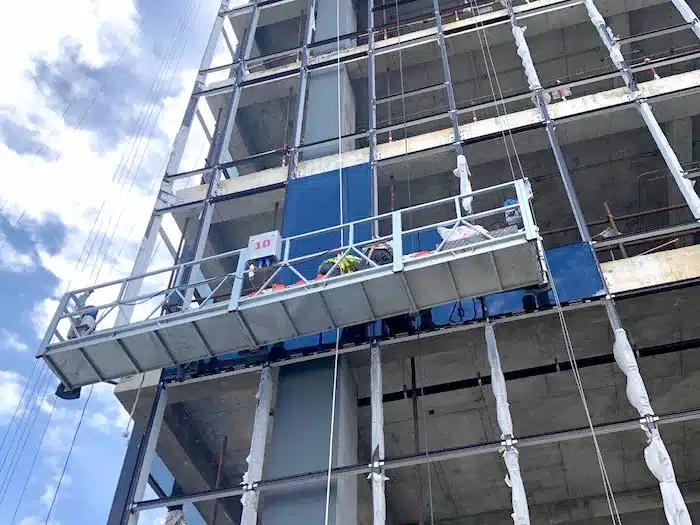
☆ Anti-Fall Protection

Appropriate anti-fall protection measures should be implemented during installation and maintenance, and extended to other stages where risks are identified.

Where required by system design:

  • Glass panels should use safety glass
  • Mechanical anti-fall devices should be incorporated to provide redundancy

☆ Material and Sealant Control

Materials should be:

  • Suitable for the environmental conditions
  • Compliant with relevant standards

Sealants should:

  • Be within their valid service period
  • Pass required adhesion and compatibility tests

Environmental factors such as temperature, humidity, and UV exposure should be considered during application.

☆ Maintenance System Safety

Systems used for façade maintenance (such as window cleaning equipment) should:

  • Be supported by dedicated structural components
  • Be securely connected to the main structure
  • Be verified through structural calculation where necessary

These systems should not introduce additional risks to the curtain wall during operation.

Curtain Wall Installation Safety

07 Connection and Fixing System Requirements

Connections are critical to the overall performance of the façade system and must be designed and installed carefully.

♠ General Requirements

Connections should be designed with appropriate measures against:

  • Loosening
  • Slipping
  • Detachment

These measures should be determined based on loading conditions, material properties, and structural behavior.

♠ Special Conditions

At structural movement joints:

– Curtain wall systems should be installed independently on both sides to accommodate relative displacement.

For large, curved, or irregular panels:

  • High-stiffness connectors are generally preferred over simple screw fixing.
  • Structural analysis should be used to verify connection performance.

Proper connection design enables the façade to accommodate movement without compromising safety or durability.

08 Common Curtain Wall Construction Mistakes

Many performance issues in curtain walls can be traced back to avoidable construction errors.

☞ Typical Problems

① Inadequate anchoring

  • Insufficient embedment depth
  • Improper or missing embedded components

② Improper sealant application

  • Use of expired materials
  • Incorrect joint dimensions or poor workmanship

③ Structural misalignment

  • Deviation in mullion or transom positioning
  • Forced installation of components

④ Lack of movement allowance

  • Failure to consider thermal expansion or structural deformation

⑤ Insufficient safety measures

  • Missing anti-fall protection
  • Inadequate panel fixing

⑥ Improper installation sequencing

  • Disruption of the intended load transfer path, with potential for uneven force distribution.

Avoiding these issues is key to in maintaining structural performance and safety over time.

09 Conclusion

The durability of a curtain wall system depends not only on design quality, but also on precise and controlled construction execution.

A reliable façade system requires:

  • Installation that follows the intended load transfer principles
  • Properly verified and installed anchoring systems
  • Accurate assembly of structural components
  • Comprehensive on-site safety and quality control measures

Construction quality is therefore a critical factor in determining whether a curtain wall system can achieve its intended service life of 50 years.

Work With SunFrame on Your Next Facade Project

If you are planning a residential, commercial, or infrastructure facade project and require curtain wall system engineering, fabrication, or installation support, SunFrame can assist from system development to project execution, ensuring high-quality facade solutions for your project.

Leave a Reply

Your email address will not be published. Required fields are marked *

This site uses Akismet to reduce spam. Learn how your comment data is processed.

Other Posts

Contact Us