Sunframe-Logo

Curtain Wall Project Delivery: Why Site Issues Occur Even When the Design Is Correct

Introduction

Successful curtain wall project delivery is often judged by what happens on site. When curtain wall problems appear on site, the first question is often:

“Was there something wrong with the design?”

In many cases, the answer is no.

The drawings may be technically correct. Structural calculations may have been verified. Material specifications may meet project requirements. Yet curtain wall site issues still emerge during construction.

This is because a design drawing communicates an engineering intent—it does not control everything that happens after the drawing leaves the design office.

Between an approved design and a completed façade lies an entire project delivery process, where information is interpreted, transferred, coordinated, and executed by different teams. Every transition introduces opportunities for deviation.

The challenge is more often the gap between design intent and construction reality.

Curtain wall project delivery

How Different Disciplines Interpret the Same Drawing

Engineering drawings are one of the most important communication tools in façade projects.

However, a drawing is not the building itself.

It describes dimensions, materials, tolerances, and performance requirements, but it cannot fully represent the countless decisions made during fabrication, logistics, site coordination, and installation.

Every team involved reads the same drawing from a different perspective.

  • Engineers focus on performance.
  • Fabricators focus on manufacturability.
  • Site teams focus on constructability.
  • Installers focus on execution.

The drawing remains the same, but its interpretation changes as the project moves forward.

Every Project Handover Transforms Information

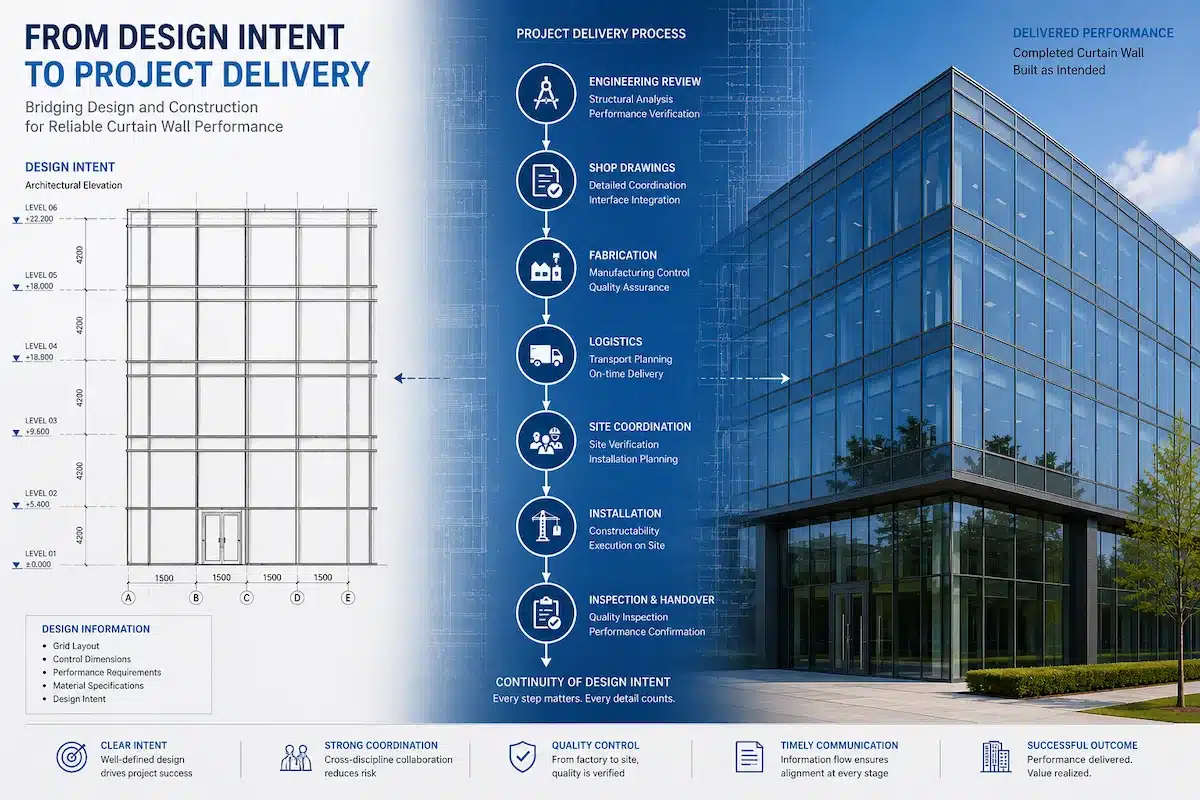
A curtain wall project follows a structured, multi-stage delivery process.

Design → Shop Drawings → Procurement → Fabrication → Logistics → Site Coordination → Installation → Inspection

Each stage builds on the previous one by refining and translating project information into more detailed and execution-ready outputs.

Questions are clarified.

Details are adjusted.

Site conditions often require decisions that cannot be fully anticipated during design.

These adjustments are an inherent part of construction delivery.

With each handover, information is progressively transformed. Small variations in assumptions, sequencing, or substitutions can accumulate across stages and influence how performance expectations are realized in execution.

Maintaining continuity of intent throughout this chain is critical to project outcome.

Many curtain wall construction issues arise from subtle gaps between intended design outcomes and final on-site execution.

Curtain Wall Site Issues

Construction Creates Decisions Beyond Design Assumptions

Construction is a process of continuous engineering judgement.

Key variables on site include:

  • Unexpected structural tolerances
  • Temporary access limitations
  • Equipment availability
  • Weather conditions
  • Trade coordination
  • Construction sequencing

These factors shape execution in real time.

Good drawings define intent, while execution defines outcome.

Project Delivery Is About Preserving Design Intent

A curtain wall project succeeds when design intent is maintained consistently through every stage of delivery.

From drawings to execution, performance depends on alignment across coordination, communication, and construction.

When this continuity is achieved, the completed façade performs as originally intended.

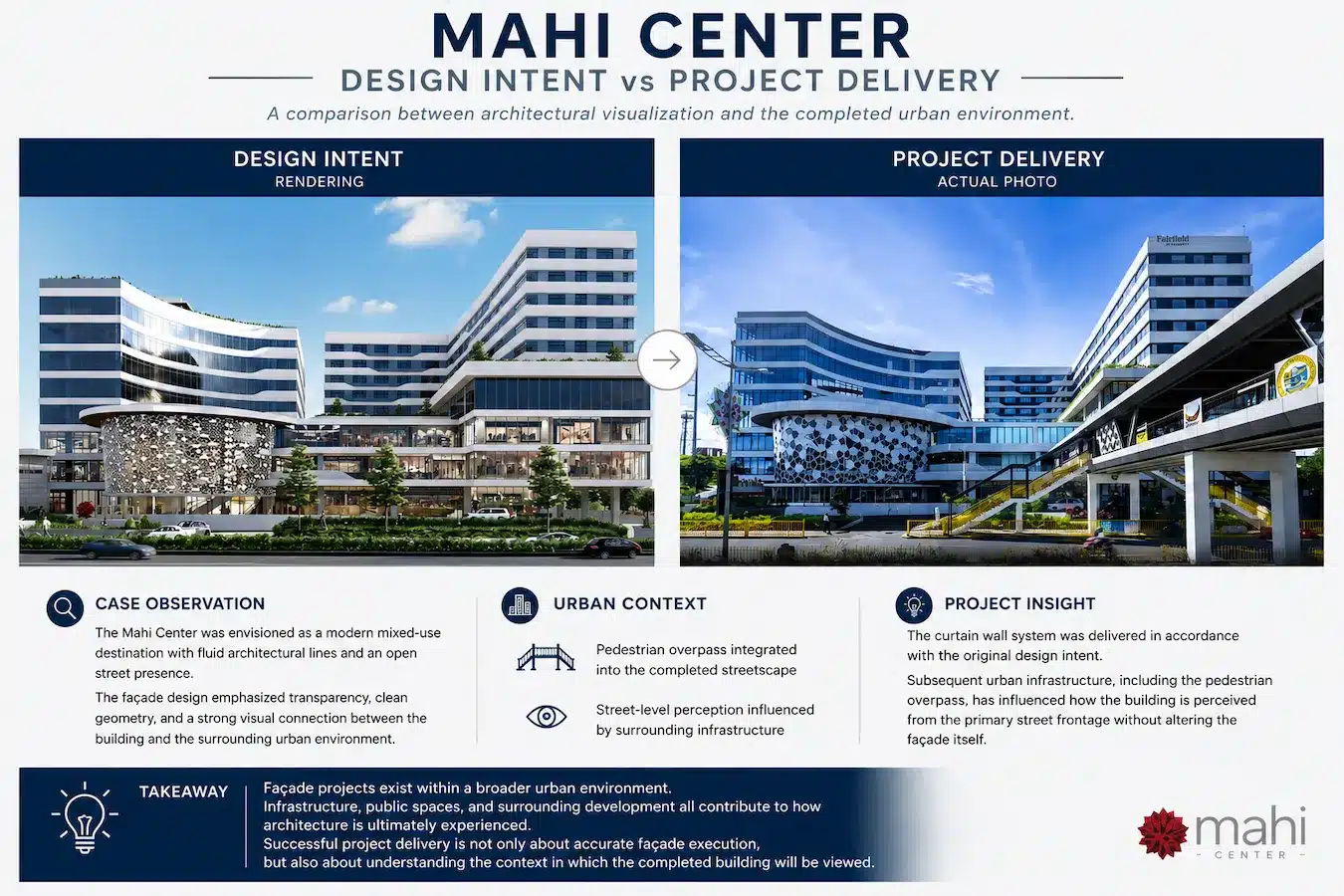
Design Intent and Project Delivery

From Design Intent to Project Delivery

Understanding where problems originate is just as important as knowing how to solve them.

At SunFrame, we view project delivery as a continuous engineering process rather than a series of independent stages. From design coordination and fabrication planning to site communication and installation support, every step is an opportunity to preserve the original concept.

While no project is entirely free from uncertainty, early coordination, transparent communication, and timely technical feedback can significantly reduce the likelihood of unnecessary deviations becoming on-site issues.

For us, successful façade engineering is not simply about delivering a curtain wall system. It’s actually about delivering the performance the design was intended to achieve.

This outcome is only possible when strong design control is established from the very beginning of a project, as discussed in our curtain wall design management and risk control strategies.

Work With SunFrame on Your Next Facade Project

If you are planning a residential, commercial, or infrastructure facade project and require curtain wall engineering, system development, or installation support, SunFrame can assist from early design coordination to project execution — helping ensure reliable, well-engineered facade performance throughout the building lifecycle.

Leave a Reply

Your email address will not be published. Required fields are marked *

This site uses Akismet to reduce spam. Learn how your comment data is processed.

Other Posts

Contact Us