Sunframe-Logo

Curtain Wall Design as Engineering Judgment

How SunFrame Integrates Structure, Materials, and Interfaces in Complex Façade Projects

In many projects, curtain walls are often seen as “façade systems” or merely a combination of materials. At SunFrame, however, we maintain that the essence of curtain wall design lies not in the panels themselves, but in the completeness of engineering judgment.

Especially in high-rise buildings, large-scale public projects, and high-standard markets, a curtain wall does more than shape architectural expression—it directly impacts structural safety, performance, long-term maintenance, and regulatory compliance. Correct decisions made during the design stage often determine whether a project remains reliable years after handover.

This understanding is rooted in our broader view of facade engineering, where curtain walls are treated not as isolated systems, but as technically demanding zones within a complete facade strategy.

For a more comprehensive discussion on how curtain walls fit into the larger context of building envelopes, see our article:
From Curtain Wall to Facade: SunFrame’s Insights into Facade Engineering

1. Curtain Wall Design Is About Interface Control, Not Material Selection

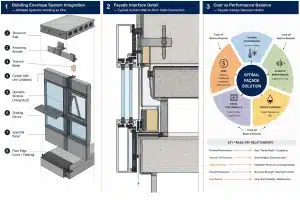
In practice, we frequently observe that curtain wall issues rarely originate from material performance deficiencies. Instead, problems usually occur at interfaces—between materials, systems, or the curtain wall and the main structure.

SunFrame therefore approaches curtain wall design primarily as a matter of interface and joint control.

  • Connections between curtain walls and the main structure
  • Load transfer between supporting systems and panels
  • Coordination of movement among different panel units

Ultimately, these interfaces determine water and air tightness, durability, and safety.

In high wind pressures, extreme temperature variations, or complex usage environments, uncontrolled interfaces often amplify risks, leading to leaks, noises, fatigue, or even structural hazards. This is why nodes and connection details are prioritized in our design process, rather than treated as afterthoughts.

2. From Points, Lines, and Surfaces to a Controllable Structural System

A curtain wall is not a collection of isolated components—it is a structural system composed of points, lines, and surfaces.

SunFrame interprets this system across three levels:

  • Points: Fasteners, anchors, and load-bearing nodes that safely transfer loads
  • Lines: Mullions and supporting members whose continuity governs overall deformation
  • Surfaces: Panel systems working in coordination to ensure façade integrity and performance

Even seemingly identical curtain wall types can behave very differently depending on building height, structural system, and environmental conditions. Our design focus is not on “reusing a standard system” but on evaluating whether the points, lines, and surfaces function correctly for each specific project.

Curtain Wall Design as Engineering Judgment (Controllable Structural System)

3. Material Selection Is a System Decision, Not a Catalog Choice

With the development of new materials and technologies, the options for curtain wall materials have grown. Yet in engineering practice, there is no absolute “best” material—only whether it suits the specific system and environment.

At SunFrame, material selection typically addresses several key questions:

  • Does it integrate with the supporting structure?
  • Does it meet local codes and durability requirements?
  • Can its maintenance and replacement be controlled over the long term?

For example, the same LOW-E glass may yield very different engineering conclusions depending on climate, energy standards, or usage patterns. Similarly, differences among metal panels, stone, or ceramic in weight, connection methods, and interface risks must all be fully evaluated during design.

SunFrame therefore focuses on how materials behave within the system, rather than isolated performance metrics.

4. Construction Type as a Risk Control Tool, Not Just Form Choice

Unitized, stick-built, and cable-supported curtain walls each have distinct engineering boundaries. In our view, choosing a construction type is fundamentally a decision on risk distribution and control strategy:

▶ Unitized curtain walls: Factory prefabrication improves consistency and installation accuracy but requires highly complete design upfront

▶ Stick-built systems: Offer flexibility for on-site adjustments but demand rigorous construction management and quality control

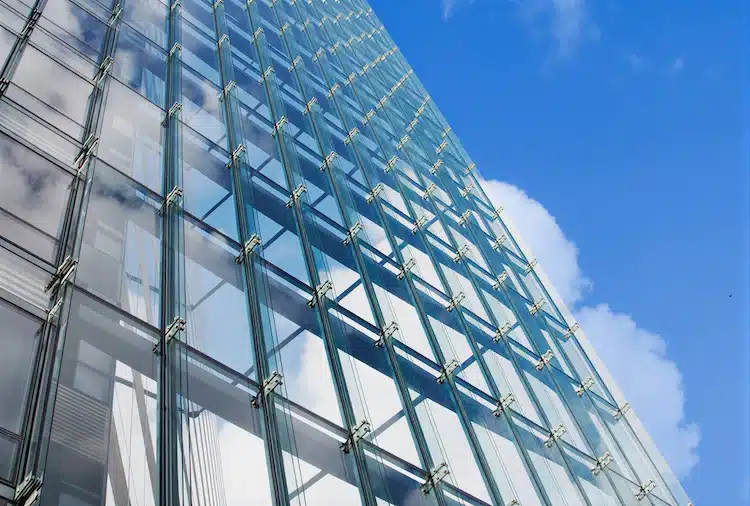
▶ Cable-supported façades: Enable transparency but are sensitive to deformation control and long-term performance

SunFrame does not preset a “best solution.” Instead, we determine which construction method provides the most controllable risk based on each project’s conditions.

Unitized curtain walls

5. Form and Function Must Be Judged Together

As the building’s “second skin,” a curtain wall is both a visual element and a functional system. Separating aesthetic design from performance design often leads to costly issues later.

At SunFrame, architectural expression, material language, and structural logic are addressed simultaneously during the design stage. Only solutions established at this stage can remain stable during construction and long-term use.

A real-world example of this approach is our work on the Burj Al Mana Tower, where bold design and precise engineering came together seamlessly. Learn more about the project →

Conclusion | Engineering Judgment Determines How Far a Curtain Wall Can Go

In high-rise buildings, complex public projects, and high-standard markets, curtain wall design has never been a purely technical issue—it is a series of engineering judgments.

SunFrame’s experience shows that what ultimately determines a curtain wall system’s long-term performance is not a specific material or construction type, but whether a clear, verifiable, and accountable engineering judgment system was established during design.

This approach forms the foundation of how we understand curtain wall engineering, participate in complex projects, and operate in markets with high standards.

Leave a Reply

Your email address will not be published. Required fields are marked *

This site uses Akismet to reduce spam. Learn how your comment data is processed.

Other Posts

Contact Us