Sunframe-Logo

Perforated Aluminum Panel Facade: Types, Cost, Installation & Applications

Perforated Aluminum Panel Facade: Types, Cost, Installation & Applications

Introduction

Perforated aluminum panels are made of pure aluminum or aluminum alloy through pressure processing (shearing, sawing), with regular cross-section and uniform thickness. They are named after the holes on the surface, and are also called perforated aluminum plates, perforated metal plates, etc.

This new material has both noise reduction and decorative functions. With its unique structural performance, it is widely used in architectural decoration, acoustic engineering and other fields.

Perforated Aluminum Panel Facade: Types, Cost, Installation & Applications

01 Key Features and Benefits of Perforated Aluminum Panels

① Strong durability

Perforated aluminum plates are resistant to high temperatures, corrosion, fire and moisture, and have good shock and chemical stability. They can still maintain their performance after long-term outdoor exposure. What’s more, their practicality is comparable to marble tiles.

② Excellent craftsmanship

Compared with other metal materials, perforated aluminum plates have a smooth surface without burrs. Also, they have superior visual and tactile textures, showing high-end quality.

③ Lightweight and convenient

Their base material are the lightweight aluminum plates and they are combined with perforated design to reduce deadweight. So they can optimize building load-bearing with their characteristics like simple process, easy installation and maintenance. They have both practical and economic value.

④ Green and environmentally friendly

Some perforated aluminum panels are 100% recyclable, which is an eco-friendly material and helps buildings obtain LEED certification. Besides, PVDF coated plates have strong oxidation resistance, resistance to harsh environments, and long service life.

⑤ Comprehensive functions

It can reduce the glass shading coefficient, filter sunlight, adjust room temperature, have good ventilation and light transmittance. The small apertures can also meet the needs. What’s more, it also has anti-theft functions.

⑥ Both viewing and safety

It can be opened flexibly to provide a wide field of vision, and act as a solid guardrail when closed, balancing viewing and safety needs.

⑦ Beautiful shape

The pattern is formed through a variety of perforation processes, with rich three-dimensional shapes and unique light and shadow effects. And so they are both practical and decorative.

⑧ Widely used

It is suitable for parking lot coverage, facility shielding and sign making. That enhances the visual appeal of the space and has both protection and temperature control functions.

02 Perforated Aluminum Panel Types for Architectural Facade Systems

In modern architectural facade and curtain wall systems, perforated aluminum panels are selected based on structural performance, aesthetic requirements, and installation system conditions.

This material choice directly determines facade efficiency, structural stability, and overall architectural expression.

2.1 Material and Technical Classification

From a perforated aluminum panel facade system perspective, material and technical classification forms the foundation of long-term durability, structural reliability, and facade performance.

☞ Alloy Composition Types

High-purity aluminum panel, pure aluminum panel, aluminum alloy panel (most commonly used in facade systems), composite aluminum panel (welded structure), aluminum-clad aluminum panel.

☞ Thickness Selection for Facade Applications

Panel thickness directly affects wind resistance, flatness, and installation stability in architectural curtain wall systems.

  • Thin plate: 0.15–2.0 mm
  • Standard facade plate: 1.0–6.0 mm (most commonly used)
  • Medium plate: 6.0–25.0 mm
  • Thick plate: 25–200 mm
  • Ultra-thick plate: >200mm

In practical facade applications, considering processing cost, self-weight, and flatness requirements, 1.0–6.0mm is the most commonly selected range.

☞ International classification

  • Aluminum plates (thickness >0.2mm, width 200–500mm)
  • Aluminum bars (width up to 600mm in some cases)
  • Aluminum foils (≤0.2mm)
Perforated Aluminum Panel - Folded plate type

LZ’s LOVE spa / T-architects ©Minh Luu

2.2 Perforation Technology Classification

Perforation technology defines facade visual identity, shading performance, and customization capability in architectural systems.

It includes both engineering-based selection methods and manufacturing-based punching classifications, depending on project requirements.

① Engineering-Based Perforation Methods (Facade Application)

CNC punching (mass facade production)

Suitable for large-scale architectural facade projects with repetitive patterns and cost-efficient production requirements.

Laser cutting (custom architectural facade patterns)

Ideal for complex facade designs requiring high precision, detailed patterns, and strong architectural expression.

Wire-cut perforation

Used for specialized architectural facade applications requiring structural detailing and unique metal shaping.

Micro-hole perforation systems

Commonly applied in facade projects requiring controlled transparency, solar shading performance, and refined visual texture.

Laser and CNC perforation are the most widely used methods in modern architectural perforated metal facade systems due to their balance of precision, efficiency, and design flexibility.

② Manufacturing-Based Punching Technology (Material Processing)

This classification defines how perforated aluminum panels are fabricated at production level.

  • Pattern punching mesh
  • Formed punching mesh
  • Heavy punching mesh
  • Ultra-thin punching mesh
  • Micro-hole punching mesh
  • Wire-cut punching mesh
  • Laser punching system

Selection depends on cost, material weight, and surface flatness requirements.

Perforated Aluminum Panel -Wave type

New Munch Museum

2.3 Perforated Aluminum Panel Types for Facade Design

Perforated aluminum panels are available in multiple geometries, including flat, folded, wavy, serrated, and short-side folded types.

These configurations influence structural behavior, module design, and facade appearance.

♢ Key Engineering Principle

Perforation ratio directly affects structural strength: higher perforation = lower strength

This relationship impacts:

  • facade module size
  • subframe (keel) system
  • structural stability
  • visual uniformity

♢ Flat Panel Type

The flat panel is the most widely used form in facade systems due to its simple fabrication and flexible perforation layout.

Advantages:

  • High design flexibility and easy pattern creation
  • Strong transparency effect
  • Clean and minimal architectural appearance

Limitations:

  • Reduced structural strength in large formats or high perforation ratios
  • Requires thicker panels or additional subframe support

♢ Folded Panel Type

Folded panels improve structural rigidity through geometric deformation.

Common forms include concave–convex folding and zigzag folding. 

Advantages:

  • Higher structural rigidity
  • Reduced joints and facade divisions
  • Lower subframe (keel) demand
  • Improved installation efficiency

Folded systems are widely used in high-rise buildings and large-span curtain wall applications, where both structural performance and cost efficiency are required.

♢ Hole Pattern Design (Punching Variation)

Perforation patterns in aluminum facade systems are highly customizable, allowing control over transparency, shading, and visual texture.

Hole size, spacing, and density directly influence transparency, shading performance, and facade expression.

Common perforation shapes include round, square, diamond, slot, hexagonal, triangular, and custom irregular patterns.

These variations enable different levels of transparency and architectural surface detail in facade design systems.

03 Construction process and installation nodes

3.1 Perforation Methods

Common fabrication methods used in perforated aluminum facade production include:

  • CNC punching
  • Stamping process
  • Laser cutting
  • Water jet cutting

These methods are applied according to production efficiency, material specifications, and project complexity.

3.2 Perforation Rate & Aperture

Perforation rate refers to the ratio of open area to total panel surface.

It is a key parameter affecting facade performance, including:

  • visual transparency
  • shading control
  • energy efficiency
  • panel flatness

Typical performance parameters:

  • Maximum perforation rate: up to 60%
  • Standard panel size: up to 1500 × 3000 mm (larger panels require secondary processing)

Aperture size and spacing directly define visual texture and light control.

Most commonly used specification:

  • 6mm hole diameter
  • 15mm spacing

Combined control of aperture, spacing, and perforation rate determines facade visual density and light permeability.

3.3 Structural System & Installation Method

Due to the relatively thin structure of perforated aluminum panels, a supporting subframe system is required for facade installation.

Typical structural system:

Main structure → Subframe (keel system) → Perforated aluminum panel

Common connection methods include:

  • Bolted fixing (most widely used, allows disassembly)
  • Rivet connection (stable mechanical fastening)
  • Welding (permanent fixing for special applications)
  • Adhesive bonding (limited use in specific facade systems)

Modern facade systems mainly adopt mechanical fixing solutions, which allow easier installation, maintenance, and future replacement while ensuring structural stability.

04 Cost of Perforated Aluminum Panels

The cost of perforated aluminum panels is primarily influenced by three key factors: alloy composition, panel thickness, and perforation pattern complexity.

  • Alloy composition: Higher-grade aluminum alloys increase material cost
  • Panel thickness: Thicker panels require more material and processing cost
  • Perforation pattern: Complex or customized hole designs increase fabrication difficulty and production time

In facade applications, the typical cost of perforated aluminum panels ranges from 800–1500 RMB per square meter.

Note: This range is indicative only. Final pricing varies depending on market conditions, project scale, and technical specifications.

05 Wide applications

The perforated aluminum sheet has a rich variety of hole types and arrangements, and has both beautiful shapes and excellent decorative effects. It can fully meet the creative needs of architects and designers and give the building a unique style.

It is not only elegant in color, but can also be used in public buildings such as hotels and cinemas and mid-to-high-end residences to optimize sound quality. Besides, it is also suitable for noise reduction in workshops, factories, civil air defense basements and other places. It is a popular product in the decoration market in recent years.

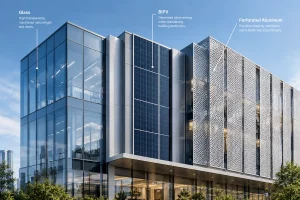
5.1  Exterior facade curtain wall

The library of Chongqing Real Estate Vocational College combines glass curtain wall with perforated metal panel to create a distinctive facade.

The interior of the library’s large roof incorporates the concept of “starry sky”. Four patterns are designed on the perforated aluminum panel. After density changes and careful arrangement, it presents a “nebula” effect.

All aluminum plates are spliced with a standard size of 2000mm×1200mm. The inner surface of the north roof consists of four perforated aluminum panels and one solid aluminum panels, a total of five patterns.

Among them, the four perforated plates are divided into four categories, ABCD, according to the density of the opening rate. On this basis, four types of perforated aluminum panels corresponding to 180-degree rotation, A’B’C’D’, are added, and a total of nine types of aluminum plates are distributed in an orderly manner.

Perforated Aluminum Panel- Exterior facade curtain wall

Real picture of entrance perforated aluminum panel application ©PH-Alpha Design

5.2 Interior decoration

Perforated aluminum plates have become an ideal material for interior decoration due to their strong plasticity.

Take the design practice of Wutopia Lab as an example. In a renovation project of an old industrial area in Shanghai, it cleverly uses perforated aluminum plates to create a three-dimensional green landscape.

The designer uses perforated aluminum plates as “brush and ink” and uses the freehand landscape technique to organically connect the building facade, landscape, lobby, office area and roof. And that constructs a three-dimensional, coherent and complete green landscape scroll, showing the unique charm of perforated aluminum plates in shaping space art.

Perforated Aluminum Panel- Interior decoration

Shanghai Gaohe Yunfeng Office Building Interior ©CreatAR

5.3 Ceiling design systems

The perforated aluminum panel on the top of the lobby of Chongqing Longhu Chenlinjian and the tree-shaped projection design fully show the philosophy of life and the immeasurable sense of ritual in life.

Perforated Aluminum Panel- Ceiling design

5.4 Staircase and Structural Applications

The stair railings of Hangzhou Yunhe Vanke Center Innovation Experience Center are made of orange perforated aluminum panels. This bold color and strong sculptural stair system visually creates the impression of supporting a floating circular building inside. And it becomes the visual focus in the space, guiding people to walk up and down inside the building.

Perforated Aluminum Panel- Staircase design

Atrium staircase of Hangzhou Canal Vanke Center Innovation Experience Center © Lu Yong

5.5 Balcony and Safety Railing Systems

The balcony of the apartment below is innovatively designed with perforated aluminum panels. The panel system was fully manufactured when it was delivered to the site, and can be installed very quickly and easily. Not only is the lighting and ventilation good, but privacy and fall protection can also be guaranteed.

Perforated Aluminum Panel -Balcony railing design

©Ong Chan Hao

06 Tips for selecting the perforated aluminum panels

When selecting perforated aluminum panels for a project, you need to pay attention to the following items:

6.1 Choose aperture based on visual and environmental goals

Start by defining the facade’s primary function:

  • If daylight control is required → use smaller apertures with higher density
  • If visibility is important → use larger apertures with lower density
  • If shading is critical → optimize perforation ratio instead of only hole size

▶ Focus on balancing transparency and solar control, not just aesthetics.

6.2 Select panel type based on structural span and module size

Panel geometry should follow the facade scale:

  • Flat panels → suitable for small to medium modules with simple layouts
  • Folded panels → preferred for large spans or reduced subframe systems
  • Complex shapes → used when visual expression is a priority

▶ Structural span should drive panel selection, not the other way around.

6.3 Define thickness according to wind load and installation height

Thickness should be matched with structural demand:

  • Low-rise buildings → standard 1.0–3.0 mm panels are sufficient
  • High-rise facades → thicker panels improve wind resistance
  • Large modules → require higher rigidity to avoid deformation

▶ Avoid overdesigning thickness, as it increases cost and weight.

6.4 Confirm system detailing at early design stage

Before fabrication, define:

  • whether reinforcement ribs are required
  • how panels connect to subframe systems
  • whether maintenance access is needed

▶ Early coordination reduces installation errors and long-term maintenance issues.

Need Support With Curtain Wall Materials or Installation?

SunFrame’s team can assist you in selecting, fabricating, and installing high-performance facade systems and innovative material solutions for your facade projects.

Leave a Reply

Your email address will not be published. Required fields are marked *

This site uses Akismet to reduce spam. Learn how your comment data is processed.

Other Posts

Contact Us