Curtain Walls Under Tropical Water Exposure
Curtain Walls Under Tropical Water Exposure — Water as a constant environmental condition in Southeast Asia In Southeast Asia, building envelopes operate under a consistently
In the commemorative context of ANZAC Day, the relationship between architecture and the city is closely linked to memory, visibility, and spatial perception.
The evolution of building façades can also be understood through the question of how architecture is seen.
In contemporary cities, curtain wall systems do more than change the appearance of buildings. They also redefine the cost of recognizing a building within the urban environment.
Buildings or temporary structures in wartime conditions typically share similar visual characteristics:
The main purpose of this system is to reduce visual signals and make structures harder to identify.
At this stage, the external interface mainly functions as a layer of concealment.
As urban structures become more complex, buildings begin to take on different spatial roles.
They gradually participate in the city’s recognition system by:
Building façades start to influence how the city is visually understood.
When rapid recognition is required, façade expression becomes a variable that must be carefully controlled.
The introduction of curtain wall systems transforms the building envelope from a concealment interface into an information-organizing interface.
This transformation is reflected in several aspects:
The widespread use of glass establishes visual continuity between interior and exterior spaces.
Interior activities become part of the external visual composition.
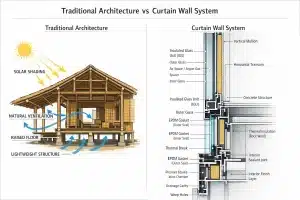
Curtain wall systems consist of multiple components:
Together, they create a layered façade structure.
The grid structure of façades introduces a stable visual rhythm.
This rhythm influences how building scale and proportion are perceived.
Curtain wall systems change how buildings are perceived.
A building is no longer read as a single mass but as a visual system that can be broken down and interpreted.
In this process, a persistent tension becomes visible:
Greater transparency improves spatial openness, while also making precise recognition more difficult.
Different façade strategies create different spatial impressions:
Buildings become readable elements within the urban environment. Curtain wall systems therefore function as a key mechanism for balancing openness and recognizability.
In Australian cities, the visual role of curtain wall systems is particularly evident.
Within the commemorative axis represented by the Australian War Memorial in Canberra, buildings achieve visibility through spatial order. In contrast, in denser cities such as Sydney and Melbourne, recognition depends more on the curtain wall system itself.
Key conditions include:
Façade systems therefore play a stronger role in visual positioning within the city.
The evolution of façades can be summarized as a clear sequence:
This progression reflects a shift in how architecture is visually perceived.
Curtain wall systems influence architecture not only at the level of enclosure but also at the level of visual organization.
They shape the relationship between buildings and the city and participate in constructing the overall visual structure of the urban environment.
In this sense, curtain wall systems are shifting from traditional enclosure systems to interfaces that actively participate in the distribution of urban visibility.
Discuss your project requirements with our team and explore facade solutions that balance visibility, performance, and architectural intent.

Curtain Walls Under Tropical Water Exposure — Water as a constant environmental condition in Southeast Asia In Southeast Asia, building envelopes operate under a consistently

Curtain Wall Color Durability: From Aesthetics to Performance As Easter approaches, the colors of spring begin to fill urban spaces. From the playful decorations of

How Modern Facades Shape Space Through Light and Acoustics In a hotel lobby in the early morning, sunlight passes through the glass façade and settles

BIPV Façades for Nighttime Urban Spaces During Ramadan, urban rhythms across the Middle East shift noticeably. Daytime activity slows, while commercial and religious spaces become