Sunframe-Logo

Metal Facade Systems as a Medium of Brand Architecture

— An Observation on Geometric Expression and Constructive Order

The facade of a commercial space is often the first architectural interface through which a brand is perceived.

This perception relies on order — and order must be realized through structure.

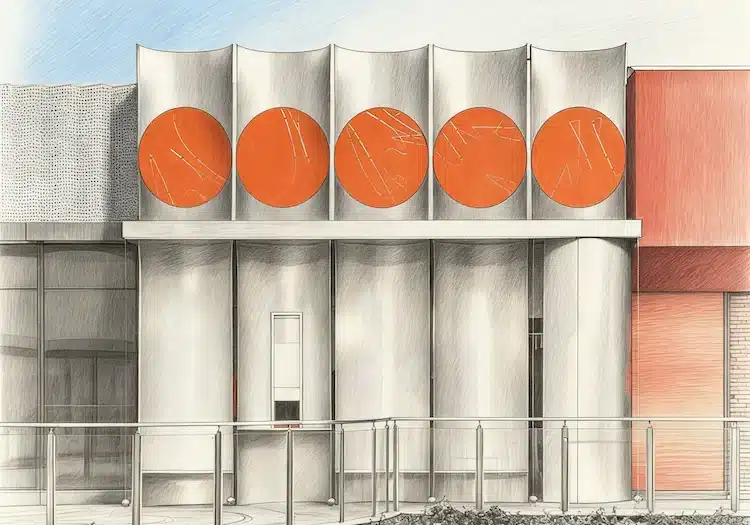
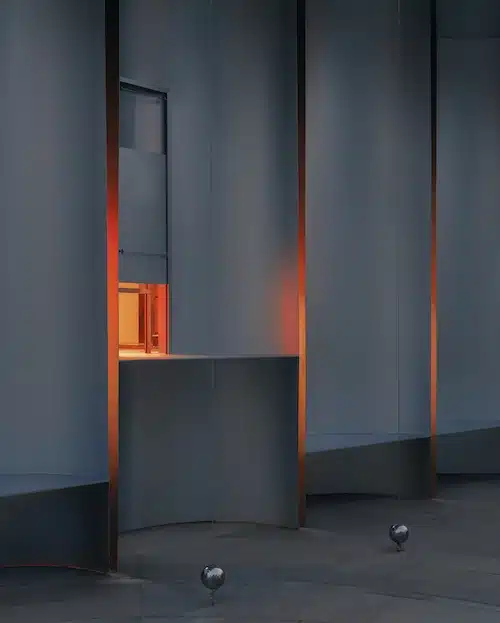
Café On-Site in Wenzhou, designed by aptdotapt, provides a clear example. Its front facade features five repeated semi-circular volumes, creating a rhythmic interface that establishes a stable, recognizable geometric identity at street scale.

Sketch showing geometric metal facade systems used to translate brand identity into architectural design

Café On-Site curved metal facade design in Wenzhou (Source: aptdotapt / Photo: Zhu Yumeng)

The repeated semi-circular volumes translate the brand’s geometric motifs into architectural scale, serving as a reference for the analysis below.

This project raises a question worth examining:

When a brand’s visual language enters architectural scale, how does it transform into a facade system that is buildable, maintainable, and sustainable?

01 Geometric Compression of Brand Structure

Brand concepts such as “field,” “aggregation,” or “energy” are translated into geometric motifs: circles, arcs, repetition, and thickness.

When geometry becomes the core design grammar, the facade gains three fundamental characteristics:

  • Recognizable rhythm
  • Continuity of modules
  • Controllable proportional relationships

Repetition establishes order; order establishes memory.

Here, geometry functions as a structural framework, giving the brand concept spatial dimension.

02 Geometry Enters the Construction System

Once geometry acquires volume and thickness, it enters the realm of construction.

Curved facades typically rely on a collaboration between metal panels and internal support systems. For example, custom-bent aluminum panels paired with a steel frame can maintain surface precision and weather resistance while controlling overall weight.

When the construction strategy aligns with the geometric logic, the technical system becomes part of the expression. Key considerations include:

  • Matching curvature with fabrication capabilities
  • Maintaining geometric order across joints
  • Module standardization
  • Allowances for lighting and maintenance access
  • Thermal expansion and contraction management

When constructive logic follows geometric order, structure and brand speak the same language.

Geometric Facade Design

Local perspective illustrating geometric order and joint logic (Source: aptdotapt / Photo: Zhu Yumeng)

03 Facade as an Urban Interface

In complex urban contexts, the front facade establishes a sense of boundary through solid volumes. Repeated semi-circles create a stable rhythm, and shadow depth reinforces recognition.

The metal system delivers clear outlines, structural support, and long-term durability, ensuring continuity in the facade’s expression.

When geometric order aligns with construction logic, the facade expression rests on a stable structural foundation.

Brand expression only achieves long-term value when validated through constructive order.

This perspective allows brand and technical considerations to enter a unified discussion.

04 Synchronized Logic of Brand and Technology

Facade design often unfolds in two stages: concept and development. If construction is considered only after geometry is finalized, the design can drift during implementation.

By simultaneously evolving constructive logic with geometric definition, the following aspects are addressed:

  • Panel segmentation logic
  • Support systems
  • Module control
  • Maintenance and drainage strategies

The facade order remains intact after construction.

Brand structure and technical structure follow the same developmental path.

Conclusion

A brand enters architecture through geometry.

Geometry enters reality through construction.

When structural order becomes the basis of expression, metal facade systems are no longer just a material choice — they become a medium for realizing the brand.

In facade design, our focus remains on this alignment of logic — ensuring expression remains clear under the dual verification of time and structure.

Realizing Complex Metal Facade Systems

Architectural concepts often begin with geometry and spatial expression.

SunFrame works with project teams to transform these ideas into buildable metal facade systems through engineering development, precision fabrication, and coordinated installation.

If your project involves curved geometry or customized metal facade structures, our team can assist in the technical realization and execution process.

Project reference: Café On-Site, Wenzhou
Architect: aptdotapt
Photography: Zhu Yumeng

Leave a Reply

Your email address will not be published. Required fields are marked *

This site uses Akismet to reduce spam. Learn how your comment data is processed.

Other Posts

Contact Us