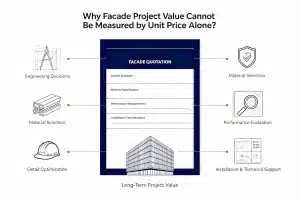
Why Facade Project Value Cannot Be Measured by Unit Price Alone?
Why Facade Project Value Cannot Be Measured by Unit Price Alone? Introduction When evaluating a facade solution, unit price is often one of the first
When you receive a façade specification with numbers such as thermal conductivity, thermal resistance, and U-value, how do you read them?
Do you simply compare the values and look for the better-performing material?
Or do you first consider what each number represents and where it applies?
These numbers are essential to understanding façade thermal performance. But knowing how to interpret them is just as important as knowing what they are.
The first step is to identify exactly what a thermal value describes.
♦ Thermal conductivity (W/m·K) — how readily heat passes through a material
It helps us understand the inherent thermal behavior of a specific material.
♦ Thermal resistance (m²·K/W) — the resistance of a material or layer to heat flow
It indicates how effectively a material or layer resists heat transfer.
♦ U-value (W/m²·K) — the rate of heat transfer through a building element or assembly
It is used to evaluate the thermal transmittance of a specific construction.
These values answer different questions because they describe different thermal properties.
Before asking whether a number is good or bad, ask:
What exactly does this number measure?
Material values describe the material itself; component and assembly values describe performance within the larger construction.
The numbers may be related, but they should not be treated as interchangeable.
Façade thermal data can describe different levels of a façade:
Level | Typical Examples | What It Tells Us |
Material | Thermal conductivity, thermal resistance | Thermal properties of a specific material |
Component | Profile, glazing unit, insulated panel | Thermal performance of an individual component |
System | Curtain wall, façade assembly | Thermal performance of multiple components working together |
Detail | Connections, slab edges, corners, interfaces | How local details affect thermal performance, including thermal bridging |
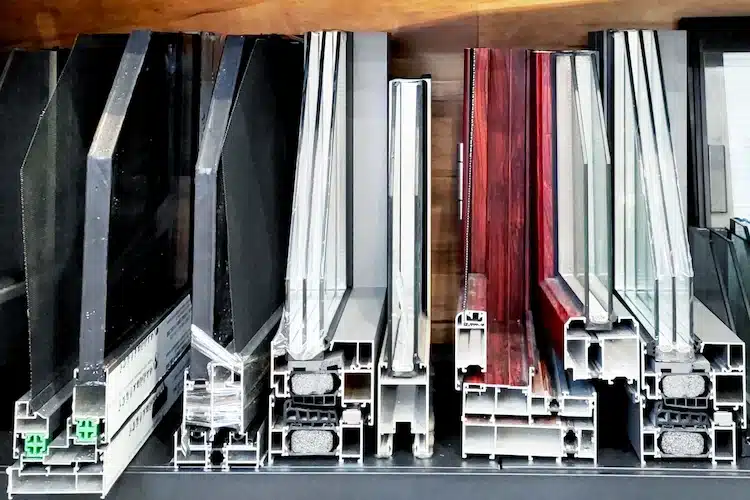
For example, a thermal break material with a low thermal conductivity may help reduce heat transfer through an aluminum profile. But its contribution to the overall façade performance also depends on its position, geometry, and integration with the surrounding components.
Before using a thermal value to evaluate a façade, ask:
What level of the façade does this data actually represent?
Two products may report similar thermal values, but can those values be compared directly?
Before comparing them, check three things:
① Standard — Which standard was used?
② Method — Was the value measured or calculated?
③ Scope — What exactly does the value cover?
For example, two thermal break materials may report different thermal conductivity values. Before deciding which one performs better, first confirm that the values were obtained using comparable methods and refer to the same property.
Before comparing the numbers, make sure they are based on comparable standards, methods, and scopes.
Once we understand what a thermal value represents and how it was determined, the next question is:
How does this property contribute to the actual façade assembly?
Consider a thermal break in an aluminum curtain wall profile. Its thermal conductivity describes the material itself, but its effect on the façade also depends on how it is incorporated into the profile.
Several factors can influence the resulting thermal performance:
For example, increasing the width of a thermal break may reduce heat transfer through part of the profile. However, the overall result also depends on the other conductive paths within the assembly.
This is why a material property should be read together with the configuration in which the material is used.
Once the façade assembly is considered as a whole, the next step is to understand where heat can actually travel.
In a curtain wall, heat transfer can occur through several typical paths:
Aluminum
Mullions, transoms, pressure plates
➡️
Connections
Brackets, fasteners, anchors
➡️
Insulated Zones
Continuous metal components crossing insulated areas
➡️
Junctions
Slab edges, corners, frame-to-wall interfaces
These paths can interact and create localized areas of increased heat transfer, known as thermal bridges.
The location and configuration of these paths can therefore affect the thermal performance of the façade, even when the material specifications remain unchanged.
Where these effects are significant, they may need to be evaluated through detailed thermal analysis rather than material data alone.
A glazing specification may provide a U-value for the glass or insulating glass unit. This value describes the glazing itself, but not necessarily the thermal performance of the complete glazed opening.
Glass / IGU U-value
→ Describes the thermal transmittance of the glazing unit
Glazed opening performance
→ Reflects the combined performance of the glazing, frame, and relevant edge conditions
The same glazing can therefore contribute to different overall results depending on the surrounding assembly.
When reading a glazing U-value, ask:
What part of the glazed assembly does this value represent?
Thermal performance also needs to be evaluated against the requirements of the project.
The same façade configuration may be evaluated differently depending on the project.
Relevant conditions may include:
A façade configuration that meets one project’s requirements may require a different approach for a project with more demanding thermal targets.
There is no single thermal performance value that is “good” for every project.
The more useful question is:
Is this performance sufficient for the project?
That question connects technical data with an actual engineering requirement.
A thermal value can help determine what information to examine next.
For example, a thermal break conductivity value may be enough to compare two materials at the material level.
But if the decision concerns the thermal performance of a complete curtain wall, the next questions may include:
Good technical evaluation focuses on the information that matters to the decision.
This turns technical data from a collection of numbers into a basis for further evaluation.
A single thermal value rarely provides enough information for a complete façade decision.
Engineering judgment comes from connecting the available information and understanding how each piece contributes to the overall assessment.
Each additional piece of information adds context, helping us see how the material, component, system, detail, and project requirements relate to one another.
A practical way to think about the process is:
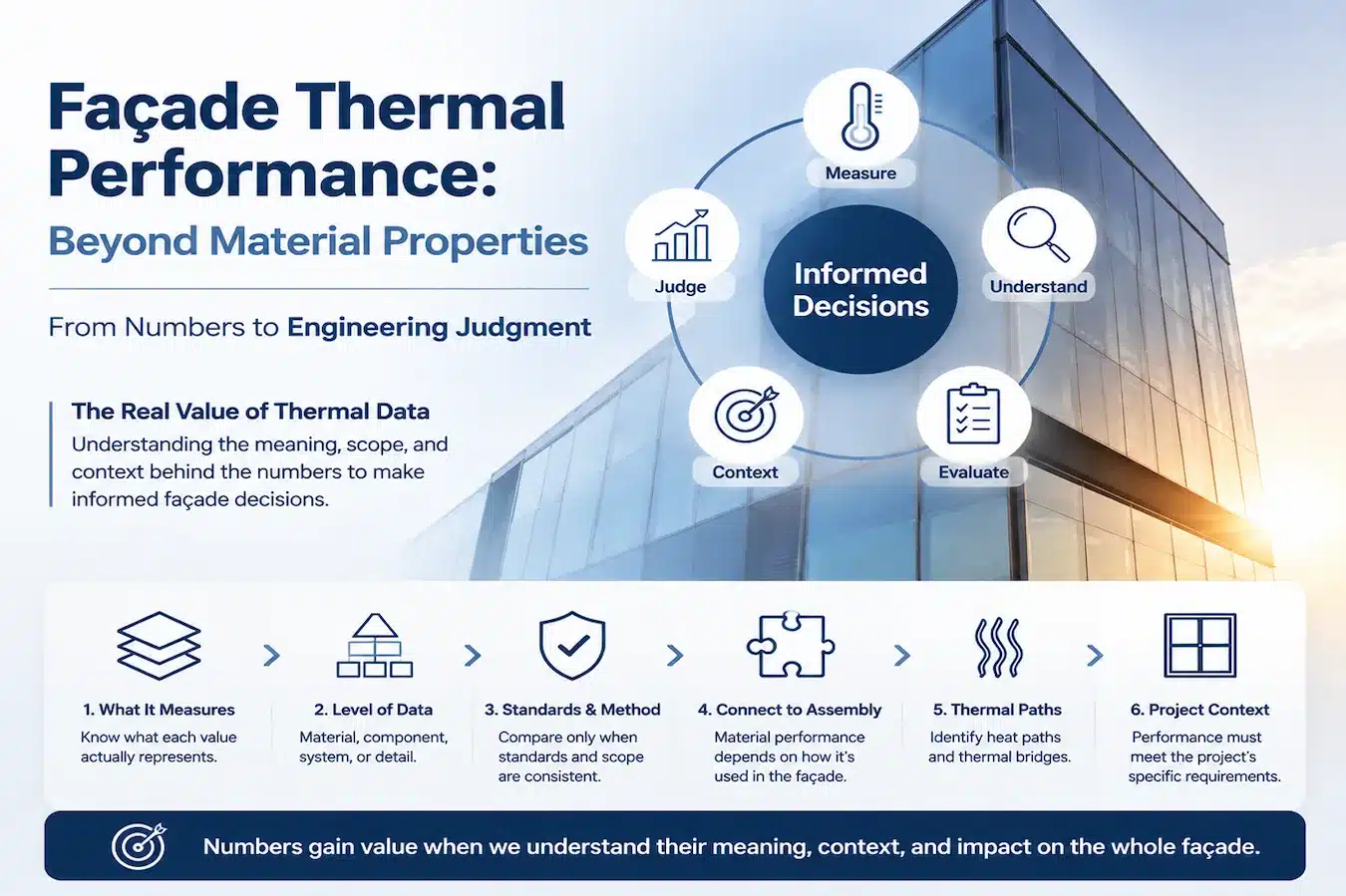
Data → Meaning → Scope → Context → Relationships → Judgment
The process starts with a number. Engineering judgment comes from understanding what that number means, how it relates to the rest of the façade, and whether the resulting performance meets the needs of the project.
Thermal conductivity, thermal resistance, and U-values provide different layers of information about façade thermal performance.
Their value comes from understanding their meaning, scope, relationships, and relevance to the project.
When these data are read together with the façade configuration, thermal paths, and project requirements, they become a basis for engineering judgment.
The real value of thermal data lies in turning numbers into informed decisions.
If you are planning a residential, commercial, or infrastructure facade project and require curtain wall engineering, system development, or installation support, SunFrame can assist from early design coordination to project execution — helping ensure reliable, well-engineered facade performance throughout the building lifecycle.

Why Facade Project Value Cannot Be Measured by Unit Price Alone? Introduction When evaluating a facade solution, unit price is often one of the first

Façade–Structure Interface: Why Do So Many Problems Start Here? Introduction The façade–structure interface is where façade design meets the actual conditions of the building structure.

Beyond Construction Volume: The Future of Façade Industry Growth Introduction For decades, growth in the façade industry has been closely tied to construction volume. More
5 Overlooked Risks During Unitized Curtain Wall Hoisting Introduction Unitized curtain wall hoisting is a critical stage where factory-fabricated panels are installed into their final