Sunframe-Logo

Hotel Façade Design: Why Different Hotel Types Require Different Façade Strategies

Introduction

Looking across SunFrame’s Hotel & Hospitality Facades Projects, one interesting observation stands out. Although they all belong to the same project category, each project reflects a different façade approach.

This raises an important question: what drives these differences?

This article explores how hotel façade design strategies are influenced by different hospitality project requirements.

Hotel Facade Design

Five Hospitality Projects at a Glance

Project

Hotel Type

Location

SunFrame Scope

Raffles Hotel Sentosa

Luxury Resort

Singapore

Glass curtain wall & aluminum louver supply

Pegasus Hotel

Business Hotel

Guyana

Unitized curtain wall design, fabrication & installation

Sheraton Hotel Cebu

International Hotel Brand

Philippines

Façade & interior aluminum systems

Camiguin Nouveau Resort

Coastal Resort

Philippines

Exterior aluminum systems for resort buildings

IKA Hotel

Urban Hotel

Angola

Site measurement, product supply, logistics coordination & installation

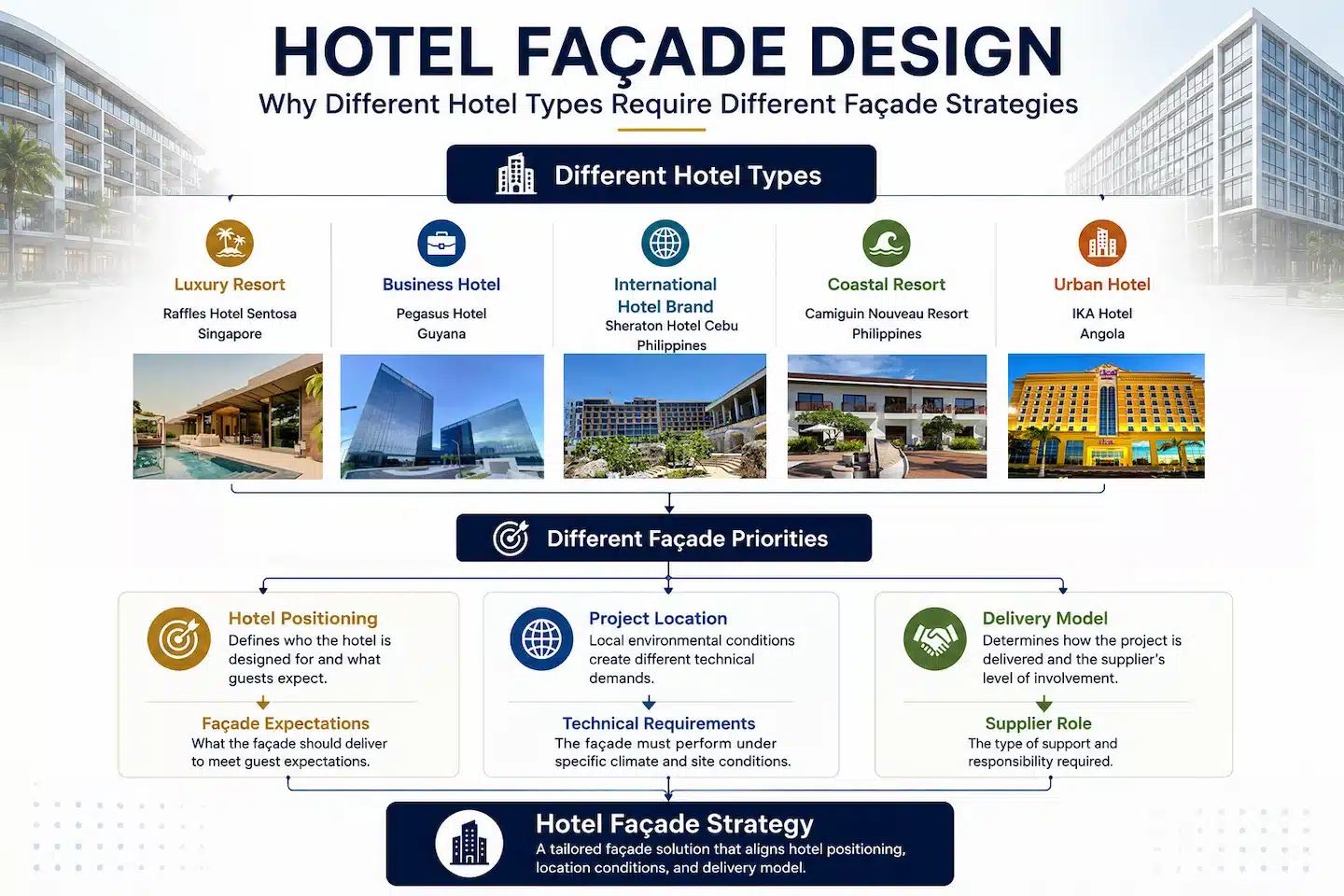
Although these projects belong to the same building category, their façade strategies differ in meaningful ways. A closer comparison helps explain why.

Different Hotel Types, Different Façade Priorities

Hotels share the same basic function of providing accommodation and guest services, but each hospitality project has its own requirements for façade design.

A comparison of these hospitality projects illustrates how façade priorities vary across different hotel types.

Hotel Type

Main Façade Priorities

Representative Project

Luxury Resort

Guest comfort, architectural quality, acoustic and thermal performance

Raffles Hotel Sentosa, Singapore

Business Hotel

Construction efficiency, installation speed, structural performance

Pegasus Hotel, Guyana

International Hotel Brand

Integrated façade solutions and consistent architectural appearance

Sheraton Hotel Cebu, Philippines

Coastal Resort

Weather resistance, corrosion protection, indoor-outdoor connection

Camiguin Nouveau Resort, Philippines

Urban Hotel

Practical performance, reliable installation, daily operation

IKA Hotel, Angola

These differences show that façade strategies are closely connected with the specific requirements of each hospitality project.

The reasons behind these variations can be traced to three key areas: hotel positioning, project location, and delivery model.

01- Hotel Positioning Shapes Façade Expectations

Hotel positioning defines who the hotel is designed for. Different target guests bring different expectations, and those expectations influence what the façade is expected to deliver.

Across these five projects, the relationship can be seen in different ways:

♦ Luxury Resort (Raffles Hotel Sentosa): Luxury resorts target guests seeking relaxation and premium hospitality. This places greater emphasis on daylight, thermal comfort, acoustic performance, and refined architectural quality.

♦Business Hotel (Pegasus Hotel): Business hotels serve travelers who value efficiency, convenience, and reliability. As a result, construction efficiency, structural performance, and dependable project delivery become key façade priorities.

♦ International Hotel Brand (Sheraton Hotel Cebu): International hotel brands focus on delivering a consistent brand experience across different markets. This increases the importance of coordinated façade systems and a unified architectural appearance.

♦ Coastal Resort (Camiguin Nouveau Resort): Coastal resorts are centered around leisure and close interaction with the surrounding environment. Façade design therefore places greater emphasis on weather resistance, corrosion protection, and seamless indoor-outdoor connections.

 Urban Hotel (IKA Hotel): Urban hotels are typically developed for practical, everyday accommodation. Their façades often emphasize durability, reliable operation, and long-term maintainability.

Beyond hotel positioning, project location introduces additional façade design considerations.

02- Different Locations Create Different Technical Requirements

Local environmental conditions directly affect façade performance requirements and technical solutions.

These variations lead to different technical considerations:

★  Singapore (Raffles Hotel Sentosa): Located in a highly developed tropical environment, the project required façade solutions that could balance solar exposure, indoor comfort, and energy performance in a luxury hospitality setting.

★  Guyana (Pegasus Hotel): As a large-scale coastal development in the Caribbean region, the project required façade systems capable of meeting structural performance requirements while supporting efficient installation for a major building envelope.

★  Tropical Philippines (Sheraton Hotel Cebu): The warm and humid climate increased the importance of durable aluminum systems that could maintain performance under long-term hospitality use.

★  Coastal Philippines (Camiguin Nouveau Resort): The marine environment created additional challenges for exterior materials, making corrosion resistance, weather protection, and long-term durability essential considerations.

★  Angola (IKA Hotel): The local project environment and construction conditions required practical façade solutions supported by coordinated measurement, logistics, and installation processes.

These examples highlight the need for façade solutions to adapt to the specific challenges and conditions of each project location.

03- Different Delivery Models Create Different Supplier Roles

The role of a façade supplier depends on how project responsibilities are divided among developers, contractors, local teams, and specialist suppliers.

Different delivery models create different levels of supplier involvement:

● Technical Supply Partner (Raffles Hotel Sentosa)

For projects where local contractors or installation teams manage site execution, façade suppliers may contribute through specialized product supply and technical coordination.

For Raffles Hotel Sentosa, SunFrame supplied glass curtain walls and aluminum louvers for key hotel areas. The project required high-performance façade products, precise coordination, and reliable international supply management to meet the expectations of a luxury hospitality development.

● Integrated Façade Partner (Pegasus Hotel)

For projects where façade systems are closely connected with overall building delivery, suppliers may take responsibility from design development to fabrication and installation.

For Pegasus Hotel, SunFrame provided a complete unitized curtain wall solution, including design, fabrication, and installation, supporting a large-scale façade execution process.

● Multi-System Façade Partner (Sheraton Hotel Cebu)

Some hospitality projects involve multiple façade-related products that need to work together as a coordinated system.

For Sheraton Hotel Cebu, SunFrame supplied and installed various aluminum systems, including windows, doors, railings, and other façade elements, helping maintain consistency across different building components.

● Exterior Solution Partner (Camiguin Nouveau Resort)

Resort projects often require diverse exterior solutions that respond to architectural concepts and environmental conditions.

For Camiguin Nouveau Resort, SunFrame supplied multiple aluminum products, including sliding doors, folding systems, railings, canopies, and other exterior elements designed for coastal conditions.

● Project Support Partner (IKA Hotel)

For projects requiring stronger site coordination, façade suppliers may extend their role beyond manufacturing.

At IKA Hotel, SunFrame supported the project through site measurement, product supply, logistics coordination, and installation, helping connect factory production with on-site execution.

One Shared Goal Across Every Hospitality Project

Despite their different façade strategies, all hospitality projects share the same goal: creating a building envelope that supports guest experience, operational needs, and long-term performance.

The way this goal is achieved varies by project, depending on hotel positioning, location, and delivery requirements.

Conclusion

The five hospitality projects demonstrate that hotel façade design is shaped by more than building type alone.

  • Hotel positioning defines façade expectations.
  • Project location drives technical requirements.
  • Delivery models determine supplier involvement.

Successful façade strategies are developed by aligning these factors with the specific goals of each hospitality project.

Work With SunFrame on Your Next Facade Project

If you are planning a residential, commercial, or infrastructure facade project and require curtain wall engineering, system development, or installation support, SunFrame can assist from early design coordination to project execution — helping ensure reliable, well-engineered facade performance throughout the building lifecycle.

Leave a Reply

Your email address will not be published. Required fields are marked *

This site uses Akismet to reduce spam. Learn how your comment data is processed.

Other Posts

Coastal Façades Across Five Regions

Coastal Façades Across Five Regions

Coastal Façades Across Five Regions Eight projects. Diverse marine environments. One continuously evolving engineering experience. Coastal developments are found across a wide range of climates,

Read More »

Contact Us