Curtain Wall Waterproofing: Is It a Material Failure or a System Failure?
Curtain Wall Waterproofing: Is It a Material Failure or a System Failure? Introduction When curtain wall leakage occurs, inspection typically covers both material and system
Air tightness is a key performance requirement of curtain wall systems.
Standardized testing helps verify whether a curtain wall system meets the specified air leakage criteria. However, achieving the desired level of air tightness relies on more than test results. It requires coordination between system design, fabrication accuracy, and installation quality.
Air tightness testing evaluates how effectively a curtain wall system controls air infiltration under specified pressure conditions.
During the test, a controlled pressure difference is applied across the façade to simulate wind pressure, and the measured air leakage rate is compared with project requirements or applicable standards.
The test mainly assesses potential air leakage paths at critical areas such as panel joints, framing connections, gaskets, and sealed interfaces, providing valuable insight into the overall performance of the curtain wall system.
While air tightness testing provides an important verification of curtain wall performance, actual building conditions involve more variables than a controlled testing environment.
Factors such as installation conditions, interfaces with other building components, workmanship consistency, and structural movement over time can influence the overall air control performance of a façade system.
For example, variations in installation details and building movement caused by thermal expansion, wind loads, and structural behavior may affect how sealing components and connections perform over time.
These factors highlight the importance of considering real-world conditions throughout the project process.
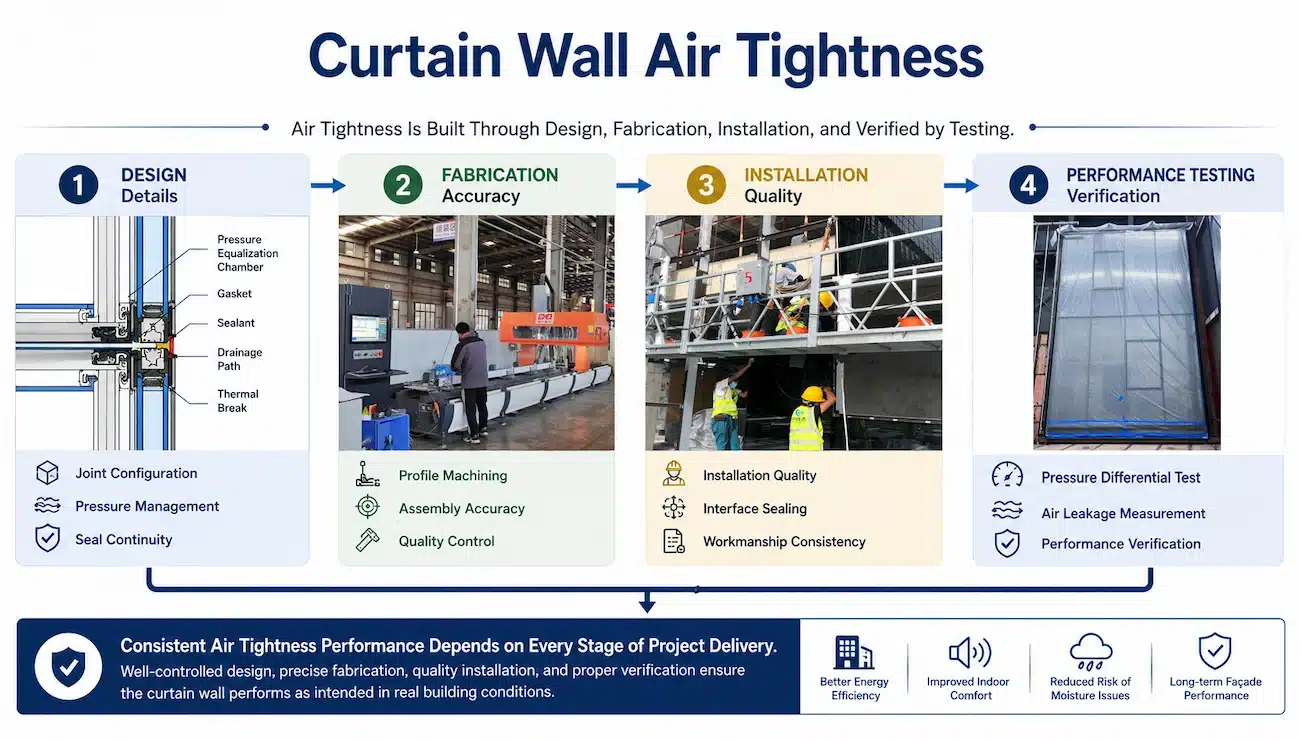
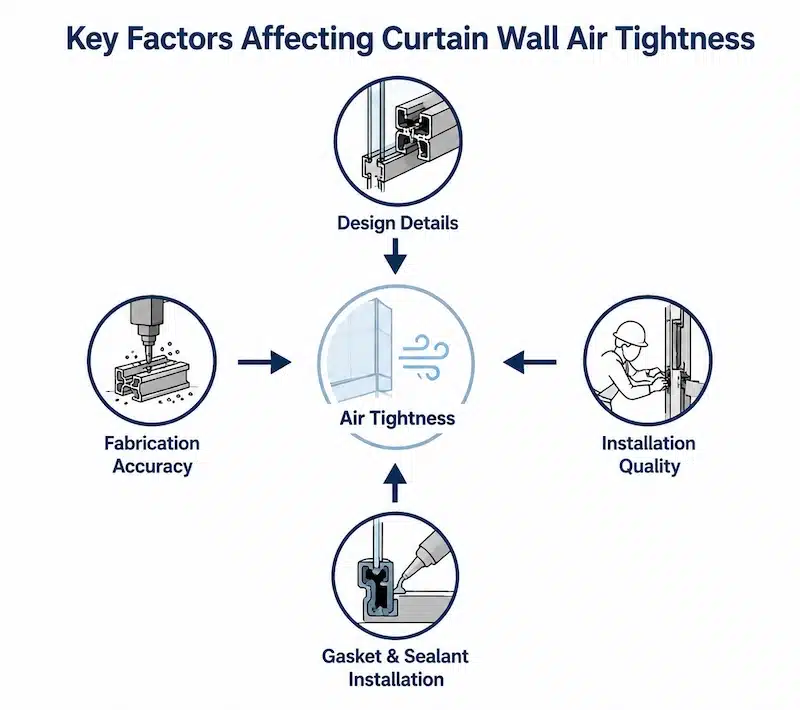
Several factors contribute to curtain wall air tightness performance, from system design and fabrication accuracy to installation quality.
Proper system design sets the foundation for air tightness performance. Critical considerations include joint configurations, pressure management strategies, sealing approaches, and interfaces between different façade components.
Well-developed details help ensure that air movement is controlled and potential leakage paths are properly addressed during the design stage.
Manufacturing precision is essential for consistent façade performance.
Accurate profile processing, machining, and assembly support proper fit and alignment of curtain wall components, joints, connections, and sealing elements before installation.
Gaskets and sealants play an important role in controlling air movement within a curtain wall system. Their performance is influenced by correct selection, positioning, compression, and installation quality.
Proper sealing practices provide continuous sealing at joints and interfaces where potential air leakage paths may occur.
Even well-designed and accurately fabricated curtain wall systems rely on proper installation to perform as intended. Site conditions, alignment, connection details, and interface treatment affect the final façade performance.
Air tightness is often measured as an air leakage rate, but its real value lies in how it influences the overall behavior of the building envelope throughout its service life.
① More predictable building performance by reducing unintended air movement through the façade.
② Better indoor environmental stability by limiting uncontrolled air exchange.
③ Lower moisture migration within the building envelope by restricting one of the primary pathways for moisture transport.
④ Greater long-term façade reliability by helping sealing systems maintain their intended function over time.
Air tightness testing establishes a performance benchmark, while the quality of design, fabrication, and installation determines how consistently that benchmark can be achieved in practice.
If you are planning a residential, commercial, or infrastructure facade project and require curtain wall engineering, system development, or installation support, SunFrame can assist from early design coordination to project execution — helping ensure reliable, well-engineered facade performance throughout the building lifecycle.

Curtain Wall Waterproofing: Is It a Material Failure or a System Failure? Introduction When curtain wall leakage occurs, inspection typically covers both material and system

Beyond Manufacturing: Where Will Future Growth Come From in the Façade Industry? Introduction For decades, growth in the façade industry was closely tied to construction

Curtain Wall Project Delivery: Why Site Issues Occur Even When the Design Is Correct Introduction Successful curtain wall project delivery is often judged by what

How Façade System Selection Shapes Project Cost and Construction Schedule Introduction Selecting a façade system is one of the earliest decisions in a building project,