Sunframe-Logo

Curtain Wall Structural Reserve and the Discipline of Margin

If uncertainty defines risk, and movement expresses it,
structural reserve determines how much of it a facade can absorb.

In structural design, efficiency is often emphasized.

Sections are optimized.
Profiles are minimized.
Material usage is reduced.

Efficiency has value. Yet in facade engineering, long-term stability depends not only on optimization, but on the margin built around it.

Curtain Wall Structural Reserve

Calculation as Baseline, Not Conclusion

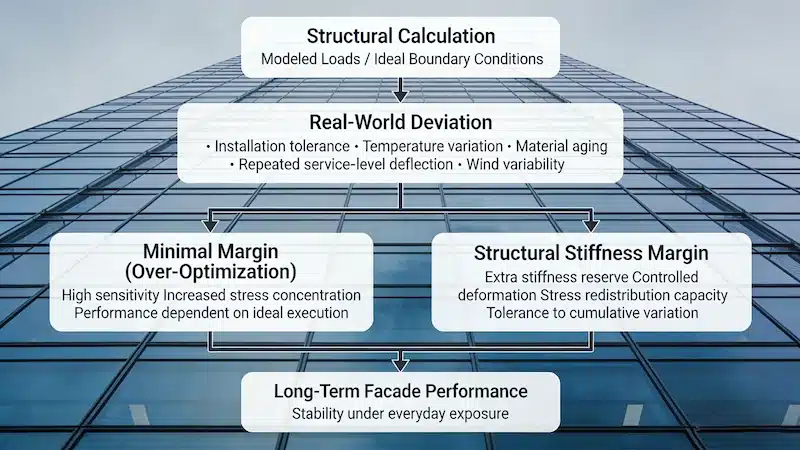
Structural verification confirms compliance within defined load combinations and boundary assumptions.

These calculations establish safety under modeled conditions.

However, buildings, particularly curtain wall systems, operate under variability:
installation tolerances accumulate, materials age, deflection repeats, and environmental exposure fluctuates over years.

Design values represent controlled scenarios.
Real conditions introduce deviation.

Reliability depends on how the system performs when deviation occurs.

Capacity and Service Behavior

A member may satisfy strength requirements while still permitting service-level deflection that influences adjacent components.

Connections may pass ultimate checks while redistributing force toward glass edges or sealant interfaces.

Glass, sealants, and anchors respond differently to repeated stress and minor misalignment. Their performance is shaped not only by peak resistance, but by daily deformation cycles.

Structural reserve provides tolerance for these cumulative effects. It allows the system to accommodate variation without concentrating stress.

Sensitivity and Over-Optimization

As reserve decreases, sensitivity increases.

Reduced section depth, tighter tolerance ranges, and minimal stiffness margins can make performance highly dependent on ideal execution.

Small deviations begin to influence behavior:

  • Installation misalignment
  • Fabrication tolerance accumulation
  • Wind events exceeding statistical averages
  • Repeated service-level deflection

Optimization improves efficiency. When carried too far, it reduces robustness.

A balanced design preserves both performance and resilience.

Structural Stiffness Margin

Stiffness as Long-Term Protection

Curtain wall failures are frequently associated with service-level behavior rather than ultimate collapse.

Excessive deflection may lead to:

  • Progressive sealant fatigue
  • Edge stress concentration
  • Incremental cracking over time

Strength governs survival under extreme load, but stiffness governs stability under everyday exposure and repeated service-level demand.

Reserve in stiffness plays a decisive role in long-term durability.

Margin as Engineering Discipline

Structural reserve reflects deliberate engineering judgment.

It may involve selecting sections with additional stiffness, limiting deflection below allowable thresholds, or interpreting boundary conditions conservatively.

Such decisions are rarely visible in architectural representation. Their value becomes evident over years of service, when variation, repetition, and environmental exposure accumulate.

Margin acknowledges that real buildings do not behave ideally.

This perspective builds on how safety boundaries are defined in facade systems through engineering judgment, as established in Curtain Wall Safety Is a Matter of Engineering Judgment.

It also extends to how movement is accommodated within facade systems, which is explored in Movement Compatibility as a Foundation of Curtain Wall Safety.

Position

A facade designed strictly at theoretical limits may satisfy calculation.

A facade designed with margin maintains stability as conditions evolve.

Structural reserve expresses engineering discipline.
Reliability depends on how responsibly limits are defined and how much variation the system is prepared to absorb.

Work With SunFrame on Your Next Facade Project

If you are planning a residential, commercial, or infrastructure facade project and require curtain wall engineering, system development, or installation support, SunFrame can assist from early design coordination to project execution — helping ensure reliable, well-engineered facade performance throughout the building lifecycle.

Leave a Reply

Your email address will not be published. Required fields are marked *

This site uses Akismet to reduce spam. Learn how your comment data is processed.

Other Posts

Contact Us