Sunframe-Logo

Boundless Spaces: Indoor-Outdoor Fluidity Through Biophilic Facade Design

Redefining the Boundary

Traditional curtain walls are often perceived as shields designed to shut the elements out. However, true architectural aesthetics lies in utilizing this “skin” to facilitate an outward expansion of interior life. The facade should not be a dead end. Instead, it serves as the threshold where the outside world begins to permeate the structure, embodying the core principles of biophilic facade design.

Biophilic Facade Design - Perforated Metal Screens

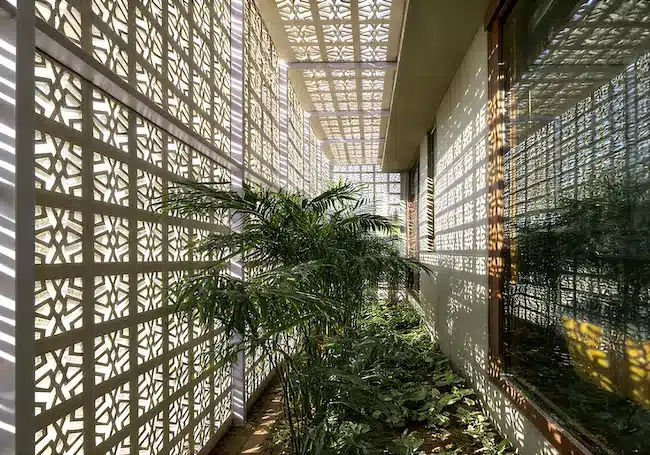
Strategy I: Perforated Metal Screens and the "Breath" of Metal

This approach employs spatial setbacks and material filtration to carve out a semi-outdoor buffer zone. The resulting gray space dissolves traditional boundaries to foster indoor-outdoor fluidity, a transformation achieved alongside steadfast structural integrity.

Spatial Logic: The Recessed Boundary

By shifting the functional glass envelope inward, a “gray space” of 0.5 to 1.5 meters is established between the structural edge and the interior. This void serves as a dedicated sanctuary for ecological landscapes.

Media Selection: The Logic of Perforation

♦ Balance of Seclusion and Connection

The perforated screen acts as a veil. It maintains privacy for internal activities while allowing occupants to gaze through the apertures into the world beyond.

♦ Inherent Nourishment

Unlike hermetically sealed systems, these perforated metal screens permit a calculated infiltration of sunlight and rainwater. Flora is not merely “contained” in this environment. It is actively sustained by the elements.

♦ Cinematic Light and Shadow

These screens act as temporal recorders. Morning light pierces the pores to cast rhythmic geometric silhouettes. As the day progresses, the sun stretches and wanders through the greenery, allowing those inside to track the subtle pulse of time.

♦ Sensory Layers

When rain strikes the metal surface, the crisp acoustics and the scent of damp earth drift through the buffer zone. This tangible proximity to the outdoors shatters the sterile vacuum typical of modern workspaces.

Glass Brick Envelope

Strategy II: The Glass Brick Envelope—A Blurred Crystalline Garden

If the first strategy is about “borrowing” the external landscape, the second focuses on “orchestrating” an internal sanctuary through a glass brick envelope.

Spatial Logic: Forging a Biophilic Core

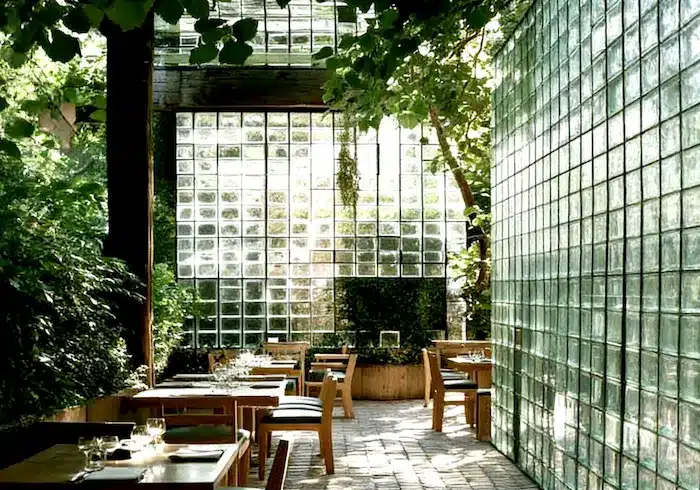
Utilizing glass masonry to delineate a sunroom or internal atrium integrates the logic of the living world directly into the heart of the building.

Media Selection: Materiality of Glass Bricks

♢ Optical Artistry

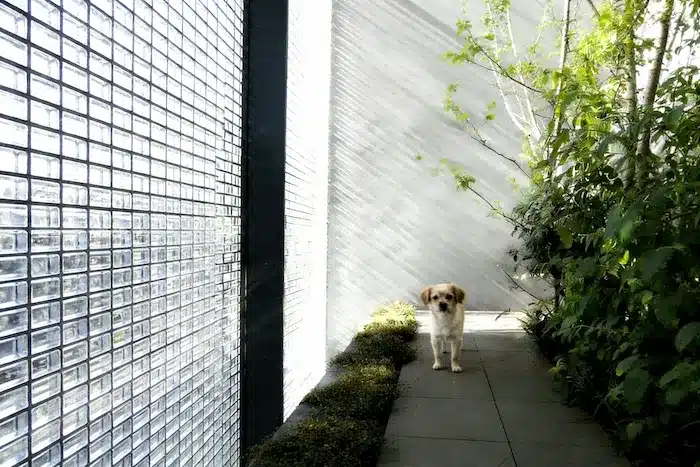
Glass bricks yield a striking paradox of profound translucency and obscured visibility. They sift the chaotic visual dissonance of the urban landscape, distilling it into a soft, ethereal glow.

♢ Atmospheric Curation

Plant life set against a glass-brick backdrop takes on a dreamlike, hazy quality. Boundaries vanish, and the greenery appears cradled within a vast, luminous crystalline vessel.

♢ Thermal and Acoustic Performance

Beyond aesthetics, the material grants superior sound insulation and thermal stability. It ensures the indoor garden remains bathed in sunlight while shielded from the dissonance of the street.

Indoor-Outdoor Fluidity

The Philosophy of Materiality: Void vs. Volume

While perforated screens facilitate a physical exchange with nature through voids, glass bricks achieve an artistic reorganization of light through volume. The former is extroverted and respiratory. In contrast, the latter is introverted and serene. This equilibrium between the hollow and the solid enriches the architectural vernacular. It affords diverse sensory experiences for different functional spaces.

Conclusion: Diversity is Architectural Freedom

The repertoire of facade systems offers designers an expansive palette. This range spans from perforated metal to glass masonry. When we cease to view the curtain wall as a mere partition, we recognize it as a medium for extension. At that point, the interior begins its symphony with the environment.

Our exploration of facade permeability reclaims spatial agency within the built environment. By receding boundaries and curating specific media, we seek to etch a respiratory fissure into the density of the urban fabric. At SunFrame, our focus on these nuanced applications transforms the building envelope—turning a cold barrier into a living conduit between humanity and the world around us.

Leave a Reply

Your email address will not be published. Required fields are marked *

This site uses Akismet to reduce spam. Learn how your comment data is processed.

Other Posts

Contact Us