Curtain Wall Color Durability: From Aesthetics to Performance
Curtain Wall Color Durability: From Aesthetics to Performance As Easter approaches, the colors of spring begin to fill urban spaces. From the playful decorations of
In contemporary architecture, the façade is often misunderstood as a simple defensive layer—a shield meant to keep nature out. Yet the deeper potential of architecture lies in using this very “skin” to extend interior life outward. As I. M. Pei once observed: “Let light be the designer.”
Light should not enter a building as a random fill for empty space. It should be directed, measured, and composed. When the façade is understood as an optical instrument rather than a static barrier, architecture ceases to be a fixed object. It becomes a living presence, moving in quiet synchrony with the rhythm of the sun.
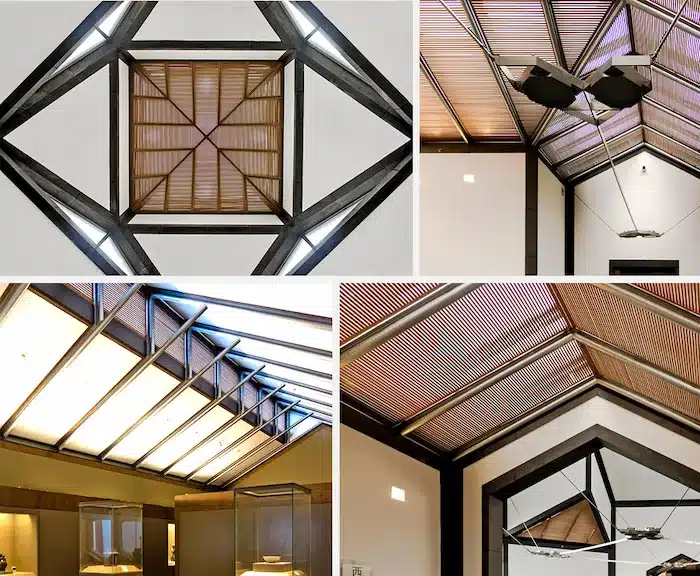
The handling of natural light at the Suzhou Museum demonstrates how architectural mediation can prevent the uncontrolled flooding of daylight.
Through a precise combination of steel structure and metal shading members, I. M. Pei orchestrated the modulation of daylight with remarkable restraint.
Light filtered through the louvers falls across white walls in shifting patterns, alternating between clarity and diffusion to create a dynamic, almost animated surface.
The resulting contrasts of brightness and shadow set surrounding lines into motion, transforming the interior into something closer to a living painting.
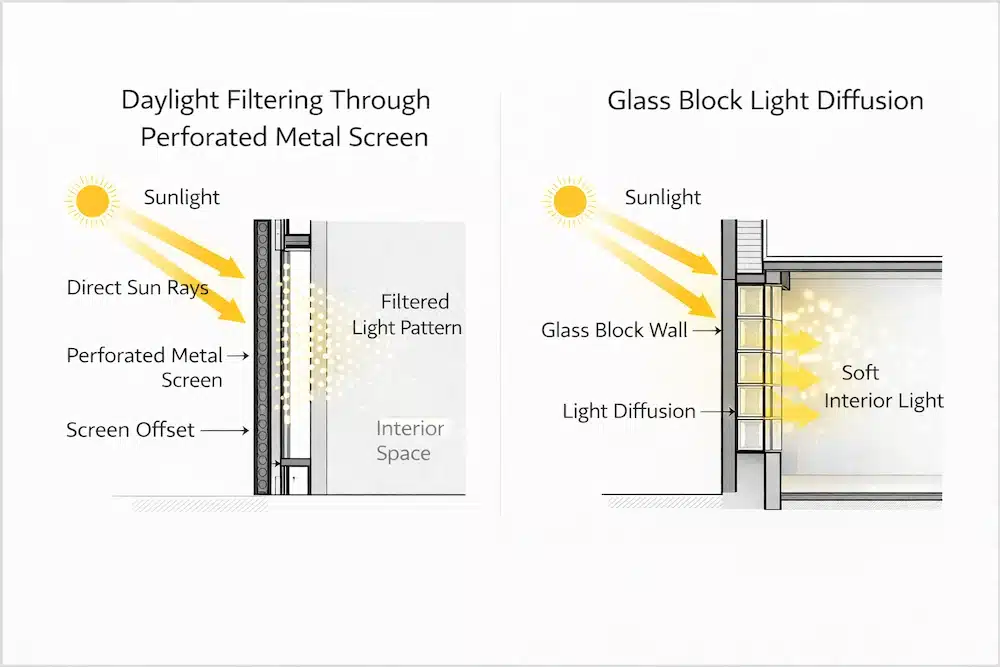
This logic echoes Strategy I introduced in our exploration of indoor–outdoor fluidity in façade design: installing perforated panels is not merely a material decision but a way of composing the granularity of light. By calibrating perforation diameters and setback distances, the screen acts as a filter, etching the chaotic exterior daylight into measured geometric projections. Within that field of filtered light, occupants begin to perceive the subtle pulse of time itself.
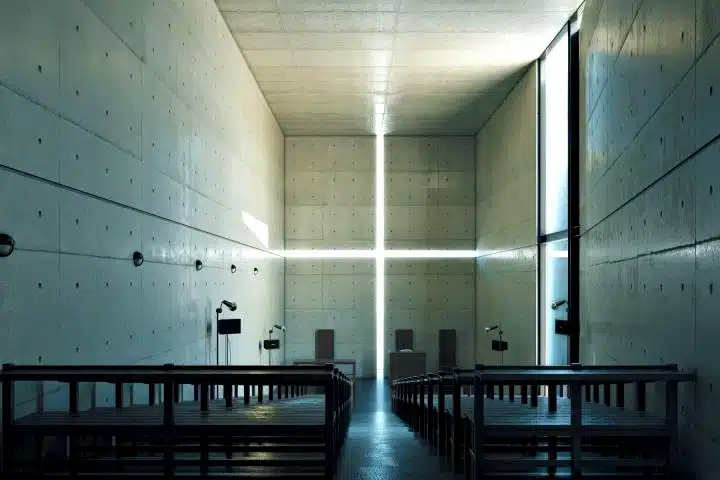
If I. M. Pei explores rhythm, Tadao Ando investigates the depth of shadow. In the Church of the Light, the façade plane is cut by a cross-shaped aperture that allows light to define space through absence.
Light draws its intensity from the darkness that surrounds it. Through an uncompromising incision in the wall plane, illumination ceases to be mere lighting—it becomes the central sculptural element of the space.
As light penetrates the darkness with force, the heavy concrete façade appears to dissolve within the glow. Architecture shifts from physical mass toward something closer to spiritual presence.
This notion of depth informs our Recessed Boundary strategy. By introducing transitional zones of roughly 0.5 to 1.5 meters, the façade gains a spatial thickness rather than remaining a flat surface.
These intermediate layers are not only suitable for vegetation or circulation; they create a measurable depth for shadow. Light no longer spreads evenly across the façade. Instead, it produces gradients of shadow and spatial depth, breaking the visual flatness that often characterizes contemporary office environments.
At a more advanced level of façade design, the material itself begins to dissolve into light.
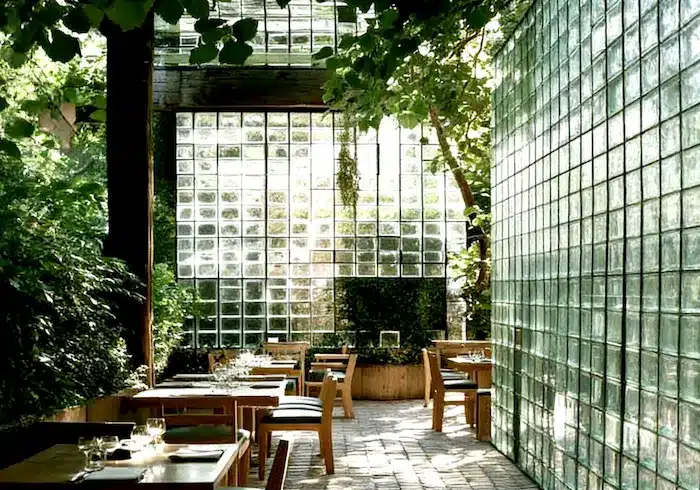
Within Strategy II, the translucent façade approach explored in our study of indoor–outdoor fluidity, glass blocks can function as optical distillers.
They absorb and soften the visual clutter of the surrounding city, transforming it into a calm and luminous field.
In this softened environment, interior vegetation appears to inhabit a glowing crystalline enclosure. Spatial boundaries blur, and the distinction between enclosure and atmosphere begins to fade.
Working with light through the façade is ultimately a way for architects to reclaim authorship over space.
It should not mark the termination of light, but rather the threshold where interior and exterior conditions negotiate with each other.
From the breathing porosity of perforated metal to the crystalline luminosity of glass blocks, each material approach generates a distinct sensory experience.
At SunFrame, we see the façade as a living conduit between people and natural light. When architects intentionally choreograph light and shadow, architecture gains the capacity to transform a static enclosure into an instrument that registers time itself. Through this quiet alchemy of light, the building envelope becomes more than protection—it becomes a device for capturing the passage of the day.
Architects and developers often face complex questions when translating daylight concepts into buildable façade systems. Our engineering team works closely with project teams to evaluate system integration, structural performance, and constructability.

Curtain Wall Color Durability: From Aesthetics to Performance As Easter approaches, the colors of spring begin to fill urban spaces. From the playful decorations of

How Modern Facades Shape Space Through Light and Acoustics In a hotel lobby in the early morning, sunlight passes through the glass façade and settles
The Future of Photovoltaic Glass — Photovoltaic Glass and the Future of Energy Integration As sustainable architecture and smart cities continue to evolve, photovoltaic glass
How Façades Drive Brand Activation and Emotional Experience High-quality façades do more than define a building’s exterior—they shape the way people see, move through, and