Unitized Curtain Walls under Typhoon Lateral Loads
Unitized Curtain Walls under Typhoon Lateral Loads — Engineering Insights from SunFrame Typhoons are among the most destructive natural disasters globally, particularly affecting coastal regions
In pedestrian bridge design, protective elements are often treated as simple railings or barriers. Discussion usually stops at whether height and strength meet code requirements.
Yet with frequent use and constant environmental exposure, these components take on a far more complex engineering role. They form a continuous surface along the bridge, shaping users’ sense of safety, spatial comfort, and long-term durability.
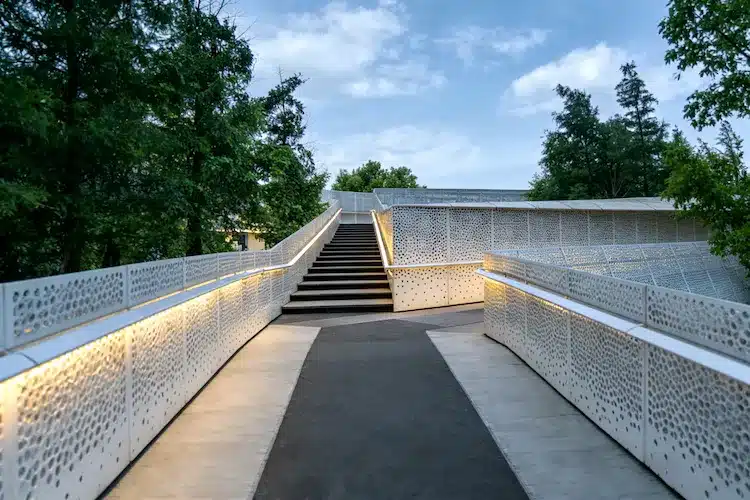
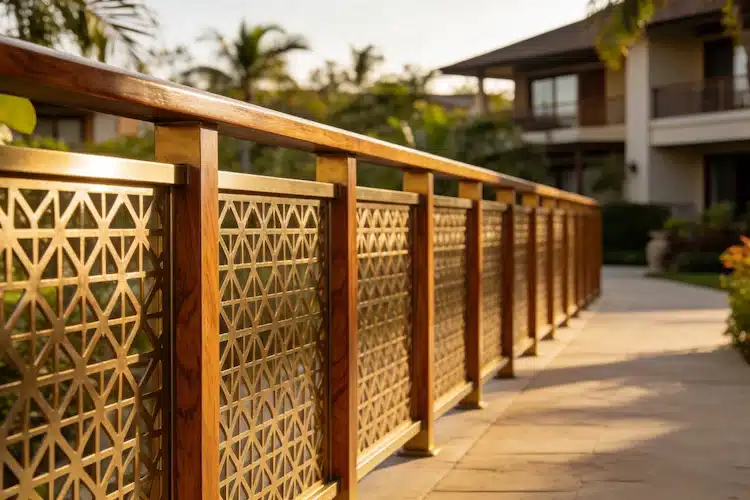
From an engineering point of view, perforated aluminum panels on pedestrian bridges act less like mere accessories and more like a continuous, low-height enclosure system.
The choice of perforated aluminum panels is not driven by visual expression, but by practical engineering considerations:
Protection is ensured while maintaining openness and clear sightlines, avoiding a sense of confinement.
Perforation allows airflow and supports natural ventilation. At the same time, a continuous surface helps moderate direct wind at pedestrian level, improving microclimatic comfort.
Panels are suitable for standardized production and straightforward maintenance over time.
A coherent facade-like surface is achieved without relying on overly complex detailing.
In pedestrian-scale public infrastructure, perforated aluminum panels reflect material decisions guided by engineering judgment rather than decorative intent.
Viewed through the lens of engineering constraints, pedestrian bridges are not a special case. Many similar environments share the same conditions: high usage, long-term exposure, and strict demands on safety and comfort, such as:
In these settings, the enclosure logic formed by perforated aluminum panels can be applied directly, rather than treated as a one-off design solution.
This type of application is not a departure from the curtain wall field. It is an extension of existing expertise:
☛ The same material systems, fabrication methods, detailing control, and installation logic remain in use
☛ Application shifts toward pedestrian-scale components with stronger emphasis on durability and maintainability
☛ Standardized and repeatable construction becomes possible, improving scalability and commercial value
In public infrastructure, the most overlooked components often serve the longest life cycles. When curtain wall engineering logic reaches these understated positions, its value lies not in formal innovation, but in whether it can withstand time, environment, and constant use.
What truly deserves to be extended is not the material itself, but the engineering judgment behind it.

Unitized Curtain Walls under Typhoon Lateral Loads — Engineering Insights from SunFrame Typhoons are among the most destructive natural disasters globally, particularly affecting coastal regions

Boundless Spaces: Indoor-Outdoor Fluidity Through Biophilic Facade Design Redefining the Boundary Traditional curtain walls are often perceived as shields designed to shut the elements out.
-300x200.webp)
Curtain Wall Design as Engineering Judgment How SunFrame Integrates Structure, Materials, and Interfaces in Complex Façade Projects In many projects, curtain walls are often seen

From Curtain Wall to Facade: SunFrame’s Insights into Facade Engineering Introduction | Why We Focus on Facade, Not Just Curtain Wall The curtain wall has