Sunframe-Logo

Rooftop Multi-Level Void Curtain Wall Design in Supertall Buildings

— A Practical Design Perspective from Sunframe

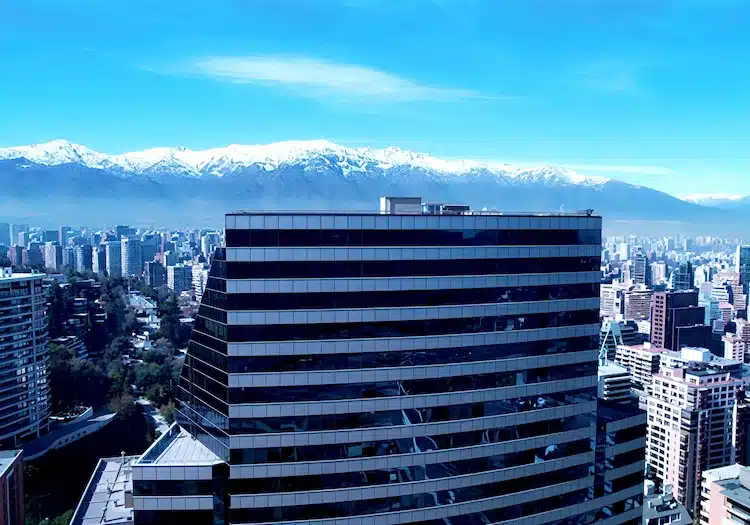
Rooftop Multi-Level Void Curtain Wall

As supertall buildings continue to reach new heights and adopt increasingly complex spatial forms, rooftop multi-level voids have become essential elements of modern façade design. While these spaces add value to the building, they introduce design and construction challenges exceeding those of standard façades.

In such environments, curtain wall design cannot rely solely on conventional assumptions. Structural continuity is often interrupted, working space is limited, and construction activities are concentrated at extreme heights. Based on project experience, Sunframe has carried out a series of design-oriented explorations, focusing on how rooftop multi-level void curtain walls can be made safer to build, easier to control, and more predictable in execution. The following discussion outlines several key aspects that frequently require special attention.

1. Innovative Structural Design

The structural stability of rooftop curtain walls is paramount. Sunframe investigates the use of high-performance materials, including high-strength steel, precision aluminum alloys, and composite materials. These also are combined with advanced connection methods such as high-strength bolts, rivets, or custom fittings. Together, they improve the overall robustness of the curtain wall system under extreme rooftop conditions.

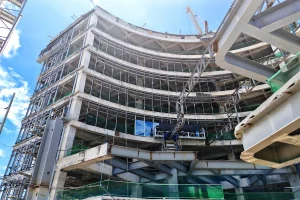
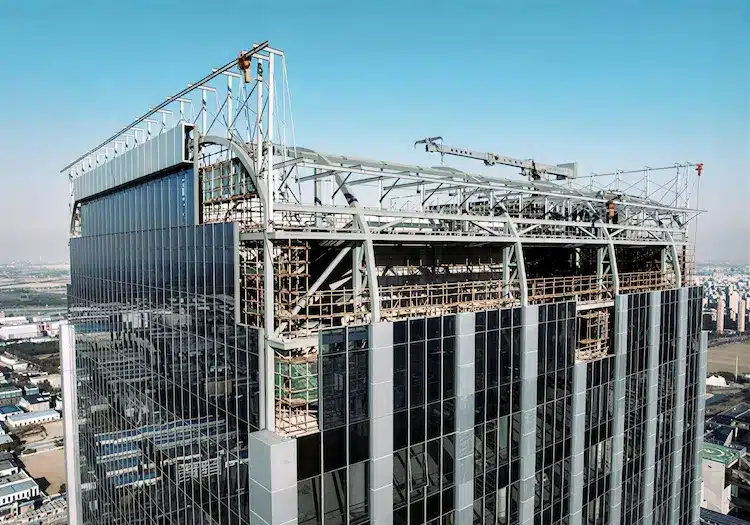
In construction planning, the multi-level voids themselves can be leveraged as temporary workspaces. By using mobile operation platforms, clamp-type gondolas, and segmented construction strategies, installation can proceed efficiently while minimizing interference with roofing and mechanical systems.

2. Energy Performance and Environmental Response

Rooftop curtain walls are directly exposed to solar radiation and external climate effects. Therefore, they significantly affect the building’s energy performance.

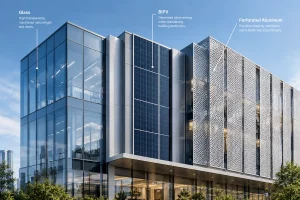
Low-emissivity glass, high-performance insulation, and carefully tuned shading systems collaborate to temper heat gain while bathing interiors in soft daylight. In select designs, rooftop gardens or inhabitable zones act as natural thermal buffers, offering comfort and inviting spaces above the skyline. Thoughtful early coordination ensures these interventions harmonize flawlessly with the curtain wall system.

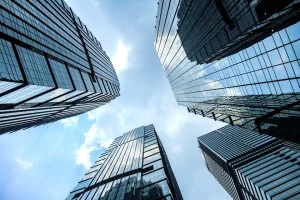
Supertall Building Facade Design

3. Wind and Rain Resistance

Wind behavior near the top of a supertall building is often complex, especially around open voids. Rainwater can also accumulate or be redirected in unexpected ways.

For this reason, wind stability, waterproof detailing, and drainage paths are treated as interconnected issues rather than isolated design checks. Anti-sway considerations, continuous waterproof layers, and clearly defined drainage routes all contribute to improving long-term performance and reducing maintenance risks.

4. Architectural Expression with Constructability in Mind

The rooftop curtain wall frequently becomes a visual focal point of the building. Material choices, façade geometry, and detailing all influence the final appearance.

Glass, metal panels, and stone elements may be combined to achieve the desired architectural effect. At the same time, these choices are evaluated against fabrication limits and installation feasibility at height. In practice, architectural expression and engineering logic are developed together, rather than one being adjusted after the other.

5. Smart and Systematic Design

Rooftop curtain walls may also incorporate monitoring or control elements related to lighting, ventilation, or maintenance access. Instead of pursuing complexity for its own sake, the focus is usually on clarity and reliability.

Simple, well-integrated systems are often more effective than highly automated ones, especially in areas that are difficult to access after completion.

6. Working Within Multi-Level Void Conditions

Multi-level voids change how curtain wall installation is organized. There is rarely a single “standard” solution.

Depending on project constraints, practical measures may include mobile working platforms, clamp-supported gondolas, or segmented installation routes that progress step by step. Structural calculations and trial loading are typically carried out throughout critical stages to ensure that temporary conditions remain within safe limits. For a detailed look at how these design strategies are implemented on-site, see our Rooftop Multi-Level Void Curtain Wall Construction.

These approaches are not presented as fixed formulas, but as adaptable methods that can be adjusted to suit different building forms and construction sequences.

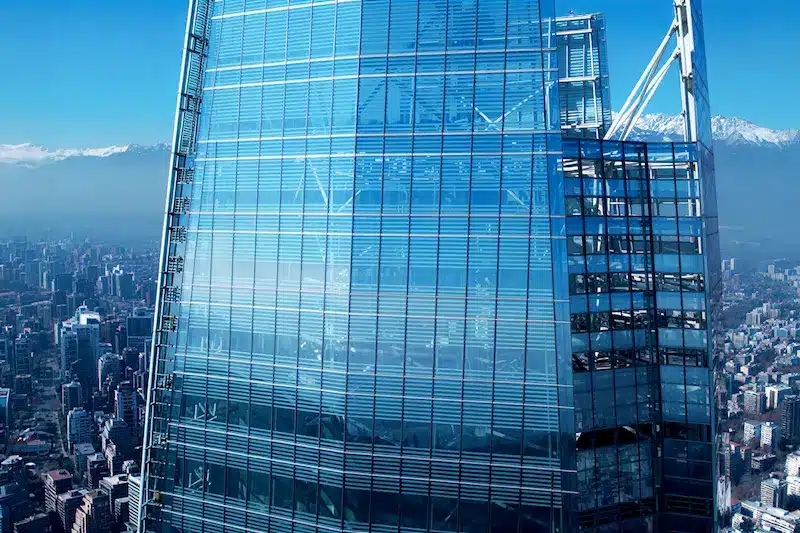
Rooftop Void Curtain Wall Design

7. Daylight and Ventilation

Where design conditions allow, rooftop curtain walls can support natural lighting and ventilation through skylights, openings, or light-guiding elements. These features improve indoor comfort and reduce reliance on mechanical systems, while placing higher demands on detailing accuracy and coordination.

8. Green Building Strategies

Rooftop zones offer ideal opportunities to embed green technologies, including rainwater harvesting for irrigation or cleaning and photovoltaic panels. When these systems are planned early in the design process, they can be seamlessly coordinated with the curtain wall system, supporting resource conservation while maintaining performance and construction efficiency.

9. Human-Centric and Cultural Expression

Beyond technical performance, rooftop spaces may serve people directly. Viewing platforms, maintenance walkways, or service areas all require careful attention to safety and accessibility.

Material selection and design language can also reflect local context, allowing the rooftop curtain wall to contribute to the building’s identity rather than functioning purely as an enclosure.

Conclusion

Rooftop multi-level void curtain walls are among the most technically complex and management-intensive components of supertall buildings. Sunframe develops systematic and innovative design and construction solutions, addressing structural stability, functional performance, energy efficiency, smart systems, and architectural expression as a whole.

These exploratory practices offer practical, replicable guidance for multi-level void curtain wall projects while demonstrating Sunframe’s ongoing commitment to systematic design and construction innovation.

Leave a Reply

Your email address will not be published. Required fields are marked *

This site uses Akismet to reduce spam. Learn how your comment data is processed.

Other Posts

Contact Us