The Restraint Behind a Perforated Aluminum Façade
The Restraint Behind a Perforated Aluminum Façade One day, while passing by a school, I found myself paying attention to its exterior. Along the corridors
The curtain wall has been an important technological system in modern architecture since the mid-19th century. With the continuous advancement of materials, construction techniques, and computational tools, curtain walls have evolved from simple enclosures into comprehensive systems integrating structure, safety, performance, and aesthetics.
At SunFrame, however, we believe that the challenges facing contemporary architecture extend beyond the curtain wall itself. They lie in the broader scope of Facade Engineering.
A facade is not merely a construction type; it is the integrated interface between building and city, structure and space, performance and visual experience. The curtain wall is only one of its most typical and technically demanding components.
From an engineering perspective, a facade is not just an outer skin—it is an independent system that relies closely on the primary structure for coordination.
Functionally, a facade must address:
From the architectural perspective, the facade is also the building’s most direct expressive interface, shaping proportions, rhythm, void-solid relationships, and the interaction between people and the built environment.
It is at this intersection of engineering and architecture that Facade Engineering becomes a highly integrated discipline.
In practice, we emphasize a key principle:
Facade design is essentially an organization of structure and assembly, not merely a choice of materials.
Designs may use glass, metal, stone, or composite panels. The key is to translate design intentions into an implementable, controllable, and durable engineering system through the relationships of points, lines, and surfaces.
This means:
Curtain wall systems exemplify this complexity. They bring together all the key engineering challenges of Facade design, from structural coordination and tolerance control to seal continuity and maintenance planning.
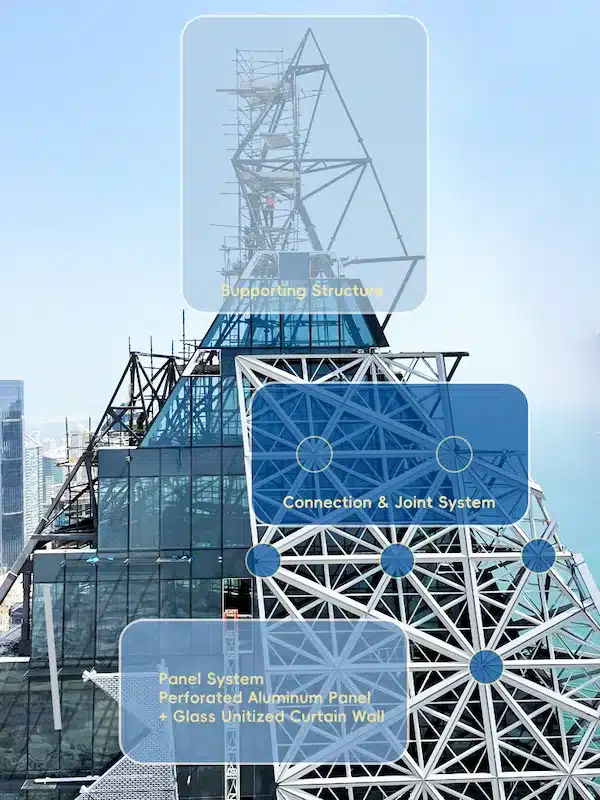
From an engineering standpoint, any facade system can be broken down into three core components:
♦ Panel System
Includes glass, metal, stone, ceramic panels, etc., serving as the visual carrier and a partial performance layer of the facade.
♦ Supporting Structure
Composed of aluminum profiles, steel frameworks, cable systems, etc., responsible for reliably transferring loads to the main structure.
♦ Connection & Joint System
Determines the system’s overall stability, deformation capacity, and long-term durability.
At SunFrame, we tend to regard Facade Engineering as fundamentally “joint engineering.”
How nodes and joints are designed often determines whether the facade will perform reliably over its service life.
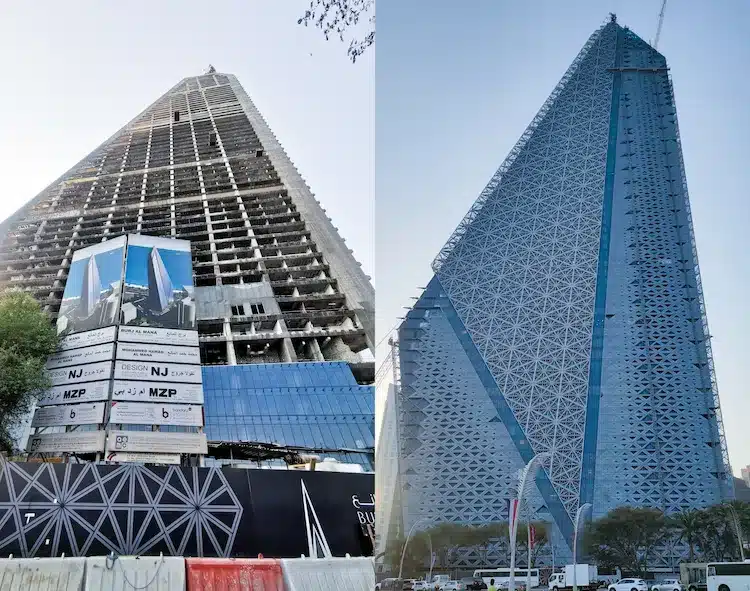
Among facade systems, curtain walls are frequently discussed not because of their ubiquity, but because they concentrate the complexity of facade engineering.
Take the unitized curtain wall as an example:
Curtain walls often serve as a key benchmark for evaluating a Facade Engineering team’s capability. Their design and installation directly test tolerance control, seal continuity, and structural coordination on-site.
Because of this concentration of structural, performance, and interface challenges, curtain walls frequently become the point where facade engineering principles are most rigorously tested in practice.
This perspective is explored further in our article, Curtain Wall Design as Engineering Judgment, where we discuss how interface control, structural logic, and construction strategy shape reliable curtain wall performance in complex projects.
With the rise of parametric design and digital modeling, facades enjoy unprecedented freedom of form. However, increased technical tools do not diminish the importance of engineering judgment.
In complex projects, success is determined by:
The value of Facade Engineering lies not in creating facades that merely look innovative, but in ensuring that designs work in reality and remain effective over time.
At SunFrame, a facade is never a one-off deliverable—it is an engineering responsibility that spans the building’s entire lifecycle.
This is why we prefer to approach curtain walls, material choices, and construction methods from a Facade Engineering perspective, rather than reducing them to a single product or system.
Curtain walls are our familiar engineering field; facades are the holistic problem we continually address.

The Restraint Behind a Perforated Aluminum Façade One day, while passing by a school, I found myself paying attention to its exterior. Along the corridors

Rooftop Multi-Level Void Curtain Wall Construction — Sunframe’s Systematic Solutions for Complex High-Altitude Conditions As supertall buildings reach unprecedented heights and embrace increasingly complex spatial

Rooftop Multi-Level Void Curtain Wall Design in Supertall Buildings — A Practical Design Perspective from Sunframe As supertall buildings continue to reach new heights and

Aluminum Panel Curtain Wall Construction — Key Technical Points for Reliable On-Site Execution In real-world curtain wall projects, the facade functions as a secondary envelope.