Facade Engineering in Guyana: Insights on Durable and Practical Design
Facade Engineering in Guyana: Insights on Durable and Practical Design In many countries, Republic Day is a moment to look back on history and celebrate
The Brazilian Carnival is not only a globally renowned cultural festival but also marks a period of extreme environmental challenge for urban buildings. Held during the Southern Hemisphere’s summer rainy season, the combination of short, intense rainstorms and high-frequency urban activity places exceptionally high durability demands on building façades. In such conditions, curtain wall systems must rely on their intrinsic physical logic and high-specification materials, rather than solely on manual maintenance.
For non-unitized curtain walls, we implement a closed-loop defense system to ensure interior dryness under extreme wind pressure:
Weatherproof Sealing:
High-performance waterproof sealant is applied to exterior joints, providing the first line of physical defense.
Structural Filling:
The gaps between the curtain wall and the main wall are deeply filled with polyurethane foam sealant, preventing thermal bridging and fine leakage.
Physical Shielding:
Custom aluminum flashings are installed around the joints, forming a solid physical barrier to prevent water intrusion.
We emphasize coordinated water management through the interplay of internal system pressure and material characteristics:
The system incorporates high-performance gaskets and dedicated drainage channels. Utilizing the “equal pressure principle,” even if small amounts of water penetrate under extreme wind, they are captured by internal collection troughs and quickly directed outside.
Self-Cleaning Glass Application:
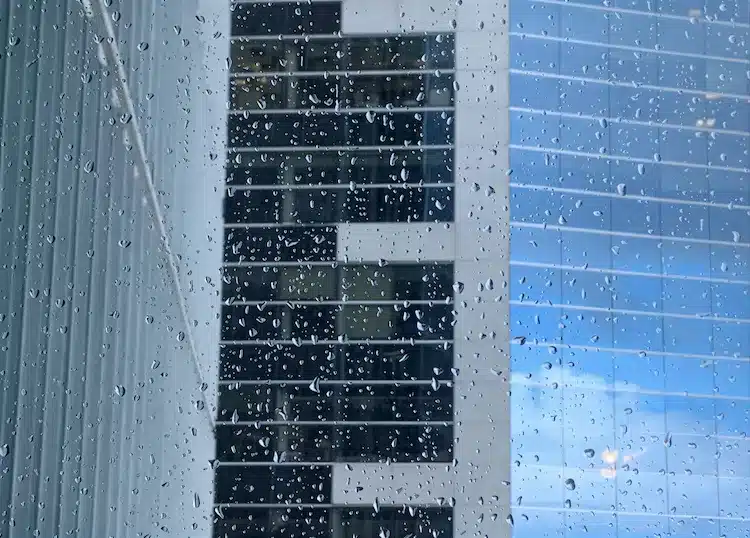
Self-cleaning glass employs a hydrophilic surface that allows rainwater to flow as a thin sheet, removing organic dirt along the way. Combined with steeply inclined façade cover panels, this achieves comprehensive physical self-cleaning.
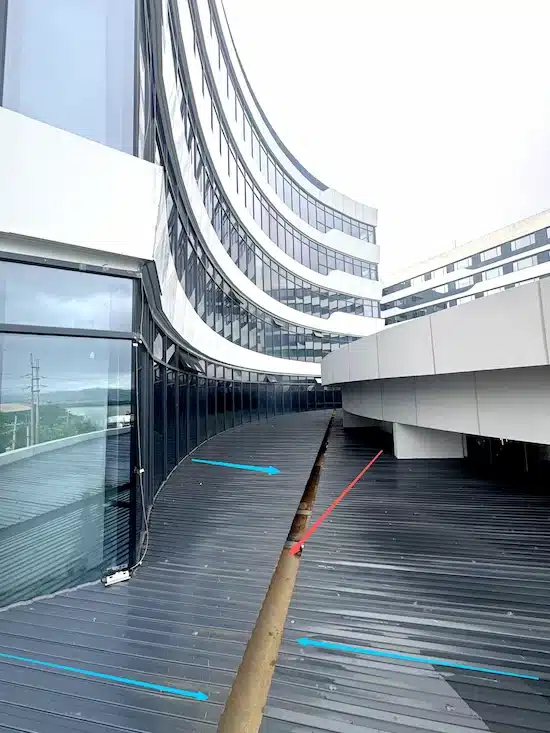
At the Mahi Center project, the curtain wall system closely interfaces with the rooftop terrace. To manage large volumes of water running down the façade and prevent rooftop pooling from undermining the base of the curtain wall, we implemented a composite drainage solution:
Terrace Interface Layer – 316 Stainless Steel U-Shaped Trough Array:
Along the terrace adjacent to the façade base, modular arrays of parallel 316 stainless steel U-shaped troughs were installed. This design integrates pedestrian functionality with the terminal drainage of the façade, breaking water surface tension and enabling instantaneous capture of runoff, fundamentally preventing water from lingering at the interface.
Two-Level Flow Logic:
All secondary U-shaped troughs follow the terrace slope and direct collected rainwater to the structural main drainage channel (as indicated by red arrows in diagrams). This system, combining façade self-cleaning with terrace interception, leverages the excellent corrosion resistance of 316 stainless steel to address protection challenges at terrace interfaces under tropical high-salinity conditions.
“Maintenance-first” is not merely a matter of material accumulation but a reflection of deep consideration for construction details. This holistic design approach spans from internal drainage channels within unitized curtain walls to integrated rooftop drainage terminals. It coordinates façade function with building boundaries to preserve controlled water paths and airtight interfaces. Such integration of interior and exterior design logic is the key to maintaining long-term stability and cleanliness of curtain walls under extreme environmental conditions.

Facade Engineering in Guyana: Insights on Durable and Practical Design In many countries, Republic Day is a moment to look back on history and celebrate

Lunar New Year, Proven Reliability: Custom Façade Engineering & Delivery To much of the world, the Lunar New Year is a time to slow down,

Fit and Resilience: The Design Logic of Facade Systems in Australia Architecture in Australia Begins with Environmental Considerations When designing buildings in Australia, many decisions

2026 Façade Systems: From Visual Expression to Long-Term Performance Observations on Façade Technology, Operation, and Maintenance The turn of a new calendar year is often