Curtain Wall Color Durability: From Aesthetics to Performance
Curtain Wall Color Durability: From Aesthetics to Performance As Easter approaches, the colors of spring begin to fill urban spaces. From the playful decorations of
In Southeast Asia, building envelopes operate under a consistently humid and water-intensive climate throughout the year.
This condition is clearly reflected during events such as the Songkran Festival in Thailand, where urban façades are directly exposed to continuous water interaction and high humidity, illustrating the region’s environmental characteristics in a highly visual way.
Across Thailand, Malaysia, Singapore, and neighboring regions, curtain wall systems are subjected to combined environmental stresses, including intense rainfall, high humidity, solar radiation, and thermal movement cycles.
Under these conditions, water becomes a continuous design parameter that must be managed through controlled and system-level performance.
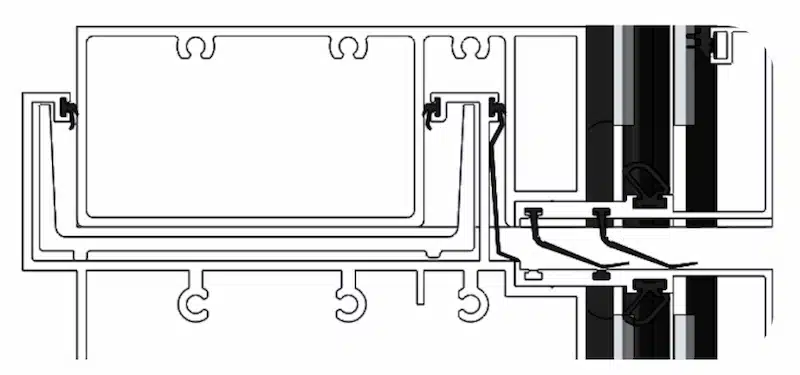
The key differentiation in façade performance lies in how effectively a curtain wall system organizes internal water behavior through integrated drainage and system coordination.
In practice, this aspect is still often underestimated during early-stage design, where material specifications tend to receive more attention than system-level water management behavior.
From practical project experience, water leakage in curtain wall systems rarely originates from large glazed areas. It is predominantly concentrated at interface and detail zones.
Typical risk locations include:
While sealant performance is often identified as the immediate cause in site assessments, leakage behavior is more accurately linked to the system’s internal water movement logic and the continuity of its drainage design.
This distinction is critical in façade engineering, yet it is not always explicitly addressed in conventional design workflows.
In Southeast Asian projects, several recurring patterns can be observed:
These issues are rarely evident at project handover. Their impact typically becomes apparent only after exposure to one or more seasonal rainfall cycles, when façade performance begins to differentiate under sustained environmental loading.
From a design perspective, this highlights the importance of addressing water management as an integrated system from the earliest stages of façade coordination, rather than treating it as a series of isolated component-level decisions.
In high-humidity and high-rainfall regions, stable curtain wall performance is typically achieved through the following principles:
A properly designed system does not aim to eliminate all water at the outer surface. Instead, it allows controlled water entry into designated cavities without affecting the interior environment.
Systems designed to fully block water at the outer layer often experience increased long-term stress at joints and interfaces.
Any water entering the system must be guided through a continuous and uninterrupted drainage route.
Accordingly, drainage continuity is more critical to long-term performance than sealant upgrades or increased thickness.
Pressure equalization reduces wind-driven water penetration into deeper system layers.
This becomes especially important in regions where strong wind loads and heavy rainfall occur simultaneously.
Sealants, gaskets, and surface materials should be evaluated based on:
In tropical environments, material selection should prioritize long-term environmental performance over datasheet-level indicators.
Even well-designed systems depend heavily on manufacturing accuracy and on-site installation quality.
Small deviations in joint alignment or installation tolerances can significantly affect water tightness performance over time.
This is one of the most common gap points between design intent and real performance.
In high-humidity and high-rainfall regions, curtain wall performance is better assessed through system-level behavior rather than isolated component specifications:
System-level performance is a key driver of long-term maintenance costs, more than individual material upgrades.
In tropical climates, water cannot be eliminated — it can only be managed.
The real capability of a curtain wall system does not lie in blocking water at a single point, but in its ability to ensure:
When these elements are properly coordinated, façade systems can maintain stable performance even under continuous exposure conditions.
For projects in Southeast Asia and similar climatic regions, we provide:
If you are currently developing a project in such environments, you are welcome to share project information for preliminary technical evaluation. We can support analysis of system adaptability and provide optimization recommendations at an early stage.

Curtain Wall Color Durability: From Aesthetics to Performance As Easter approaches, the colors of spring begin to fill urban spaces. From the playful decorations of

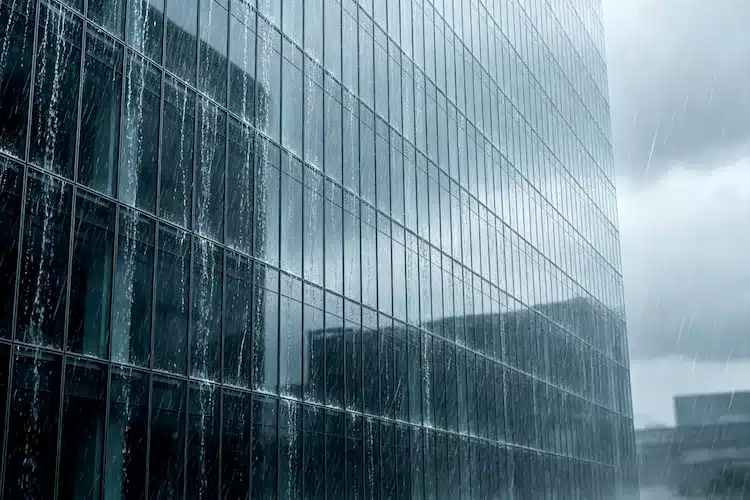
How Modern Facades Shape Space Through Light and Acoustics In a hotel lobby in the early morning, sunlight passes through the glass façade and settles
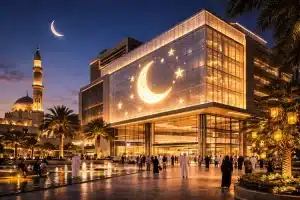
BIPV Façades for Nighttime Urban Spaces During Ramadan, urban rhythms across the Middle East shift noticeably. Daytime activity slows, while commercial and religious spaces become
Facade Engineering in Guyana: Insights on Durable and Practical Design In many countries, Republic Day is a moment to look back on history and celebrate