Sunframe-Logo

Rooftop Multi-Level Void Curtain Wall Construction

— Sunframe’s Systematic Solutions for Complex High-Altitude Conditions

Rooftop Multi-Level Void Curtain Wall Construction

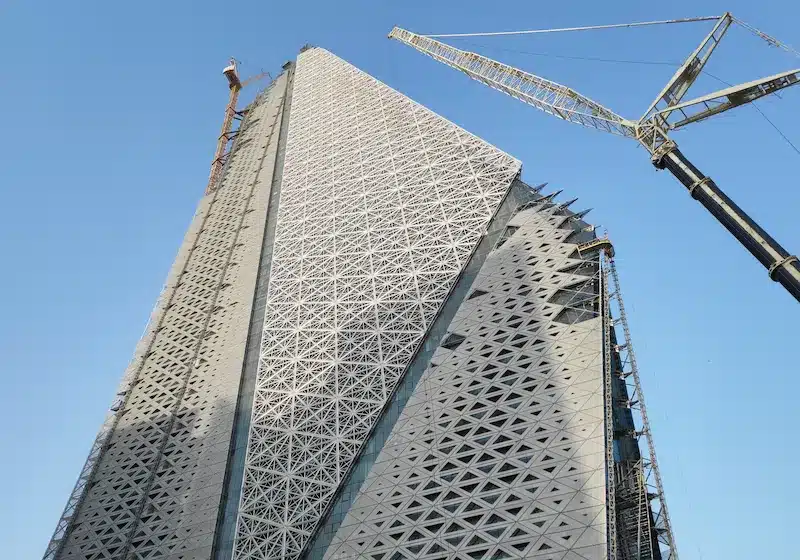
As supertall buildings reach unprecedented heights and embrace increasingly complex spatial forms, rooftop multi-level voids have become a notable characteristic of modern architectural design. These spaces not only fulfill requirements for ventilation, equipment layout, and architectural expression but also create formidable challenges for curtain wall installation.

Unlike conventional façades, rooftop multi-level voids often lack continuous floor slabs and feature complex structural conditions. They also have limited working space and concentrate high-altitude risks. Traditional construction methods, whether for stick-built or unitized curtain walls, often fall short in terms of safety, cost-effectiveness, and efficiency.

Based on years of experience in supertall curtain wall projects, Sunframe has systematically studied the limitations of conventional methods and developed a set of innovative approaches tailored to diverse rooftop conditions, offering safer, more efficient, and controllable solutions for multi-level rooftop void curtain wall installation.

1. Limitations of Traditional Construction Methods

For rooftop multi-level voids in supertall buildings, common conventional methods include:

  • Suspended gondola (electric hoist) systems
  • Scaffolding (including cantilevered scaffolds)
  • Tower crane-assisted installation (for unitized curtain walls)

While these approaches are mature for typical façades, they often face the following challenges in rooftop void areas:

  • Lack of floor slabs limits gondola and scaffolding placement
  • Cantilever scaffolds require long construction cycles and high setup costs
  • High-altitude work is concentrated, significantly increasing safety risks
  • Heavy reliance on the general contractor’s tower crane restricts installation windows
  • Final dismantling often encounters difficulties in completing the last steps

Simply applying traditional methods is no longer sufficient to meet the comprehensive requirements of safety, efficiency, and cost-effectiveness in rooftop multi-level void curtain wall construction.

2. Sunframe’s Overall Innovative Approach

For the unique challenges of rooftop multi-level voids, Sunframe’s core idea is not just to “replace a tool,” but to rethink the construction logic based on structural conditions, focusing on solving the following “4 how”:

  • How to establish safe working platforms without continuous floor slabs
  • How to reduce reliance on a single tower crane
  • How to integrate exterior and interior installation into a complete closed-loop process
  • How to balance safety, schedule control, and setup costs

Based on different curtain wall systems and site conditions, Sunframe has developed three replicable innovative corooftop multi-level voids construction models.

3. Innovative Approach for Stick-Built Curtain Walls

In rooftop multi-level voids, stick-built curtain walls require all columns, beams, panels, and sealing to be installed piece by piece at high altitude, making organization extremely challenging.

Sunframe’s approach focuses on:

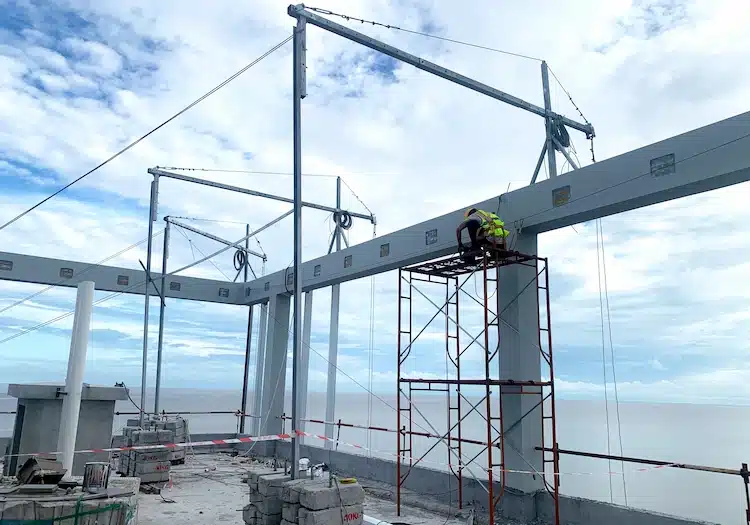
✔ Installing mobile working platforms on the roof structure as temporary construction bases
✔ Using clamp-type gondola systems aligned with structural beams
✔ Ensuring rigorous connection and load verification between gondola supports and the underlying structure
✔ Completing all exterior components and sealing before moving to interior work
✔ Phased and orderly dismantling of temporary installations

Advantages of this model:

☛ Does not occupy the main roof working area, avoiding interference with roofing or MEP work
☛ Eliminates the need for large cantilever scaffolds
☛ Provides a clear installation path and controllable safety risks
☛ Significantly reduces setup costs and construction duration

Innovative Approach for Stick-Built Curtain Walls

Clamp-type gondola and temporary working platform for stick-built curtain walls in a multi-level rooftop void

4. Innovative Approach for Unitized Curtain Walls (With Tower Crane)

When installing unitized curtain walls on a rooftop and a tower crane is available, Sunframe prioritizes a “tower crane + auxiliary platform” strategy.

Key points include:

♦ Establishing temporary working platforms based on roof structural conditions
♦ Using electric gondolas for unit supports, auxiliary components, and exterior finishes
♦ Tower cranes handle vertical and horizontal transportation of unit panels
♦ Gondolas serve only as adjustment and installation platforms, not primary lifting tools

This approach avoids complex overhead lifting setups, reducing organizational complexity and construction risk.

Innovative Approach for Unitized Curtain Walls (With Tower Crane)

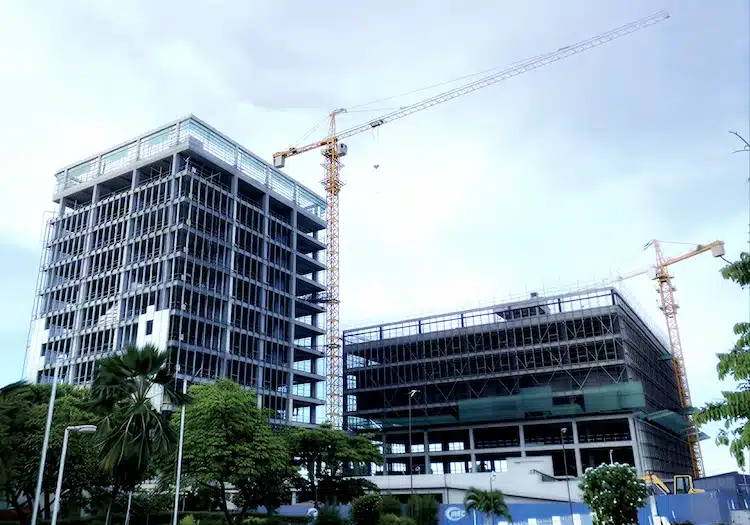
Segmental installation of unitized curtain walls in a rooftop void without requiring complex crane arrangements

5. Innovative Approach for Unitized Curtain Walls (Without Tower Crane)

In some projects, the main structure is complete and tower cranes have been removed. The rooftop void curtain wall is still pending, which poses the greatest challenge.

Sunframe’s strategy includes:

▶ Phased construction planning, starting with curtain walls below the roof level
▶ Establishing temporary internal construction systems within the rooftop void
▶ Implementing segmented, stepped lifting track systems to adapt to complex façade geometry
▶ Advancing lifting equipment segment by segment to maintain a safe, controllable path
▶ Performing full structural calculations and trial loads throughout

Though organizationally complex, this solution enables safe, efficient installation of unitized curtain walls in rooftop voids even without tower crane support.

Innovative Approach for Unitized Curtain Walls (Without Tower Crane)

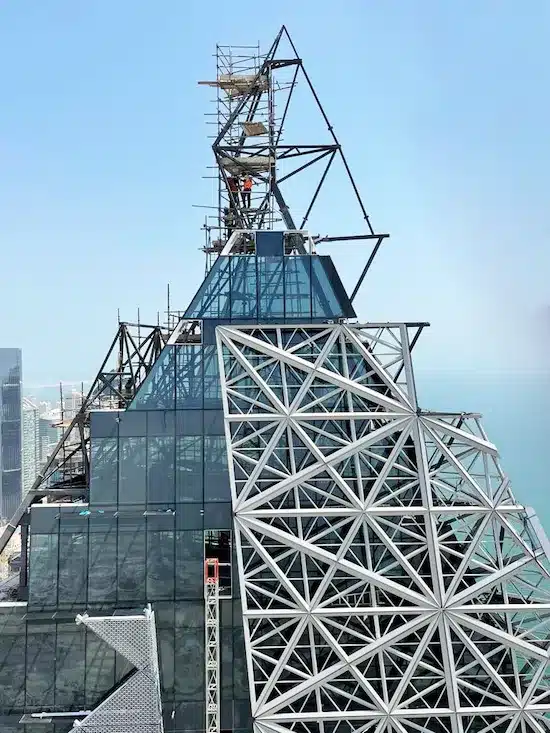
Segmented lifting installation of unitized curtain walls in a rooftop void without tower crane

Conclusion

Rooftop multi-level void curtain wall construction is one of the most technically challenging, safety-critical, and management-intensive aspects of supertall building projects. The quality of the construction plan directly affects project safety, schedule, cost, and delivery quality.

Sunframe consistently approaches these projects from the perspective of structural conditions, construction logic, and the essence of engineering safety, developing systematic and innovative solutions adaptable to a variety of project conditions. The underlying design principles behind these solutions are outlined in our Rooftop Multi-Level Void Curtain Wall Design in Supertall Buildings.

These innovations break the limitations of traditional methods and provide replicable engineering pathways for rooftop curtain wall construction in supertall buildings. 

Moving forward, Sunframe will continue to prioritize safety, optimize efficiency and quality, and deliver reliable, mature curtain wall solutions to owners and partners.

Leave a Reply

Your email address will not be published. Required fields are marked *

This site uses Akismet to reduce spam. Learn how your comment data is processed.

Other Posts

Contact Us