Sunframe-Logo

The Restraint Behind a Perforated Aluminum Façade

One day, while passing by a school, I found myself paying attention to its exterior.

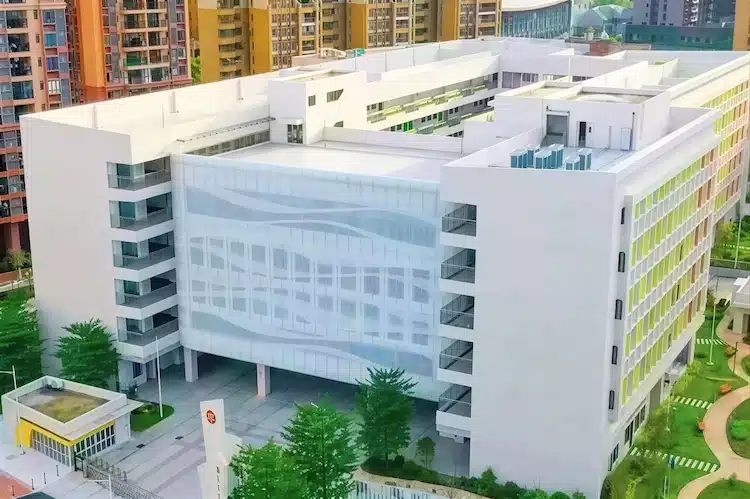
Along the corridors on the second floor and above, both in teaching buildings or dormitories, the façades were wrapped in large areas of perforated aluminum panels.

The perforations formed fluid, dynamic patterns, almost as if shaped by the movement of air. Within this type of perforated aluminum façade, variations in perforation density and localized enlargements naturally emerge.

In some implementations, these take the form of larger circular openings—wide enough to offer a clear view outward, yet unmistakably too small for a person to pass through.

The Restraint Behind a Perforated Aluminum Façade

What was more striking was that these circular openings were not singular gestures. 

Along longer corridors, they often repeat at controlled intervals, responding to the linear nature of circulation space rather than serving as isolated visual highlights.

This made it clear that they were not intended as isolated visual highlights within the façade composition. Instead, they responded directly to the nature of the corridor as a linear public space. Students moving along the corridor are thus offered recurring, carefully calibrated moments to look outward.

At specific points, one could pause and observe the outside environment. Yet the size and scale of these openings are consistently controlled, maintaining a balance between visual openness and behavioral safety.

My first reaction was instinctive:
this design was probably not about looking good.

A Safety-Driven Decision

School buildings differ fundamentally from commercial or office buildings.

For teaching buildings and dormitories in particular, once public corridors rise above the second floor, one issue becomes almost impossible to avoid: fall prevention.

The real challenge, however, is not whether protection is needed, but how it should be achieved.

From a purely technical standpoint, the solutions are straightforward:
higher railings, protective nets, or fully enclosed barriers.

Yet in school environments, these measures often introduce new problems—feelings of oppression, institutional overtones, and unintended psychological pressure on students.

What emerges instead is a different approach.
Not blocking people away from danger, but moving danger out of reach.

The continuous layer of perforated aluminum effectively becomes a secondary protective interface.

It shifts the boundary of the corridor from a reachable edge, such as a window sill or railing, to an outer layer that cannot be directly accessed.

As students move along the corridor, they are no longer confronted with a clear “point of no return.”

Instead, distance is quietly introduced between them and the risk itself.

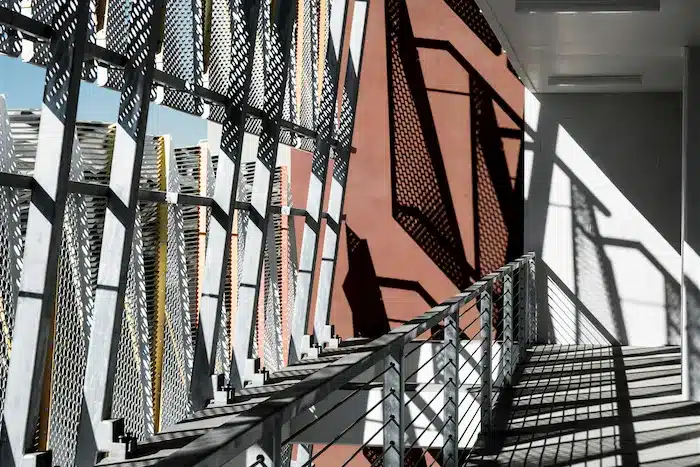
Perforated aluminum railing mounted panel

Perforated panels mounted above the railing extend the corridor boundary and maintain light and visual connection, enhancing both safety and spatial experience.

Why Perforated, Rather Than Fully Enclosed?

What makes this strategy more subtle is that the aluminum panels are not completely closed.

The directional, flowing perforation patterns soften the presence of the protective layer.

The circular openings, in particular, function like carefully calibrated viewing frames.

The message is simple and unambiguous:
you are allowed to look out into the world, but you are neither required nor permitted to approach danger.

This is a familiar logic in educational architecture.
Not the removal of perception, but the regulation of behavior.

Psychologically, such a solution feels far gentler than railings or safety nets.
Students do not feel confined, yet are subtly guided away from risk without conscious effort.

This is not decoration.
It is freedom that has been deliberately designed.

Perforated aluminum safety facade-yellow

Perforated metal panels used as a semi-transparent safety barrier, allowing visibility while preventing access to hazardous areas.

From Architectural Language to Engineering Logic

Viewed through a façade and engineering lens, the system becomes even clearer.

The perforated aluminum panels are not merely surface treatments. They function as an integrated enclosure system serving multiple objectives:

♦ Safety

Continuous coverage and controlled perforation sizes address fall prevention and climbing risks.

♦ Behavioral guidance

Risk boundaries are translated into physical limits rather than relying on individual self-control.

♦ Environmental comfort

Perforation allows natural ventilation and daylight, avoiding the heaviness of enclosed corridors.

♦ Psychological and educational context

The façade acts simultaneously as protection and interface, preserving the openness expected of a campus environment.

From this perspective, material selection, panel dimensions, perforation ratios, and opening sizes are never arbitrary. They are the result of repeated balancing between codes, safety requirements, and everyday use.

In practical application, such perforated aluminum systems place high demands on material strength, panel sizing, perforation control, and installation accuracy, especially when applied continuously over large areas, where safety, ventilation, and overall structural stability must be carefully reconciled.

A Quiet but Deliberate Presence

School façades like these often go unnoticed precisely because they avoid spectacle.

There is no exaggerated form, no dominant visual symbol. Yet they quietly perform their most important role every day: protecting students without making that protection feel intrusive.

From the street, it appears to be just another perforated aluminum panel.

From a design perspective, it is a carefully constructed translation of safety requirements into architectural language.

In this sense, it reflects what I consider a mature approach to façade design—one that does not insist on being noticed, but is always present when it matters most.

Leave a Reply

Your email address will not be published. Required fields are marked *

This site uses Akismet to reduce spam. Learn how your comment data is processed.

Other Posts

Contact Us