2026 Façade Systems: From Visual Expression to Long-Term Performance
2026 Façade Systems: From Visual Expression to Long-Term Performance Observations on Façade Technology, Operation, and Maintenance The turn of a new calendar year is often
When designing buildings in Australia, many decisions are driven less by aesthetics and more by environmental realities.
Wind loads, prolonged sun exposure, temperature fluctuations, and the persistent risk of bushfires in certain regions often shape the building’s façade and system selection from the very early stages.
These conditions are not extreme, yet they are constant and unavoidable.
As a result, architectural design prioritizes long-term controllability and durability rather than short-term visual impact.
Indigenous construction practices rarely sought to confront nature directly.
Instead, they emphasized orientation, shading, and fire-awareness strategies to reduce the uncertainty posed by the environment.
While these approaches do not directly dictate the language of contemporary architecture, their logic continues to influence practical design decisions, distilled into three critical “which” questions guiding every design move:
① Which façades require higher shading ratios
② Which orientations need carefully controlled openings
③ Which sections are likely to reveal weak points over years of use
These considerations remain central in the early discussions of curtain wall engineering today.
In Australian projects, curtain wall design rarely aims for maximal expression.
More often, engineering teams focus on identifying unnecessary elements that do not contribute to long-term reliability.
For example:
These judgments directly impact future maintenance costs and the performance of the building over time.
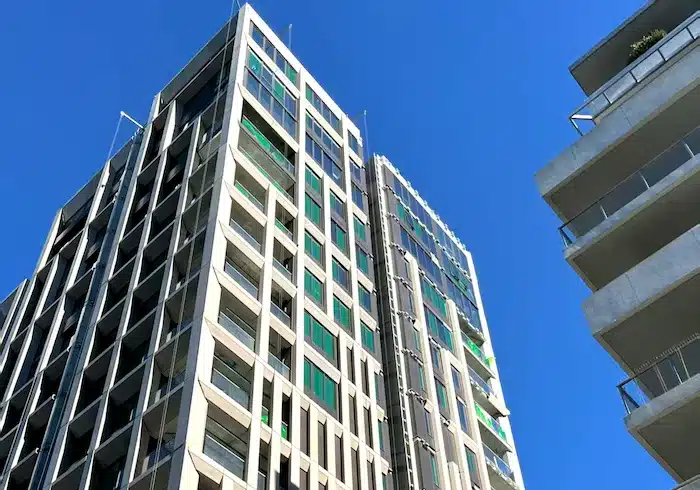
ETHOS Sydney is a residential project designed with occupant comfort at its core.
The façades employ a Window Wall system integrated with GRC elements to achieve a cohesive architectural expression.
In this project, transparency was not the sole objective. Engineering priorities included:
☛ Ensuring the Window Wall system passed AS4284 overall performance testing, not just isolated component checks
☛ Maintaining long-term sealing integrity while allowing for structural movement at nodes
☛ Minimizing performance degradation from thermal stress under intense sun exposure
Though subtle to the residents, these design choices significantly affect the building’s long-term reliability and user experience.
HUME Showroom is a typical display-oriented building with stringent requirements for construction progress and quality.
The project adopts a Unitized Curtain Wall system, with major units prefabricated off-site before on-site installation.
This approach addresses not “advanced technology” but predictable, controllable outcomes:
☛ Off-site prefabrication reduces potential installation errors
☛ Unitized construction clarifies drainage and sealing paths
☛ System integrity ensures consistent performance under wind and rain
For this type of commercial building, stability itself is a valuable design outcome.
In Australian projects, most engineering choices are not made once and for all.
They are informed by the recurrence of similar challenges:
☼ Certain nodes degrade faster under prolonged sun exposure
☈ Some assemblies struggle to maintain consistent performance in strong winds
❁ Designs that appear reasonable at first can incur high maintenance costs later
By systematically recording and feeding back these observations, a reliable engineering framework gradually emerges.
Australia Day is not about dictating uniform architectural answers.
Rather, it serves as a reminder that, in this land, “appropriate” often outweighs “impressive.”
For curtain wall systems, effective design is not about form or showiness.
It lies in making proven choices that respond to environmental conditions and stand the test of time.
These decisions may appear restrained, yet they are precisely what enable buildings to remain stable and functional over decades.

2026 Façade Systems: From Visual Expression to Long-Term Performance Observations on Façade Technology, Operation, and Maintenance The turn of a new calendar year is often

Warmth in the Frozen North: Advanced Façade Thermal Insulation Technologies As the Christmas season approaches, northern cities are dusted in snow and sparkling lights. Cold

Sand-Resilient Façade Engineering in Lusail —Technologies Behind Qatar’s New Skyline As Qatar National Day draws near, Lusail begins to glow a little earlier each evening.

Weaving the Sky: Prefabricated Facades Craft Kenya’s Modern City 1. The City’s New Garment: Prefabricated Facades Weaving the Future A nation is weaving its new